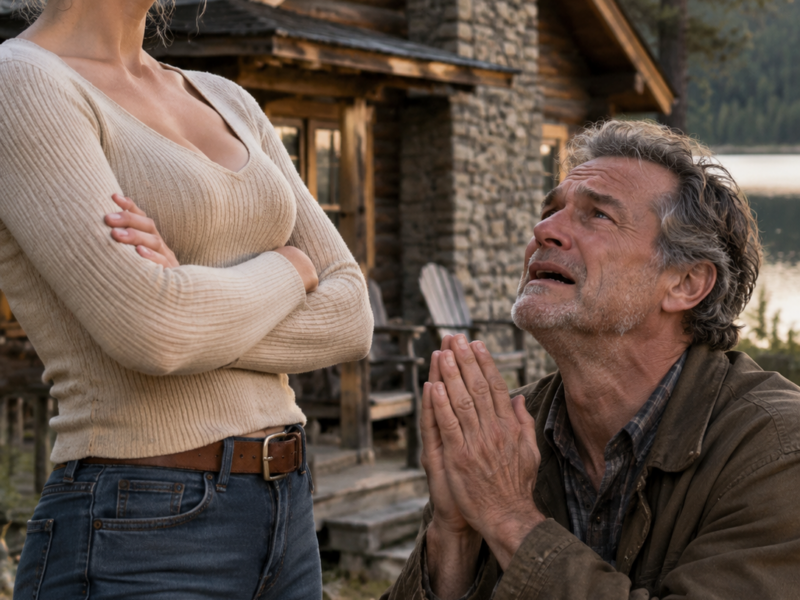
At 20, My Father Kicked Me Out of His House Because I Refused to Give My Grandfather’s Mountain Cabin to My Older Brother. I Left With Less Than $100, One Duffel Bag, and No Idea How I Would Survive, While My Family Stayed Behind and Said Nothing. For 12 Years, I Rebuilt the Cabin and My Life Without Them. Then, at 32, My Father Walked Into My Office Carrying a Manila Envelope With My Brother’s Name on It—and Said, “Your Brother Needs the Cabin.” But When I Opened It, I Realized He Had Come Back for Much More Than an Apology…
At 20, My Father Kicked Me Out of His House Because I Refused to Give My Grandfather’s Mountain Cabin to My Older Brother. I Left With Less Than $100, One Duffel Bag, and No Idea How I Would Survive, While My Family Stayed Behind and Said Nothing. For 12 Years, I Rebuilt the Cabin and My Life Without Them. Then, at 32, My Father Walked Into My Office Carrying a Manila Envelope With My Brother’s Name on It—and Said, “Your Brother Needs the Cabin.” But When I Opened It, I Realized He Had Come Back for Much More Than an Apology…
Part 1
My father was standing in the doorway of my office with a manila envelope in his hand, and my brother’s name was written across the front.
For a moment, I forgot where I was.
I was no longer a thirty-two-year-old woman sitting behind a desk in Colorado, managing properties, reviewing contracts, and making decisions that affected other people’s homes. Instead, I was twenty again, standing in my childhood kitchen with a duffel bag at my feet while my father pointed toward the front door and told me I was no longer welcome.
Twelve years had passed since that night.
Twelve years since I had driven away with less than a hundred dollars in my wallet, a handful of clothes, and an inheritance my family believed I had no right to keep.
I had built a life for myself during those years. I had found work, repaired the little mountain cabin my grandfather left me, and learned how to survive without waiting for my parents to rescue me. I had even stopped expecting an apology.
Yet the moment I saw my father’s face, all those carefully buried memories came rushing back.
He looked older than I remembered. His hair had turned mostly gray around the temples, and his shoulders seemed narrower beneath his jacket. But he still carried himself with the same confidence, as though every room belonged to him before anyone invited him inside.
“Claire,” he said. “I need to talk to you about the cabin.”
My eyes moved to the envelope.
“Does Evan know you’re here?”
“He knows I’m trying to help.”
That answer told me almost everything.
I asked my assistant to hold my calls and closed the office door. I didn’t offer my father coffee or ask how the drive had been. I simply stood beside my desk and waited.
He placed the envelope in front of me.
“Your brother is having a difficult time. His business isn’t doing well. He’s behind on payments, and he needs a way to get back on his feet.”
I opened the envelope.
Inside was a draft agreement proposing that I transfer an ownership share of my grandfather’s cabin to Evan. The document had already been prepared, and a pen was clipped to the first page.
My father’s expression suggested that he expected this to be a straightforward conversation.
“The cabin could solve a lot of his problems,” he explained. “He could sell it, clear his debts, and start over.”
I slowly closed the folder.
“The cabin is mine.”
“I know what the papers say.”
“Then why are we discussing giving it away?”
He lowered his voice.
“Because we’re family. Your grandfather would have wanted the place to help all of us.”
I looked at him for several seconds before answering.
“No.”
He rubbed his forehead.
“You haven’t even asked what Evan needs.”
“I don’t need to know what he needs to decide whether I’m giving away part of my home.”
“Claire, this isn’t fair.”
I almost smiled at the irony.
“It wasn’t fair when you told me to leave because I wouldn’t give it to him either.”
My father looked away.
For the first time since entering my office, he seemed uncertain about what to say.
He tried to explain that everyone had been upset back then, that things had gotten out of hand, and that I should understand how difficult the situation had been for him.
But I remembered that night differently.
I remembered every word.
I was twenty years old when my grandfather, Arthur Hayes, died.
He had been my father’s father, a quiet man who had spent most of his working life repairing farm equipment. He wasn’t wealthy, and he never pretended to be. He believed in fixing things instead of replacing them, showing up when people needed help, and keeping promises even when nobody was watching.
The cabin had been his favorite place.
It sat on a wooded property outside a small mountain town in Colorado, about two hours from my parents’ house. It had two bedrooms, a narrow kitchen, a wood stove, and a porch that leaned slightly toward the western side.
From the porch, you could see a distant ridge through the pine trees.
In summer, the air smelled of warm wood and pine needles. In winter, smoke drifted from the chimney while snow covered the surrounding trees.
I had loved that place since childhood.
My older brother, Evan, used to come with us, but as he grew older, he became more interested in the city. He liked business, money, and the idea of building something impressive.
I preferred sitting beside Grandpa while he worked on old equipment or listened to baseball games on his little radio.
He never needed to entertain me. Being around him was enough.
Sometimes he would hand me a screwdriver and show me how to tighten a loose hinge. Other times, he would let me sit quietly while he prepared coffee.
He taught me things without making them feel like lessons.
When he died, our entire family gathered at a small church for his funeral.
I remember my father crying in the front row. Evan stood beside him, looking serious and uncomfortable. My mother held a tissue in both hands.
I thought grief had made everyone look older.
A few weeks later, we met with the attorney who had prepared Grandpa’s will.
The attorney explained the arrangements carefully.
My father received some savings and several tools. Evan received a modest amount of money and a collection of equipment Grandpa had kept in his storage shed.
The cabin was left entirely to me.
I remember looking at the attorney because I thought I had misunderstood.
“Are you sure?” I asked.
He nodded.
“Your grandfather specifically named you. There are no conditions requiring you to share the property or sell it.”
I didn’t feel victorious.
I felt embarrassed.
Evan had always been the confident one. My parents had expected him to become successful, and they often spoke about his future as though it were already guaranteed.
I was still trying to figure out what I wanted from life.
I assumed my father would eventually accept the decision as Grandpa’s choice.
I was wrong.
About a week after the meeting, Evan came to our parents’ house. We were sitting at the kitchen table when he brought up the cabin.
“You’re not going to use it enough,” he said. “I could actually do something with that property.”
“What does that mean?” I asked. “Fix it up? Rent it out?”
“Maybe. I could use it as a base for work. There are plenty of opportunities up there.”
“Grandpa left it to me.”
Evan leaned back.
“You always were his favorite.”
“I don’t think that’s true.”
“Then why did he give you the one thing that matters?”
I didn’t have an answer.
I didn’t know whether Grandpa had chosen me because I visited more often, because I loved the place, or because he had seen something in me that I hadn’t discovered yet.
But the will was clear.
“I’m keeping it,” I said.
My father had been standing in the kitchen doorway, listening.
He walked toward us and pulled out a chair.
“You should reconsider.”
“Why?”
“The cabin is a family asset. You should share it with your brother.”
“I’m happy to let him visit. But I’m not giving it to him.”
My father’s expression hardened.
“You’re being selfish.”
I looked at him, genuinely surprised.
“I don’t understand why this is a problem. Grandpa made his decision.”
“Your brother could do more with it.”
“Then he can buy his own property.”
That was when my father’s temper finally erupted.
He pushed his chair back and pointed toward the hallway.
“Get out of my house.”
For a moment, I thought he was joking.
“What?”
“If you’re going to choose that cabin over your family, then leave.”
“I’m not choosing the cabin over anyone. I’m just refusing to give Evan something Grandpa left to me.”
“Then get out.”
The kitchen suddenly felt smaller.
I looked toward the hallway, expecting my mother to intervene. She had been upstairs, but I could hear her moving around.
I waited for her to come down.
She didn’t.
Evan remained silent.
My father pointed toward the stairs again.
I understood then that he meant it.
I went upstairs and began packing.
I had one duffel bag, a cardboard box for a few books, and less than a hundred dollars in my wallet. I folded my clothes mechanically, trying not to think about what was happening.
My mother eventually appeared in the bedroom doorway.
“Are you sure you have to leave tonight?”
I looked at her.
“Dad told me to go.”
“He’s angry.”
“That doesn’t mean I should have to leave.”
She lowered her eyes.
“Maybe you should wait until tomorrow. Everyone might feel differently in the morning.”
I wanted her to tell me that I could stay. I wanted her to go downstairs and tell my father he had crossed a line.
Instead, she stood there watching me fold another sweater.
I finished packing just before dark.
My father never came upstairs.
My mother stood near the front door while I carried my things outside. Evan stayed inside the house.
I loaded the car, placed the duffel bag on the passenger seat, and drove west toward the mountains.
I had no job waiting for me, no reliable source of income, and no idea whether the cabin’s heating system even worked.
By the time I arrived, it was completely dark.
The porch light wouldn’t turn on. The key stuck in the lock, and the house was freezing.
I found a flashlight in a kitchen drawer and checked the windows before bringing my belongings inside.
Then I sat at the kitchen table.
For the first time that evening, I allowed myself to cry.
On the wall near the door was a photograph of Grandpa standing beside the porch. He was wearing his old wool jacket and holding a thermos.
I stared at that photograph for a long time.
I had spent the entire day refusing to surrender something he had trusted me with.
Now I had nowhere else to go.
The cabin wasn’t comfortable. It wasn’t even properly maintained. But it was mine.
And for the first time in my life, nobody could tell me I wasn’t allowed to stay.
Part 2
The next morning, I called Grandpa’s attorney and asked what I needed to do to complete the property transfer. Then I called a diner in town and asked whether they were hiring.
They needed someone for weekend shifts.
“I can start this week,” I told the woman.
That was how my new life began: with a job application, a cold house, and a list of repairs written on the back of an envelope.
I didn’t know how long I would survive there. I only knew I wasn’t going to return to my parents’ house and apologize for keeping what belonged to me.
The first winter nearly broke me.
The water heater failed, the roof leaked, and the mountain roads became dangerous after heavy snowfall. I worked two jobs, counted every dollar, and learned how to repair things I had never imagined touching.
Then, one afternoon, I discovered a small tin box hidden in the back of Grandpa’s closet.
Inside were property records, old photographs, and a handwritten letter addressed to me.
I opened it expecting answers about why he had chosen me.
What I found changed the way I understood the inheritance.
Part 3
Grandpa’s letter wasn’t long.
He hadn’t written a dramatic explanation or listed all the reasons he believed I deserved the cabin. There were no accusations against my father, no predictions about what Evan might do, and no instructions about how I should handle disagreements with the family.
Instead, he wrote about ordinary things.
He mentioned the porch that needed resealing, the chimney cap that had been replaced several years earlier, and the importance of having the wood stove inspected before winter.
Then he wrote a few sentences about me.
He said he wanted me to have the cabin because I paid attention to people and places. He believed I understood that caring for something required more than simply owning it.
He also wrote that accepting a gift did not mean surrendering control of my life to the people around me.
I read that sentence several times.
I had been looking for an explanation of why he chose me, but what I found was something more useful. He trusted me to make my own decisions.
I folded the letter carefully and placed it back inside the tin box.
For the first time since arriving at the cabin, I felt as though I might actually be able to build something there.
That didn’t make the work easier.
The following months were a constant exercise in deciding which problem I could afford to solve.
The water heater worked only occasionally. One of the spare bedroom windows wouldn’t lock properly, and the roof leaked near the chimney whenever it rained.
The refrigerator made a noise like an old truck struggling to start.
I worked weekend shifts at the diner and cleaned rooms at a motel along the highway. When the hardware store needed extra help during busy periods, I took those shifts too.
Some weeks, I barely had enough money for groceries.
I learned to keep receipts in a shoebox because Grandpa’s attorney had advised me to document property expenses. At the time, I thought it was simply responsible recordkeeping.
I had no idea how important those records would eventually become.
The people in town slowly became familiar with my situation.
A neighbor named Ruth lived a short distance down the road. She was a practical woman who seemed to know everything about surviving mountain winters.
One afternoon, she noticed me struggling to clear snow away from the back entrance.
“You need to stop piling it against the door,” she said. “When it freezes overnight, you’ll have a much bigger problem.”
She showed me where to shovel and how to create a path that would remain usable after another snowfall.
At first, I was embarrassed to ask questions. I thought everyone would realize how inexperienced I was.
But Ruth never made me feel foolish.
Jim, the manager at the hardware store, let me borrow a ladder to inspect the gutters. A retired contractor charged me only for materials and a couple of hours of labor to patch the worst section of the roof.
Nobody offered help with the expectation that I would eventually owe them something.
That was a lesson I needed to learn.
I had grown up believing that asking for help meant admitting weakness. After leaving home, I discovered that refusing help could sometimes be the more expensive mistake.
My first winter was especially difficult.
I learned to stack firewood beneath a proper cover, leave a slow drip from the kitchen faucet when temperatures dropped, and keep emergency supplies in my car.
I learned that mountain weather could change quickly and that a road that looked perfectly safe in town could become dangerous a few miles higher.
There were mornings when I woke up before sunrise, lit the wood stove, and sat at the kitchen table waiting for the house to warm.
I missed having someone to talk to.
I missed my mother, even though our conversations were uncomfortable.
She called twice during my first month away.
The first time, she asked whether I had enough food.
The second time, she told me my father was still angry.
“Did he ask how I’m doing?” I asked.
There was a pause.
“He assumes you’re managing.”
“I am.”
“I know you are.”
We talked about ordinary things after that. She asked about my work, and I asked whether she was eating properly.
Neither of us mentioned the argument.
That became our pattern for a while: care at a distance, with the hardest part left untouched.
Evan never called.
I heard about him through relatives. He had started a small contracting business and was doing reasonably well. He was dating someone and had sold one of Grandpa’s tools.
I didn’t know whether those stories were intended to make me jealous or simply keep me informed.
I stopped asking.
Meanwhile, the cabin began changing.
After months of saving, I replaced the water heater. I repaired the bedroom window, painted the kitchen cabinets a soft green, and planted a small row of hardy flowers beside the porch.
None of those improvements made the property spectacularly valuable.
They made it warmer, safer, and more comfortable.
More importantly, every improvement represented a decision I had made for myself.
When I was twenty-two, I found myself considering whether I should continue keeping the cabin.
The roof needed more extensive repairs, and I had been offered a better-paying job in Denver. I was tired of calculating every expense and worrying about the next winter storm.
I wanted a small apartment with reliable heating, a grocery store nearby, and a driveway I didn’t have to clear myself.
I contacted a real estate agent and asked what the property might sell for.
Her estimate was lower than I expected because of the roof and the condition of the access road.
I considered selling.
I imagined signing the paperwork, paying off the outstanding repair costs, and finally leaving behind the place where my family had hurt me.
For a while, I wondered whether keeping the cabin meant I was allowing the past to control my future.
Then I drove up there one Saturday afternoon.
The ridge was bright with snow. Grandpa’s chair still stood beside the window, and his photograph remained near the entrance.
I sat in the chair and looked around the room.
The kitchen cabinets I had painted were beginning to look like they belonged there. The windows no longer let in cold air, and the wood stove worked properly.
I realized something important.
I wasn’t keeping the cabin to punish my father or prove that I could survive without him.
I was keeping it because I loved the place.
I had worked hard to make it livable, and I wanted to enjoy the result.
I postponed the sale.
That decision eventually allowed me to separate two things I had spent years confusing: my feelings about my family and my feelings about the property.
They were not the same.
By then, I had begun building a career in Denver.
I found work with a property management company, where I learned how to read leases, organize maintenance schedules, manage expenses, and explain complicated housing problems to people who were worried about losing their homes.
I rented a small apartment in the city and kept the cabin as my place in the mountains.
I visited once or twice a month.
Sometimes I spent an entire weekend there. Other times, I drove up, checked the pipes, inspected the property, and returned to Denver before evening.
It was enough.
For several years, I heard almost nothing from my father or Evan.
My mother called on birthdays and holidays. We spoke carefully, avoiding the subject that had divided us.
I stopped expecting anyone to admit they had been wrong.
I stopped wondering whether my father would eventually realize what he had done.
I had a career, a home, and people around me who valued my presence.
I had become someone who could make decisions without asking permission.
Then, twelve years after I left, my father walked into my office with an envelope carrying Evan’s name.
His unexpected visit stayed with me long after he left.
I completed my workday, reviewed maintenance proposals, returned phone calls, and met with a tenant whose kitchen had suffered water damage.
But my attention kept returning to the conversation.
My father hadn’t asked me to forgive him.
He hadn’t even apologized.
He had come because Evan needed something.
That evening, my mother called.
“Your father told me he came to see you.”
“He did.”
“He said you wouldn’t sign the agreement.”
“I wouldn’t.”
“I’m glad you didn’t feel pressured.”
I leaned against my kitchen counter.
That response surprised me.
For years, my mother had avoided taking a clear position. When I was twenty, she had watched me pack and suggested that I wait until morning.
I had always wondered whether she understood how deeply that silence had hurt.
“Mom, can I ask you something?”
“Of course.”
“Why didn’t you say anything that night?”
The line went quiet.
Finally, she answered.
“I was afraid he’d turn on me too. I thought if I stayed quiet, he’d calm down and you’d come home the next day.”
I closed my eyes.
“You watched me leave.”
“I know.”
“Did you ever think about what happened after I drove away?”
“More than you probably realize.”
“But you didn’t call Dad and tell him to bring me home.”
“No,” she whispered. “I should have.”
Her answer didn’t erase anything.
But it was honest.
We talked a little longer, and before ending the call, I told her something I had been holding back for years.
“If Dad wants to speak with me, he needs to talk about what happened. Not just about Evan’s money.”
“I’ll tell him.”
A week later, Evan called.
I watched his name appear on my phone and let it ring twice before answering.
“Hey,” he said.
“Hi.”
“I heard Dad came by.”
“He did.”
“He said you were upset.”
“I was clear about what I would and wouldn’t agree to.”
He exhaled.
“I know you probably think I sent him.”
“Did you?”
“I asked him to see if you’d talk to me. I didn’t ask him to pressure you into signing that agreement.”
“Did you know he was bringing it?”
There was a pause.
“I knew he wanted you to sign something.”
I leaned back in my chair.
“That’s convenient.”
“Maybe. I’m not calling to fight, Claire. I want to explain what’s happening.”
“Then explain.”
Evan told me that his contracting business had taken on more work than he could handle.
Several clients had paid late, and he had borrowed money to cover payroll and equipment expenses. He had expected the projects to catch up financially, but they hadn’t.
He had taken out a personal loan and used credit cards to keep the business running.
Now he was behind on payments and receiving warnings from lenders.
He believed the cabin could be sold for enough money to clear his debt and give him another chance.
“Why didn’t you call me yourself?” I asked.
“I was embarrassed.”
“Embarrassment doesn’t explain why you let Dad go first.”
“I know.”
His answer sounded familiar, but I wasn’t ready to trust it.
“I’ll listen to you,” I said. “But I’m not promising to sell the cabin, share ownership, or lend you money.”
“I understand.”
“Do you?”
“I think so.”
“Then don’t ask me to rescue you.”
“I wasn’t going to.”
I hoped he meant it.
We ended the call without arguing.
Over the following weeks, Evan sent two short messages. He told me he had met with an accountant and contacted a credit counselor recommended by his bank.
He didn’t ask for money.
He didn’t mention the cabin.
When I finally responded, I told him I was glad he had taken those steps.
It was the first time in years that I had communicated with my brother without feeling that the conversation was leading toward another demand.
Still, I knew a few polite messages could not repair twelve years of resentment.
If anything was going to change, it would take more than words.
Part 4
My father began calling more often.
At first, the conversations were short and uncomfortable. He asked about my job, the weather, and whether the cabin had survived the latest storm.
I answered politely but didn’t pretend we had suddenly become close.
One evening, he asked whether he could visit the cabin.
“Why?” I asked.
“I want to see it.”
“You haven’t been there since Grandpa was alive.”
“I know.”
“Are you asking because you want to see the property, or because you think I’ll change my mind about the agreement?”
He hesitated.
“Both, perhaps. But mostly because I’m sorry I’ve stayed away.”
I wasn’t ready to say yes.
“I’ll think about it.”
He accepted my answer.
A few weeks later, I drove to the cabin after a heavy storm. The roof had survived without major damage, although a strip of flashing near the chimney had loosened.
I called a roofer and scheduled a repair.
Afterward, I made coffee and sat at Grandpa’s kitchen table.
Late afternoon light moved slowly across the floor.
I thought about reconciliation.
For years, I had imagined that if my family ever returned, everything would somehow go back to normal.
But the more I considered it, the less I wanted that.
The old version of our family had allowed my father to turn an argument into an expulsion. It had allowed Evan to benefit from silence and my mother to hope that a painful decision would disappear if nobody discussed it.
I didn’t want that family back.
I might someday want a different one.
For that to happen, everyone would have to change the way they behaved when conversations became uncomfortable.
I couldn’t make those changes for them.
I could only decide whether I was willing to leave the door open.
The next day, I called my father.
He answered almost immediately.
“I’ve thought about your request,” I said. “You can come to the cabin.”
There was a brief silence.
“Thank you.”
“But I have some conditions.”
“All right.”
“We’re going to talk about what happened twelve years ago. You’re not bringing paperwork. Nobody is asking me to decide anything about the cabin that day.”
He listened without interrupting.
“Evan can come if he wants to speak for himself. I don’t want you acting as his representative.”
“Understood.”
“And if the conversation turns into pressure, I’ll end the visit.”
“I understand, Claire.”
We agreed on Saturday.
When I hung up, I noticed something surprising.
I felt nervous, but I didn’t feel trapped.
I had chosen the meeting. I had set the conditions. I had the deed, my car keys, and the right to ask anyone to leave.
That was very different from being twenty.
Evan arrived first.
He parked near the road and walked toward the porch with his hands in his jacket pockets.
He looked older than the brother I remembered. His hair had become thinner, and his expression carried the carefulness of someone who didn’t want to make another mistake.
“Thanks for agreeing to meet,” he said.
“I agreed to talk.”
“I know.”
He looked at the porch.
“You fixed it.”
“Some of it.”
“It looks good.”
“It’s still crooked.”
He smiled faintly.
“Grandpa would have called that character.”
“He would have called it a project.”
For a moment, we both laughed.
It was the first time we had shared a joke in years.
I wasn’t sure whether to welcome that feeling or be cautious about how easily old habits could return.
My father arrived about ten minutes later.
He carried a paper grocery bag containing coffee and bread.
He stopped at the bottom of the steps and looked up at the cabin.
For a few seconds, he didn’t move.
I wondered what he was thinking. Perhaps he remembered visiting with Grandpa. Perhaps he was seeing the property differently now that it belonged to the daughter he had once ordered out of his house.
I opened the door.
“You can leave the bag in the kitchen.”
He nodded and followed Evan inside.
We sat around the kitchen table.
I had prepared a folder containing copies of the deed, Grandpa’s will, property tax statements, and records of major repairs.
My father noticed it immediately.
“You brought papers.”
“I brought information. I’m not asking anyone to sign anything.”
He nodded.
Evan spoke first.
“I’m sorry I put Dad in the middle.”
I looked at him.
“You didn’t just put him in the middle. You asked him to come and convince me to give up the cabin.”
“I thought if he explained the situation, you might be willing to help.”
“That’s not different.”
“I know.”
He looked down at the table.
For a moment, nobody spoke.
Then Evan explained what had happened to his business.
He had spent more than a year trying to keep it running while several projects became financially difficult. He had borrowed money to cover expenses and convinced himself that everything would improve once clients paid their outstanding invoices.
Instead, the debt kept growing.
He had been ashamed to tell the family.
He thought selling the cabin would be the cleanest solution.
“For you?” I asked.
“Yes. For me.”
It was the first completely honest statement he had made that afternoon.
I appreciated it.
But honesty didn’t change the fact that he had expected me to surrender my property.
“I don’t know what Grandpa would have thought about your financial problems,” Evan continued. “But I know he left you the cabin. I never really accepted that.”
“Why?”
He considered the question.
“I thought you wouldn’t care about it as much as I would. I told myself you had been lucky. I convinced myself the will was unfair.”
“You never asked me what it meant to me.”
“No, I didn’t.”
My father had remained quiet throughout the exchange.
Finally, he placed both hands on the table.
“I thought I was keeping the peace.”
I looked at him.
“You were keeping Evan comfortable.”
He flinched slightly, but he didn’t argue.
“I was angry,” he admitted. “Your grandfather had made his decision, and I couldn’t change it. Evan was upset, and I thought you were being rigid.”
“You thought it was better to pressure me than tell him no.”
“Yes.”
“You told me to leave.”
“I know.”
“I was twenty. I packed one bag because I thought you meant it. I had a job interview the next morning, and I had no idea how I was going to pay for anything.”
My father lowered his gaze.
“Did you ever ask Mom whether I got there safely?”
“No.”
“Did you wonder how I managed?”
“I did. I told myself you were strong.”
“That’s not the same as helping.”
“No,” he said quietly. “It isn’t.”
He didn’t try to explain away the past.
He didn’t tell me I was remembering things incorrectly or accuse me of exaggerating.
Instead, he admitted that he had been afraid of damaging his relationship with Evan.
He believed that if he challenged his son, they might become estranged.
He had chosen the relationship he thought he could control, without realizing that he was putting his relationship with me at risk.
“I should have told Evan that the will was the will,” he said. “I should have told you that you could stay. I did neither.”
He took a breath.
“I’m sorry.”
The apology was clear.
It didn’t restore the twelve years we had lost, but it was the first time he had acknowledged his responsibility without attaching an excuse.
I opened the folder.
I showed them the property transfer records, tax statements, insurance documents, and a summary of the repairs I had paid for over the years.
I had replaced the water heater, repaired the windows, maintained the road access, repaired the roof, and kept the property insured.
The total expenses were substantial.
Evan looked through the pages.
“I didn’t know it cost that much.”
“You could have asked.”
“I should have.”
My father stared at the records.
“You did all of this alone?”
“Mostly. I hired professionals when I needed them. I learned not to try to do everything myself.”
I told them about the first winter, the motel job, the diner, and the months when I had barely managed to save enough for the next repair.
I explained that I had nearly sold the property because I was tired of the financial pressure.
I wasn’t trying to make them feel guilty for every difficult day.
I wanted them to understand that the cabin had never been a valuable prize sitting untouched while I waited for it to appreciate.
It had been a responsibility.
I had accepted that responsibility when I was twenty, and I had spent twelve years honoring it.
“I thought you went there because you wanted to prove something,” my father said.
“I did, at first. I wanted to prove I could survive without you.”
“And now?”
“Now I keep it because I love it. I don’t need to prove anything.”
Evan looked toward the window.
“What happens if I get my finances under control and want to visit?”
“You can visit if we’re on good terms. That doesn’t give you an ownership share.”
“I understand.”
“If I ever sell, I’ll make that decision. I won’t give you the cabin because you’re in trouble.”
He nodded.
“I know.”
“And if you need help with a practical question, I can point you toward someone qualified. But I won’t lend you money or sign anything connected to your debt.”
“That’s fair.”
I looked directly at him.
“I’m not saying this to punish you. I just don’t want another argument about whether I’m selfish because I won’t give away something that belongs to me.”
My father reached for his coffee but didn’t lift the cup.
“You should have been able to say no without losing your home.”
The sentence caught me off guard.
I looked at him.
He seemed to understand that those words couldn’t undo everything, but they described the harm more clearly than anything he had said before.
“Yes,” I replied.
My mother hadn’t come.
She had called earlier that morning and explained that she wasn’t ready to sit in the same room with everyone.
She apologized again for not speaking up when I left.
I told her I wasn’t asking her to choose sides now. If she wanted a relationship with me, we could talk separately.
I needed her to acknowledge that her silence had hurt me.
She had done that.
For that day, it was enough.
The three of us stayed at the table for another hour.
We talked about Grandpa’s tools, the strange way he labeled every jar in his pantry, and the time Evan dropped a fishing rod into the creek.
Those memories didn’t erase what had happened.
They reminded me that our family had included other things besides the argument.
When my father finally stood to leave, he looked toward the porch.
“Would you like me to help fix that loose board?”
“I already scheduled a carpenter.”
He nodded.
“Of course.”
I hesitated before adding, “You could help me carry the woodpile to the shed next time.”
He looked surprised.
“I’d like that.”
After my father drove away, Evan remained outside with me.
He told me he had begun working with an accountant and a credit counselor. He was learning to separate the fear of losing his business from the practical question of what he could actually afford.
“I’m trying not to turn every mistake into an excuse,” he said.
“That’s a good place to start.”
He asked whether I would consider having dinner sometime.
I said yes, but I wanted to take things slowly.
“I can do slowly,” he replied.
When he finally left, I stood on the porch and watched the road until his car disappeared.
I felt tired.
I didn’t feel as though my family had suddenly become whole again.
But I felt a little lighter.
The cabin was still mine.
And I hadn’t needed to surrender it to earn an apology.
Part 5
The first dinner with Evan lasted a little over an hour.
We met at a diner between Denver and the mountains, somewhere neither of us had to host the other.
I arrived a few minutes early and chose a table near the window.
When Evan walked in, he looked uncomfortable, almost as though he expected me to change my mind and leave.
We ordered coffee and talked about work.
He explained that his accountant had helped him organize his business expenses and contact his lenders before the situation became more complicated.
He had stopped taking on projects that required him to borrow money for materials.
He had also downsized the business and reduced the number of jobs he accepted.
Most importantly, he didn’t ask me for a loan.
That mattered more than any dramatic promise he could have made.
I listened and asked questions when I didn’t understand something. I offered advice only when he requested it.
We didn’t discuss the cabin beyond the fact that I planned to visit it the following weekend.
At the end of dinner, Evan paid for his own meal and stood beside the table.
“I’m glad you came,” he said.
“I’m glad we talked.”
He nodded.
“I know I have a lot of work to do.”
“You do.”
“I’m not expecting you to trust me immediately.”
“I don’t.”
He looked down, then nodded.
“I understand.”
It wasn’t a warm goodbye, but it was honest.
I had spent enough years accepting statements designed to smooth things over. This time, I wanted to see what he actually did.
My father began calling every other week.
At first, he asked practical questions. He wanted to know how much snow had fallen, whether the road was open, and whether the cabin had made it through another storm.
I answered without pretending we had become close again.
After a while, he asked whether he could come up for a day.
I agreed on one condition: the visit wasn’t going to become another negotiation.
He accepted.
He arrived on a Saturday morning carrying gloves and a thermos.
There was a stack of firewood beside the shed, and he asked whether I needed help moving it.
I said yes.
We spent nearly an hour carrying logs and arranging them beneath the cover.
My father worked more slowly than I remembered. His back bothered him, and he finally admitted it when I asked whether he wanted to rest.
I found a chair, poured coffee, and sat across from him.
We talked about the repairman who had fixed the porch and a neighbor whose dog kept stealing socks from the laundry line.
The conversation remained ordinary until my father placed his cup on the table.
“I’ve been thinking about that night,” he said.
I looked at him.
“I know you probably don’t want to hear about it every time I come here. But I want you to know I’ve thought about what happened.”
I waited.
“I told myself I was being a strong father. I thought I was teaching you to understand that family comes first.”
He paused.
“I was actually using anger to get the answer I wanted.”
“What answer was that?”
“That you would give the cabin to Evan.”
“Why?”
He looked toward the window.
“Because I thought Evan deserved it more. I believed he would do more with it. I thought being the oldest meant something.”
“Did you believe that before Grandpa died?”
He considered the question.
“I don’t think I ever said it out loud. But when the will made the decision clear, I felt embarrassed. I was angry at your grandfather, and instead of admitting I had no right to interfere, I made you responsible for my feelings.”
I had wondered about that for years.
I had wondered whether my father believed I was undeserving, whether he thought Evan’s needs mattered more, or whether he simply couldn’t accept a decision he hadn’t made himself.
Hearing him admit it didn’t make the past disappear.
But it answered a question I had carried for a long time.
“Why didn’t you call after I left?” I asked.
He looked down at his hands.
“I thought you would come back when you needed us.”
“I did need you.”
He nodded slowly.
“That was the problem.”
I didn’t know what to say.
He continued.
“I don’t know how to make that right.”
“You can’t make that night disappear. But you can choose not to treat my boundaries as an attack.”
“I can try.”
“Trying has to mean something you do over time.”
“I know.”
We finished our coffee and went inside.
Before he left, he asked whether he could come again.
I said yes.
As long as he kept showing up as my father and not as Evan’s representative.
He told me he could do that.
My mother and I had our own conversation about a month later.
We met at her house for lunch.
She looked nervous when I arrived, and I noticed she had prepared more food than either of us could possibly eat.
We talked about ordinary things for a while before she finally brought up the past.
She told me she had been afraid of my father’s temper.
She had believed that if she stayed quiet, he would eventually calm down and allow me to return.
“I watched you pack,” she said. “I can still see you folding your sweaters into that bag.”
I looked at her.
“I wanted you to tell me I could stay.”
“I know.”
“You could have stood up to him.”
She nodded.
“I should have. I should have told you that you could stay with me, even if he was angry.”
“Would you have?”
She looked down.
“I don’t know. That’s the part I’m ashamed of.”
Her answer surprised me.
She could have told me that she would have done anything for me. She could have offered the comforting version of the story I might have wanted to hear.
Instead, she admitted that she wasn’t sure she would have been brave enough.
I believed her.
Not because her explanation made everything better, but because she wasn’t pretending to have been someone she hadn’t been.
We talked for two hours.
I told her I didn’t want her passing messages between me and my father or Evan. If either of them wanted to say something, they could contact me directly.
She agreed.
She also asked whether she might visit the cabin someday.
I said yes.
But I wanted our relationship to exist outside the cabin, too.
I didn’t want every family interaction to revolve around the property or the argument that had separated us.
She began calling me on Sunday afternoons.
Sometimes we talked about groceries, work, and the weather. Sometimes we talked about the past.
We didn’t try to resolve twelve years of silence in a single conversation.
The relationship grew through small, repeated actions.
A phone call returned.
A promise kept.
An apology that wasn’t followed by a demand.
Evan continued working on his finances.
He made payments under a revised plan, downsized his business, and began meeting regularly with a counselor.
He told me that embarrassment had prevented him from asking for advice until his mistakes became much more expensive.
He didn’t become a different person overnight.
There were still moments when he became defensive. Sometimes he tried to change the subject whenever I brought up something uncomfortable.
But the difference was that he started coming back to the conversation.
He would call the next day and say he had thought about what I told him.
Sometimes he admitted I had been right.
It didn’t happen every time, but it happened often enough that I began to believe his efforts were genuine.
One fall, I invited my parents and Evan to spend a weekend at the cabin.
I had considered the decision for several weeks.
I wanted to see how we would behave together when there was no formal conversation planned and no documents on the table.
I wanted to know whether we could simply exist in the same place without returning to the argument.
My mother brought a pie.
Evan helped carry groceries from the cars.
My father chopped vegetables at the kitchen counter and asked where I kept the knives instead of assuming he knew.
That small question meant more than he probably realized.
We made dinner together.
Nobody delivered a grand speech.
Nobody announced that everything was forgiven.
We ate, washed dishes, and talked about ordinary things.
The following morning, we walked along the short trail near the property.
The trees had turned shades of orange and gold, and the air was cool enough to make us glad we had brought jackets.
At one point, Evan stopped at a clearing and looked toward the ridge.
“I used to think you were lucky,” he said.
I turned toward him.
“How?”
“Grandpa handed you something, and you got to keep it. I thought you had been given the best part of his life without having to do anything.”
I waited.
“I didn’t understand what it cost you.”
“It wasn’t only a cost,” I said. “I wanted it. I chose to stay.”
He nodded.
“I understand that better now.”
I looked at the cabin through the trees.
For years, I had imagined that my family might eventually recognize what the inheritance meant to me.
Now I understood that I didn’t need their recognition to make it meaningful.
The cabin wasn’t a prize we had finally agreed to share.
It was my home.
They were guests.
And there was nothing wrong with that.
Family didn’t have to mean equal ownership of everything.
It didn’t mean I owed everyone access to what I had inherited or worked hard to maintain.
It meant we could care about each other while respecting that we were separate people.
On the final morning, my father walked with me toward the car.
He didn’t ask about the deed, the property value, or whether I had reconsidered the agreement.
He simply said he hoped we could do it again.
“Maybe,” I replied. “Let’s keep building on what we’ve done.”
“I will.”
I believed he meant it.
But I also understood that trust wasn’t built through one meaningful weekend.
It was built when the next visit came without an expectation.
When someone accepted a boundary the first time.
When an apology was followed by different behavior.
We were still practicing.
I kept Grandpa’s letter in the small tin box with the old property records.
I didn’t read it often anymore.
I no longer needed it to remind me that the cabin was mine.
The deed said that clearly. The tax statements said it. Every repair I had paid for over the years said it.
So did all the quiet mornings I had spent there, learning how to care for a place and for myself.
Sometimes, when I sat in Grandpa’s old chair, I remembered the twenty-year-old girl who had arrived with a duffel bag and almost no money.
I remembered how frightened she had been.
I remembered sitting at that kitchen table on the first night, wondering whether she had made a terrible mistake.
I wished I could tell her that she would be okay.
I wished I could tell her that the water heater would eventually be replaced, the roof would stop leaking, and the kitchen would become warm and comfortable.
I would tell her that she would find people who helped without asking for anything in return.
I would tell her that she would build a career, make her own decisions, and discover that being alone was not the same as being unwanted.
Most importantly, I would tell her that she didn’t have to surrender something she loved to prove she loved her family.
For a long time, I had believed that keeping the peace was the same as being a good daughter.
I thought that if I were patient enough, understanding enough, and willing to compromise enough, my family would eventually treat me fairly.
But I learned that peace built on one person’s silence isn’t really peace.
Sometimes it is simply an arrangement in which the person who has been hurt is expected to pretend nothing happened.
I also learned that forgiveness and reconciliation are different.
I can forgive my father for the decision he made without pretending it was harmless.
I can understand that he was angry, embarrassed, and afraid of losing his relationship with Evan without accepting those feelings as an excuse.
Reconciliation has required more than an apology.
It has required my father to accept my decisions, respect my boundaries, and spend time with me without asking for something.
Evan has had to do his own work.
His financial problems were real, but they were not mine to solve by surrendering the home I had spent twelve years maintaining.
He found help through an accountant, his lenders, and counseling.
He is learning that asking for support doesn’t mean someone else must give up what belongs to them.
My mother has had to acknowledge that silence can hurt just as deeply as angry words.
She is still learning to speak when a difficult conversation needs to happen.
None of us is perfect now.
My father sometimes tries to fix a problem before listening to what I’m saying.
My mother still worries that difficult conversations will end badly.
Evan occasionally becomes defensive.
And I sometimes withdraw before explaining what I feel.
But we have started recognizing those patterns.
We can stop, acknowledge them, and try again.
That is what the cabin means to me now.
It is the place I inherited from my grandfather, but it is also where I learned that standing up for myself did not make me cruel.
I didn’t need to make my family suffer because they had hurt me.
I didn’t need to punish my brother for his financial mistakes or spend the rest of my life waiting for my father to regret his decision.
I needed to protect what was mine, tell the truth about what had happened, and leave room for people to change without pretending they had already changed.
There are still days when I look at the cabin and remember the night I arrived.
The cold kitchen.
The broken porch light.
The photograph of Grandpa beside the door.
But those memories no longer make me feel unwanted.
They remind me of the moment I began choosing my own life.
My father once believed that telling me to leave would make me understand how much I needed my family.
Instead, it taught me that I could build a life without depending on his approval.
Twelve years later, he returned because my brother needed the property he had once demanded I surrender.
I said no.
And for the first time, my father listened.
That doesn’t mean everything is perfect.
It means we finally have a chance to build something different.
Sometimes I still wonder what Grandpa would think if he could see us now.
I imagine him sitting in his old chair, listening to the wind move through the pine trees, and quietly approving of the repairs.
Perhaps he would say nothing at all.
He would probably ask whether the chimney had been inspected and whether I had enough firewood for winter.
Then he would make coffee.
I think that would be enough.
Because the greatest thing he left me wasn’t simply a cabin in the mountains.
It was the opportunity to discover that I could take care of myself, make difficult decisions, and remain kind without allowing other people to control my life.
And if there is one thing I hope someone takes from my story, it is this:
You can love your family without giving them everything they ask for.
You can forgive someone without immediately trusting them again.
You can offer people another chance without handing them the power to hurt you in the same way twice.
And when someone tells you that protecting what belongs to you makes you selfish, remember that love should never require you to abandon yourself.
I still own Grandpa’s cabin.
I still visit it whenever life in Denver becomes too busy.
Sometimes I spend an entire weekend there, sitting on the porch with coffee while the sun rises above the ridge.
Sometimes my father comes to help move firewood. Sometimes Evan visits and brings groceries. My mother occasionally comes with a pie and stays long enough for us to have dinner together.
We are not the family we were before Grandpa died.
Perhaps we never will be.
But we are slowly becoming something better.
And every time I unlock that cabin door, step inside, and place my keys on the shelf Grandpa built, I remember the most important part.
I never had to give it away to belong.
It was mine when I was twenty, when I had almost nothing, and it is still mine now.
Not because I won an argument.
Not because my father finally admitted he was wrong.
But because my grandfather trusted me, I trusted myself, and I never stopped choosing the life I wanted to build.