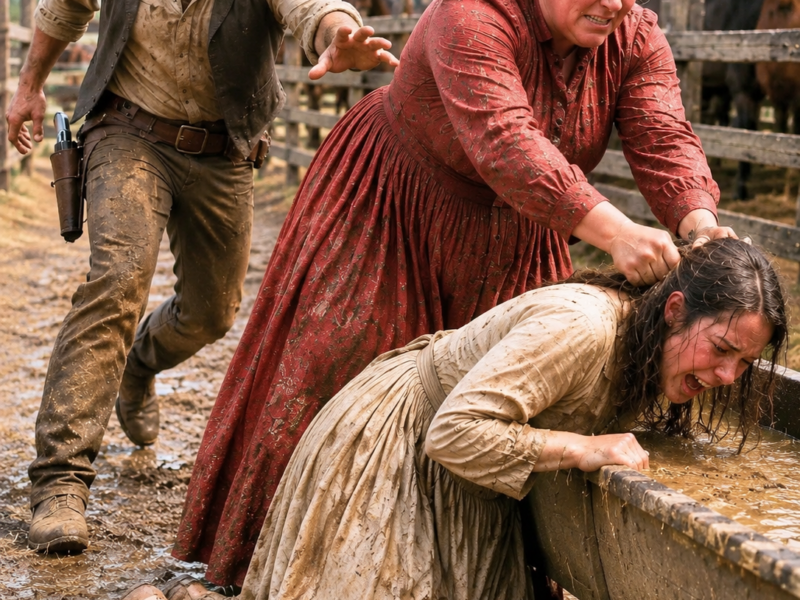
At 20, I Was Humiliated in the Dirt on Main Street While My Stepmother Called Me Worthless, and the Entire Town Watched Without Helping. After Controlling My Father’s Ranch for Four Years, She Threatened, “You’ll Regret Embarrassing Me,” When a Mysterious Cowboy Named Cole Maddox Finally Stood Up for Me. But When I Discovered a Hidden Ledger Showing a Suspicious Payment to a County Clerk, I Realized My Stepmother Might Have Lied About My Father’s Will—and What Cole Uncovered Next Left Me Speechless…
At 20, I Was Humiliated in the Dirt on Main Street While My Stepmother Called Me Worthless, and the Entire Town Watched Without Helping. After Controlling My Father’s Ranch for Four Years, She Threatened, “You’ll Regret Embarrassing Me,” When a Mysterious Cowboy Named Cole Maddox Finally Stood Up for Me. But When I Discovered a Hidden Ledger Showing a Suspicious Payment to a County Clerk, I Realized My Stepmother Might Have Lied About My Father’s Will—and What Cole Uncovered Next Left Me Speechless…
PART 1
The first time Cole Maddox saw me, I was lying in the dirt in the middle of Willow Creek, Montana, while my stepmother stood over me and told the entire town that I was worthless.
I was twenty years old, but at that moment, I felt smaller than I had at sixteen.
“Get up, Clara!” Evelyn Harper snapped. “Have you no shame? Look at yourself!”
I could hear people watching.
Mr. Parsons, the feed store owner, stood outside his shop. Three ranch hands leaned against a wooden fence. Even Reverend Marsh’s wife had stopped on her way to the general store.
Nobody helped.
Nobody ever helped.
I pressed my palms against the dusty ground, wondering whether standing would make Evelyn angrier.
My crime was arriving five minutes late after delivering financial documents to the county office.
Five minutes.
The leather strap on my bag had broken, scattering papers across the street. I had spent precious minutes gathering them, but Evelyn had no interest in explanations.
“You are an embarrassment to this family,” she announced. “Your father would be ashamed.”
Those words hurt more than the fall.
My father had been dead for four years, and Evelyn had spent every one of them using his memory as a weapon against me.
Then a shadow fell across the ground.
A pair of worn cowboy boots stopped beside my hands.
“Ma’am,” a deep voice said, “are you hurt?”
I looked up.
The stranger was tall, broad-shouldered, and covered in trail dust. His dark hair curled beneath a weathered hat, and his gray horse waited patiently behind him.
Evelyn immediately straightened.
“This is a private family matter.”
The cowboy barely glanced at her.
“I asked the young lady.”
Nobody had spoken to Evelyn like that in years.
I swallowed.
“I’m fine.”
He studied my face, then held out his hand.
“You have a name?”
“Clara Whitmore.”
“Cole Maddox.”
I took his hand.
He helped me stand without pulling too hard, without making me feel foolish, and without asking questions I couldn’t safely answer.
Then he touched his hat.
“Pleased to meet you, Miss Whitmore.”
Evelyn was furious.
I could tell by the way she smiled.
But Cole simply walked away, leaving me with something I hadn’t felt in four years.
The strange possibility that someone had actually seen me.
What I didn’t know was that this quiet cowboy would eventually uncover a secret buried inside my father’s will.
And that secret would destroy everything Evelyn had built.
My father, Douglas Whitmore, had owned one of the finest cattle ranches in the valley.
He wasn’t wealthy by the standards of railroad investors or eastern bankers, but he had built something respectable through twenty years of work.
Our ranch stretched from the southern creek to the northern foothills. We had fertile grazing land, reliable water, and enough cattle to survive even difficult seasons.
Father loved numbers almost as much as he loved horses.
When I was twelve, he started teaching me the accounts.
“Numbers tell the truth, Clara,” he used to say. “But only when honest people write them down.”
I remembered those words long after his death.
Especially when I began noticing that Evelyn’s numbers didn’t make sense.
Father married Evelyn when I was fourteen.
At first, she seemed kind.
She brought flowers into the house, attended church faithfully, and spoke warmly about becoming a family.
I wanted to believe her.
Father had been lonely since my mother’s death, and I wanted him to be happy.
But everything changed after his funeral.
Within a month, Evelyn moved into Father’s study and announced that she would control the estate until I turned twenty-one.
She showed me a document bearing his signature.
According to that document, I couldn’t make financial decisions, sell property, or challenge her management.
I was sixteen.
I had just buried the only parent who had ever truly understood me.
So I believed her.
For the first year, Evelyn treated me like unpaid help.
By the second, she was treating me like a prisoner.
She dismissed workers who had been loyal to Father, reduced my allowance to almost nothing, and moved me into a cramped bedroom behind the kitchen.
When I questioned a suspicious expense, she took away my access to the books.
When I asked why cattle were disappearing, she accused me of spreading lies.
When I suggested consulting Father’s former lawyer, she threatened to send me away.
“You should be grateful I haven’t abandoned you,” she told me.
I learned to stay quiet.
But I never stopped counting.
Every week, I walked the pastures and recorded how many cattle remained. I memorized invoices, compared purchases, and secretly copied figures whenever Evelyn left the office unlocked.
I hid everything beneath a loose floorboard.
One day, I believed, I would have enough evidence to reclaim what Father had left me.
Until then, survival was my only option.
Three days after Cole helped me in the street, I saw him again.
I was carrying two buckets of water near the southern fence when his gray horse appeared along the ridge.
He stopped several yards away.
“Morning, Miss Whitmore.”
“Good morning.”
He pointed toward the mountains.
“I’m looking at purchasing the old Callaway property. Seems it shares a boundary with your ranch.”
“It does.”
“Good land?”
“Mostly. The northern spring runs dry in August, but the lower pasture has excellent grazing.”
He smiled faintly.
“You know your land.”
“I grew up here.”
Cole looked toward the ranch house.
“That woman in town. Your stepmother?”
I tightened my grip on the buckets.
“Yes.”
He seemed to notice my discomfort.
Instead of questioning me further, he simply nodded.
“Well, I appreciate the information.”
Then he rode away.
I watched him until he disappeared.
It was such an ordinary conversation.
Yet I couldn’t remember the last time someone had spoken to me without wanting something.
Over the following two weeks, Cole became a familiar presence.
Sometimes I saw him at the general store.
Sometimes near the courthouse.
Once, he helped me load flour sacks onto the ranch wagon while Evelyn’s favorite shopkeeper muttered that I was getting too accustomed to male attention.
Cole stopped lifting the sack.
He looked directly at the man.
“She’s carrying enough already.”
The shopkeeper said nothing else.
I nearly smiled.
But Evelyn noticed.
One evening, she entered the kitchen while I was balancing the household accounts.
“You’ve been speaking to that cowboy.”
I kept writing.
“Occasionally.”
“He’s been asking questions about our property.”
“He’s considering the neighboring land.”
Evelyn pulled out a chair.
That frightened me more than her shouting.
She rarely sat beside me unless she wanted to deliver a threat.
“Clara, I know you’re approaching twenty-one. Perhaps you imagine that gives you certain privileges.”
I remained silent.
“But until that birthday arrives, every decision concerning this estate belongs to me.”
She leaned forward.
“And anyone who interferes with my management will regret it.”
I knew she meant Cole.
The following morning, I found him at the livery stable.
He was brushing his horse, Biscuit, when I approached.
“Evelyn knows you’ve been asking questions.”
He continued brushing.
“I figured she might.”
“She can ruin your reputation. She’s done it before.”
Cole set down the brush.
“Has she threatened you?”
“Not directly.”
He waited.
I hated how easily his silence encouraged honesty.
“Three years ago, a ranch worker tried reporting stolen cattle. Evelyn accused him of owing money to the estate. He lost his job and disappeared from town.”
Cole studied me.
“Do you believe she stole those cattle?”
“I know she did.”
The words escaped before I could stop them.
He didn’t look surprised.
“How?”
“Because I count them. Every single week.”
For the first time, I told someone about the missing cattle, the suspicious expenses, and the documents I had hidden.
Cole listened without interrupting.
When I finished, he asked one question.
“Have you kept records?”
“For four years.”
He nodded slowly.
“Then you’ve been building a case.”
“I’ve been trying.”
“That’s more than trying, Clara.”
I looked away.
“None of it matters if everyone in this county is afraid of her.”
“Then we find someone outside the county.”
I stared at him.
“You don’t understand. Evelyn knows the sheriff. She knows the county clerk. She knows practically everyone.”
Cole leaned against the stable door.
“I’ve dealt with dishonest people before.”
“Why would you help me?”
He was quiet for several seconds.
Then he told me about an elderly widow from his hometown.
A respected businessman had cheated her out of her property while the entire community looked away.
Cole had been twelve.
He had known something was wrong but hadn’t understood how to stop it.
“She lost everything,” he said. “I’ve regretted doing nothing ever since.”
His eyes met mine.
“I don’t intend to make that mistake again.”
Something tightened in my throat.
“You barely know me.”
“I know enough to recognize when someone deserves better.”
I wanted to trust him.
But four years of cruelty had taught me that kindness often came with a hidden price.
“What if Evelyn comes after you?”
“Then she’ll have to explain herself.”
“You make that sound easy.”
“Never said it would be easy.”
He picked up his hat.
“Just said I’m not leaving.”
Those four words stayed with me all day.
And that afternoon, while Evelyn attended a church committee meeting, I discovered something that changed everything.
I had entered Father’s old office searching for a missing cattle receipt.
The desk drawer stuck when I pulled it.
I remembered noticing years earlier that its interior seemed shallower than its exterior.
This time, I removed the papers and pressed against the wooden bottom.
It shifted.
My heart began pounding.
Beneath the false panel lay a small brown ledger.
Not the official ranch account book.
A second ledger.
I opened it.
There were payments to unfamiliar companies, withdrawals without invoices, and proceeds from land sales I had never authorized.
My eyes moved faster.
Then I found an entry dated fourteen months earlier.
A substantial payment had been made to an official in Beaverhead County.
Beside the amount, in Evelyn’s handwriting, were two words.
Document correction.
I read them three times.
My father had always insisted that legal documents must never be altered without proper authorization.
And there was only one document Evelyn had needed to change to gain control over my life.
His will.
I sat on the floor, holding that ledger, as the terrible possibility settled over me.
What if Father had never appointed Evelyn to manage the ranch?
What if the document she’d shown me after his funeral wasn’t the document he’d signed?
What if every humiliation, every stolen dollar, every year of fear had been made possible by a lie?
I heard a wagon approaching outside.
Evelyn was coming home.
My hands shook as I replaced the ledger beneath the false bottom.
I closed the drawer, collected the receipt, and hurried outside.
Behind the barn, I pressed my back against the timber wall.
For four years, I’d been waiting to turn twenty-one.
But suddenly I understood something.
I might not have another year.
And the only person I could think of telling was the cowboy who had promised he wasn’t leaving.
PART 2
That night, I copied everything I remembered from Evelyn’s secret ledger into the back of my father’s Bible.
The next morning, I found Cole near the northern fence.
“I think Evelyn forged my father’s will,” I whispered.
He stopped working.
I explained the hidden account, the payment, and the words document correction.
Cole listened carefully.
Then he said something that made my blood run cold.
“I found a lawyer in Helena who filed an amendment to your father’s estate records.”
I stared at him.
“You knew?”
“I suspected. Now we have a reason to investigate.”
He promised to contact someone at the territorial land office.
But before leaving, he warned me.
“If Evelyn realizes what we’ve discovered, she may act quickly.”
He was right.
Two days later, I overheard Evelyn speaking with two wealthy strangers.
She was negotiating the sale of our eastern pasture.
When one buyer asked whether I would agree, she laughed.
“Clara’s signature won’t be necessary.”
I felt sick.
She intended to sell my inheritance before I could stop her.
That evening, I went to the stable and approached Silas, Father’s oldest employee.
“Have you noticed anything wrong with the ranch accounts?”
He quietly opened his coat.
Inside was a notebook.
“Every missing animal,” he whispered. “Every suspicious transaction. Four years.”
Then he looked at me.
“I’ve been waiting for you to ask.”
PART 3
I nearly cried when Silas handed me his notebook.
Not because the numbers surprised me. I had suspected most of them for years.
It was the realization that someone else had been watching.
Someone else had known.
And someone else had been frightened into silence just as I had.
Silas was sixty-four, with weathered hands and a back that had slowly bent after decades of working horses.
He had served my father since before I was born.
“Why didn’t you tell me?” I asked.
He looked ashamed.
“Because Evelyn could’ve thrown me off this ranch with nowhere to go. And because I wasn’t sure anybody would believe an old horse tender.”
I understood.
That didn’t make the lost years easier to accept.
But I understood.
“Will you tell the truth in court?”
He looked directly at me.
“For your father, and for you, I’ll tell every word.”
That evening, Silas and I slipped through the back entrance of Mrs. Garrett’s boarding house.
Cole was waiting.
So was a woman named Ruth Hennessy.
I recognized her immediately.
Her family operated a small farm west of town. They had borrowed money from the Whitmore estate during a drought.
Ruth placed two documents on the table.
“One says four percent interest,” she explained. “That’s what we signed. The other says nine percent. That’s the version registered at the county office.”
Cole pushed the documents toward me.
I compared them.
The signatures matched.
The dates matched.
But the interest rates were different.
Evelyn hadn’t merely stolen from my inheritance.
She had been exploiting struggling families.
“How many?” I asked.
“At least three that we’ve identified,” Cole answered. “Possibly more.”
Ruth folded her arms.
“My husband and I have been paying almost everything we earn toward a debt that should’ve been shrinking. Evelyn threatened foreclosure twice.”
I felt ashamed.
The money had been taken in my family’s name.
Ruth must have recognized what I was thinking.
“Don’t you dare blame yourself,” she said. “You were a child when this began.”
I looked down.
Nobody had called me a child in years.
Evelyn had always insisted I was old enough to obey but too young to decide anything.
Cole spread out his records.
“We have the loan agreements, Silas’s notebook, Clara’s account of the hidden ledger, and evidence of an estate amendment in another county.”
“Is that enough?” I asked.
“Not yet.”
I felt my stomach sink.
“We need the original will,” he continued. “And we need to prevent Evelyn from selling the property while we obtain it.”
“How?”
“Delay her. Ask questions. Refuse to sign anything.”
I swallowed.
“She’ll punish me.”
Cole didn’t pretend otherwise.
“She might.”
Silas looked up.
“Then she won’t face the girl alone.”
Ruth nodded.
“Nor will she face the court alone.”
For the first time, the room felt stronger than Evelyn.
Six days later, she made her move.
I came downstairs before sunrise and found a stranger sitting at the kitchen table.
He introduced himself as Mr. Alcott, a legal representative.
Evelyn stood beside him wearing her sweetest smile.
“Clara, we’ve arranged a very beneficial sale of the eastern acreage.”
I stopped in the doorway.
“What sale?”
“The one I’ve been discussing with investors. It’s in the estate’s best interests.”
Mr. Alcott opened a leather folder.
“All we need is confirmation of the representative’s authority.”
I stepped forward and read the papers.
Father had taught me to examine contracts before signing anything.
That morning, his lessons saved me.
The document described a transfer of eastern grazing land and timber rights.
The signature line named the guardian or estate representative.
Not the beneficiary.
Not me.
“Why doesn’t this require my signature?” I asked.
Evelyn’s smile tightened.
“Because the will authorizes me.”
“Then I’d like to read the will.”
Silence.
Mr. Alcott adjusted his spectacles.
“That can be arranged later.”
“Before anything is sold,” I said.
Evelyn stared.
I had contradicted her before, but never like this.
Never calmly.
Never with a stranger watching.
“Clara,” she said, “you’re being difficult.”
“I’m requesting a copy of my father’s will.”
“The transaction is time-sensitive.”
“Then perhaps it shouldn’t proceed.”
Mr. Alcott looked between us.
Finally, he closed the folder.
“I believe further documentation would be advisable.”
After he left, Evelyn turned toward me.
“You’ve been speaking to that cowboy.”
I said nothing.
“You think he can protect you?”
Still, I said nothing.
She stepped closer.
“I made you everything you are.”
I looked at her.
“No. My father did.”
Her expression changed.
For a second, I believed she might strike me.
Instead, she whispered, “You’ll regret embarrassing me.”
She left the kitchen.
I stood there shaking so badly that I had to grip the table.
But beneath the fear was something unfamiliar.
Pride.
I had refused her.
And the world hadn’t ended.
That afternoon, Pete Harding found me near the southern gate.
He was one of the few workers who had served my father and remained after Evelyn took control.
“Miss Clara,” he said, “Mr. Maddox came to speak with me.”
I waited.
Pete removed his hat.
“I’ve watched cattle leave this ranch without proper records. Eleven times I can remember clearly. Sometimes Evelyn told us they were being transferred. Sometimes she said they belonged to investors.”
“Can you prove it?”
“I wrote down the dates.”
He handed me several pages.
I read them carefully.
He had recorded movements of cattle, unusual wagons, and discrepancies in the official count.
My throat tightened.
“Why are you telling me now?”
Pete looked ashamed.
“Because I should’ve told you years ago.”
I wanted to be angry.
Part of me was.
But I could see he was struggling against the same fear Evelyn had used to control everyone.
“Will you testify?”
He nodded.
“Yes, ma’am.”
The following Wednesday, Cole received the letter from Helena.
I found him standing beside the boarding house window.
His face was unusually serious.
“Clara,” he said, “you need to read this.”
He placed a certified copy of a document before me.
I recognized Father’s signature.
I recognized the property descriptions.
Then I reached the section concerning inheritance.
And everything inside me seemed to stop.
The original will transferred the ranch directly to me upon Father’s death.
There was no twenty-one-year age requirement.
No extended estate management arrangement.
No authority granting Evelyn control.
Father had trusted me.
He had left everything to me.
I read the document again, searching for something I had missed.
Then I sat down.
“All four years,” I whispered.
Cole remained silent.
“She lied about all of it.”
“Yes.”
I covered my mouth.
I thought of every night I’d gone to sleep hungry because Evelyn claimed the household couldn’t afford more food.
Every time she had threatened to throw me out.
Every stolen paycheck.
Every humiliation.
Every birthday I’d spent counting the years until freedom.
None of it had been necessary.
The ranch had been mine the entire time.
I began crying.
I hated it.
I hated being unable to stop.
Cole knelt beside my chair but didn’t touch me until I reached for his hand.
Then he held it.
“I should’ve known,” I whispered.
“You were sixteen.”
“I should’ve questioned the document.”
“You trusted someone your father trusted.”
I looked at him through my tears.
“How could she do this?”
Cole’s expression darkened.
“Because she believed nobody would stop her.”
I wiped my face.
“Then we stop her.”
He nodded.
“We’re going to file a formal challenge.”
I thought of the buyers.
“The land sale?”
“We’ll ask the court to freeze it.”
“How soon?”
“As soon as we have the necessary papers.”
For the next three days, we barely slept.
Cole contacted a territorial attorney named Mr. Aldridge.
Silas prepared his notebook.
Pete organized his observations.
Ruth gathered the original loan agreements, and another family, the Garzas, discovered that their registered interest rate had also been altered.
We were building something bigger than a complaint.
We were exposing a network of fraud.
But Evelyn was preparing another move.
On Thursday afternoon, she summoned me to the parlor.
Mr. Horace Fleming, the county property assessor, stood beside the fireplace.
Evelyn announced that the eastern pasture required immediate reclassification.
I understood why.
If she could change how the land was recorded, she might find another route around the signature requirement.
“I want to attend the assessment,” I said.
“That isn’t necessary,” Evelyn replied.
“I’m the beneficiary.”
Fleming shifted uncomfortably.
“There is no reason Miss Whitmore cannot attend.”
Evelyn’s jaw tightened.
“Friday. Nine o’clock.”
I nodded.
Then I left the room.
That evening, Silas carried a message to Cole.
His reply contained a simple instruction.
The injunction would be filed before the assessment.
I barely slept.
At eight fifty-five the next morning, I entered the parlor.
Evelyn was there.
So was Fleming.
Two surveyors stood near the window.
And beside them was Garrett Spence, an investor from Billings whom I’d seen visiting Evelyn.
This was not merely an assessment.
It was the beginning of a sale.
At exactly nine o’clock, someone knocked at the front door.
Mrs. Dunbar opened it.
A court officer stepped inside.
Behind him stood Cole Maddox.
The officer unfolded an official document.
“Mrs. Harper, all transactions involving the Whitmore estate have been temporarily suspended pending investigation of alleged estate fraud.”
For the first time in four years, Evelyn looked genuinely afraid.
Then she turned toward me.
“You did this.”
I lifted my chin.
“Yes.”
And I watched her realize that the girl she’d spent four years silencing had finally found her voice.
PART 4
Evelyn didn’t scream when the injunction was delivered.
That was how I knew she was frightened.
When Evelyn felt powerful, she shouted.
When she was losing control, she became frighteningly quiet.
She stood in the parlor while the court officer explained that no Whitmore property could be sold, transferred, or reclassified until the court reviewed the case.
Mr. Fleming gathered his papers.
The surveyors exchanged uncomfortable glances.
Garrett Spence, the investor from Billings, picked up his hat.
“I wasn’t informed there was a dispute over ownership,” he said.
Evelyn smiled stiffly.
“A misunderstanding, Mr. Spence. Nothing more.”
He looked at the document.
“A court injunction concerning fraud is considerably more than a misunderstanding.”
Then he walked out.
I could almost hear Evelyn’s plans collapsing.
But I knew better than to celebrate.
Evelyn had survived for years by changing tactics whenever someone questioned her.
And before sunset, she proved that she wasn’t finished.
Mrs. Dunbar found me in the kitchen.
Her face was pale.
“Miss Clara, Mrs. Harper has informed the sheriff that documents were stolen from the estate office.”
I froze.
“What documents?”
“She didn’t say. Only that she suspects you.”
I knew immediately.
The hidden ledger.
Evelyn had discovered that someone had opened the false drawer.
Perhaps she had already destroyed the book.
Perhaps she wanted the sheriff to search my belongings and discover the notes I’d copied.
Either way, she intended to turn my evidence against me.
I hurried upstairs.
Father’s Bible still rested on my shelf.
Inside the back cover were my handwritten notes.
If Evelyn discovered them, she could argue that I’d stolen confidential records or fabricated accusations.
I carried the Bible to Silas.
“Please hide this somewhere safe.”
He saw the fear in my face.
“What happened?”
“Evelyn called the sheriff.”
His expression hardened.
“Then we’ll keep this somewhere she can’t find it.”
I handed him the book.
On the inside front cover, Father’s handwriting caught my eye.
For my Clara. The truth is always worth knowing, even when it costs you.
I remembered the day he’d given it to me.
I had been sixteen and terrified of a world without him.
He had promised that I was stronger than I realized.
Now I desperately wanted to believe him.
Less than an hour later, a deputy arrived.
He was young and clearly uncomfortable.
“Miss Whitmore, I’ve been asked to investigate a report concerning missing estate property.”
“You may search my room,” I answered.
He seemed surprised.
I led him upstairs.
He examined my drawers, wardrobe, and shelves.
He found nothing.
Before leaving, he apologized for the inconvenience.
“Deputy,” I said, “would you please record that Mrs. Harper made this accusation after receiving notice of the fraud investigation?”
He looked at me carefully.
“Yes, ma’am.”
“And that you found no stolen documents?”
“I’ll include that.”
When he left, I watched Evelyn speak to him at the gate.
Her shoulders stiffened.
Another attempt had failed.
But there were still several days before the hearing.
And I feared what she might do next.
The following Tuesday, Mrs. Dunbar asked to speak privately.
For years, I’d believed she supported Evelyn.
She had delivered every cruel message, watched silently through countless humiliations, and never once challenged my stepmother.
But that morning, she looked exhausted.
“I’ve something to tell you,” she whispered.
We sat at the kitchen table.
She removed a folded receipt from her apron.
“Three years ago, Mrs. Harper had a visitor from Beaverhead County. His name was Jay Cutter.”
My heart began pounding.
“Cutter?”
“He worked in the clerk’s office. I saw her pay him in cash.”
Mrs. Dunbar unfolded the paper.
“He dropped this beneath the desk.”
I took it.
The receipt described payment for amending and refiling an estate document.
It named the Whitmore estate.
And it carried two signatures.
Evelyn Harper.
Jay Cutter.
I stared at it.
This was no longer a suspicious ledger entry.
It was physical evidence connecting Evelyn to the altered will.
“Why did you keep it?” I asked.
Mrs. Dunbar’s eyes filled.
“Because I knew something was wrong. And because I was too frightened to say anything.”
I looked at her.
Four years of silence stood between us.
I could have accused her.
I could have asked why she hadn’t helped when I was sixteen.
Instead, I asked the only question that mattered now.
“Will you testify?”
She nodded.
“Yes.”
That evening, I brought her to Cole.
When he saw the receipt, his expression changed.
“Clara, this may be the missing piece.”
He examined both signatures, the date, and the service description.
Then he placed it beside the certified estate records.
“We can show the original will, the altered version, and a payment connected to the alteration.”
Mrs. Dunbar looked frightened.
“Will Evelyn know I gave it to you?”
“She will eventually,” Cole answered. “But you’ll have legal counsel and witnesses supporting you.”
Mrs. Dunbar straightened.
“Then I suppose it’s time she knew.”
For the next few days, Evelyn tried every remaining weapon.
She hired Bertram Hull, an experienced attorney from Butte.
Hull argued that Cole was manipulating me to gain control of the ranch.
He accused our witnesses of conspiring against Evelyn.
Then Evelyn approached Reverend Marsh.
The preacher visited me two mornings before the hearing.
He sat awkwardly in Father’s old sitting room.
“Clara, your stepmother is concerned about the damage this dispute may cause your reputation.”
I waited.
“She believes your meetings with Mr. Maddox could be misunderstood.”
I felt cold.
“Misunderstood how?”
Reverend Marsh looked at his hands.
“She suggested certain people might question the propriety of your relationship.”
For several seconds, I couldn’t speak.
Evelyn was willing to ruin my reputation to protect herself.
And she had sent a preacher to deliver the threat.
“Reverend,” I finally said, “are you telling me she’s threatening to spread rumors unless I abandon the case?”
He hesitated.
“Yes.”
I stood.
“Then please tell her that my witnesses can account for every meeting. And tell her that I won’t withdraw.”
He looked ashamed.
“I should never have brought such a message.”
“No,” I answered. “You shouldn’t have.”
Before he left, I asked him something.
“When you saw her humiliating me in the street, why didn’t you intervene?”
His face changed.
“I didn’t know the full circumstances.”
“You knew enough to see I was crying.”
He lowered his eyes.
For the first time, I realized how much damage supposedly respectable people could cause simply by remaining silent.
That evening, all our witnesses gathered in Mrs. Garrett’s kitchen.
Cole explained how Evelyn’s lawyer might question them.
He warned Ruth that Hull would ask about her debts.
He warned Pete that Hull would challenge the accuracy of his cattle records.
He warned Mrs. Dunbar that her years of silence would be used against her.
“Tell the truth,” Cole said. “Nothing more, nothing less.”
Ruth leaned forward.
“That’s all I’ve ever intended.”
Silas nodded.
Mrs. Dunbar folded her hands.
And for the first time, I looked around that room and understood that Evelyn’s greatest advantage had always been keeping us separated.
Alone, we had all been afraid.
Together, we had evidence.
After everyone left, Cole and I remained at the table.
He was organizing legal documents when I finally asked about his past.
“Why did you come to Willow Creek?”
He stopped writing.
“I wanted somewhere quiet.”
“Why?”
He considered the question.
“Three years ago, a business partner cheated me out of most of my savings. I spent a long time trying to rebuild.”
I listened.
“There was a woman I intended to marry,” he continued. “When the money disappeared, she decided she didn’t want the life I could offer.”
“I’m sorry.”
He shrugged.
“It taught me something.”
“What?”
“That people who stand beside you only when everything is easy aren’t really standing beside you.”
I looked at him.
“And now you’ve spent six weeks helping someone whose life is anything but easy.”
A faint smile touched his face.
“I reckon I found something more important than quiet.”
I didn’t know how to answer.
So I reached across the table and squeezed his hand.
He squeezed mine back.
The morning of the hearing, Evelyn came into my bedroom.
She had never entered without an accusation before.
This time, she looked almost human.
“I want you to understand why I did it,” she said.
I continued pinning my hair.
“Why you forged Father’s will?”
Her face tightened.
“The ranch was struggling. Your father left debts. I believed it would collapse under a sixteen-year-old girl.”
“So you changed his will.”
“I protected the estate.”
“You stole from it.”
“I made difficult decisions.”
I turned toward her.
“You took my inheritance. You humiliated me. You threatened anyone who tried helping me. And when I discovered the truth, you attempted to sell the land.”
Her lips trembled.
“I did what I thought necessary.”
“No,” I said. “You did what benefited you.”
She stood silently.
Then she whispered something I never expected.
“I’m sorry for the way I treated you.”
For a moment, the sixteen-year-old girl inside me wanted to believe those words could repair everything.
But they couldn’t.
An apology offered only when consequences arrive cannot erase years of cruelty.
“I’ll see you in court,” I said.
Evelyn left.
I waited until the door closed.
Then I looked at myself in the mirror.
I still wore the same plain clothes.
My hair was pinned the same way.
I was still Clara Whitmore.
But something fundamental had changed.
I no longer needed Evelyn’s permission to believe I deserved justice.
At the courthouse, every bench was filled.
I recognized the people who had watched me lying in the dirt.
Mr. Parsons.
The preacher’s wife.
Several former ranch employees.
Even families I’d never met had come to hear the case.
Cole stood near our attorney, Mr. Aldridge.
When he saw me, he offered a small nod.
Nothing dramatic.
Just reassurance.
Judge Carver entered.
The room fell silent.
Then he opened the file containing the two versions of my father’s will.
And the hearing that would decide my future began.
PART 5
Mrs. Dunbar was the first witness.
I watched her walk toward the witness chair, her hands trembling slightly as she adjusted her skirt.
She had spent six years working inside the Whitmore house.
For four of them, she’d been afraid of Evelyn.
Now she sat beneath the courtroom windows and told the truth.
She described Jay Cutter’s visit.
She explained how she’d seen Evelyn count out money.
Then she produced the receipt.
Mr. Aldridge placed it before Judge Carver.
The courtroom became completely silent.
Evelyn’s attorney rose.
“Mrs. Dunbar, you’ve worked for Mrs. Harper for years, correct?”
“Yes.”
“And you’ve recently become close to Miss Whitmore?”
“I’ve always known Miss Whitmore.”
“Is it possible your loyalty influenced your recollection?”
Mrs. Dunbar looked at him steadily.
“No, sir. I remember what I saw because I was frightened by it.”
“Yet you remained silent.”
“Yes.”
“Why?”
“Because I was afraid.”
Hull paused.
Mrs. Dunbar continued before he could speak.
“And I regret that more than anything.”
I felt tears gathering.
She had finally said aloud what so many people in Willow Creek had been unwilling to admit.
Fear had made them silent.
But silence had allowed Evelyn to continue.
Silas testified next.
He carried his notebook like something precious.
Judge Carver examined four years of cattle records.
Hull questioned whether an elderly stable worker could accurately count an entire herd.
Silas didn’t hesitate.
“Douglas Whitmore trusted me with those numbers for twenty years.”
“People make mistakes,” Hull replied.
“Of course they do,” Silas answered. “That’s why I counted twice.”
A few people in the gallery smiled.
He explained how the official records had begun diverging from his counts after Evelyn assumed control.
Pete Harding confirmed specific cattle transfers that had never appeared in the accounts.
Then Ruth Hennessy testified.
She placed her original loan agreement beside the registered copy.
Four percent interest.
Nine percent interest.
Same date.
Same signatures.
Different numbers.
Hull suggested there had been a clerical error.
Ruth looked directly at the judge.
“Then it’s an error that’s taken money from my family for two years.”
The Garza family’s evidence revealed a similar discrepancy.
One by one, the people Evelyn had frightened began dismantling her lies.
Then the court called me.
My legs felt heavy as I approached the witness chair.
I could feel Evelyn watching.
But I refused to look at her.
I looked at Judge Carver.
Mr. Aldridge asked me to explain what had happened after my father’s death.
So I told him.
I told him about the supposed management arrangement.
About being denied access to money and documents.
About counting cattle because I couldn’t trust the official records.
About the hidden ledger.
About the payment marked document correction.
I described the amount and date exactly as I’d memorized them.
When I finished, Hull stood.
He questioned my memory.
He questioned my knowledge of estate documents.
He questioned why I’d waited four years before speaking.
Finally, he leaned toward me.
“Miss Whitmore, isn’t it true that Mr. Maddox has influenced your understanding of these matters?”
“No.”
“Has he not helped you organize this lawsuit?”
“Yes.”
“Then perhaps you’ve become convinced of wrongdoing because a persuasive stranger suggested it.”
I looked at him calmly.
“Mr. Hull, I began keeping records four years before Mr. Maddox arrived.”
He paused.
“And what qualifications do you possess to interpret complex financial documents?”
“My father taught me the ranch accounts when I was twelve.”
“That’s hardly a legal education.”
“No,” I replied. “That’s why we brought the documents to a court.”
The gallery stirred.
Judge Carver leaned forward.
“Miss Whitmore, you’ve testified concerning a payment entered in the hidden ledger.”
“Yes, Your Honor.”
“Can you recall the exact date?”
I gave it without hesitation.
He examined the certified amendment records.
Then he looked toward Evelyn’s attorney.
“Eleven days,” he said.
Everyone waited.
“Eleven days separate the payment recorded in the witness’s account and the filing of the altered will.”
Hull said nothing.
The judge studied the evidence for another moment.
Then he called a recess.
Those thirty minutes felt longer than four years.
I sat in the hallway between Cole and Mr. Aldridge.
Silas rested against the opposite wall.
Ruth sat beside her husband.
Mrs. Dunbar held her hands together tightly.
Nobody spoke much.
There was nothing left to explain.
We had told the truth.
Now someone with authority had to decide whether that truth mattered.
Eventually, the courtroom doors reopened.
We returned to our seats.
Judge Carver reviewed his notes.
Then he began speaking.
He explained that the original will clearly transferred ownership of the Whitmore ranch directly to me.
He stated that a second document had been filed months after Father’s death.
That second document had altered the ownership arrangement and granted Evelyn authority she had not originally possessed.
The evidence connected her to the alteration.
The payment receipt supported that connection.
And the financial records demonstrated a broader pattern of suspicious transactions.
My heart hammered.
Then the judge spoke the words that changed my life.
“This court finds the amended will to be fraudulent.”
I stopped breathing.
“The original testamentary document is recognized as controlling. The Whitmore estate belongs to Clara Whitmore.”
For one extraordinary second, I heard nothing.
Then the courtroom erupted.
People gasped.
Someone began crying.
Ruth grabbed her husband’s hand.
Silas lowered his head.
Cole sat perfectly still beside me.
The judge continued.
Evelyn’s authority over the estate was dissolved.
The evidence of financial misconduct would be referred for criminal investigation.
The disputed property transactions would receive further review.
And Evelyn could no longer exercise control over the ranch.
I turned toward her.
She sat rigidly, her face pale.
For years, she’d made me feel powerless.
Now the authority she’d stolen was gone.
Yet I didn’t feel the triumph I’d imagined.
I felt something quieter.
Freedom.
When court ended, I stood.
My knees didn’t shake.
Outside, people approached to congratulate me.
Ruth held both my hands.
“Your father would be proud.”
Those words finally broke me.
I began crying.
Not because I was frightened.
Because for the first time in four years, I didn’t have to hide my feelings.
Cole waited until everyone else had stepped away.
Then he walked beside me through town.
We passed the feed store.
The same place where Evelyn had knocked me into the dirt.
I stopped.
Cole looked at me.
“You all right?”
I stared at the street.
“I remember thinking nobody would ever help me.”
He said nothing.
“And then you walked over.”
He looked toward the ground where I’d fallen.
“You were already fighting long before I got here, Clara.”
I smiled through my tears.
“Maybe. But you reminded me I didn’t have to fight alone.”
We continued walking.
The following morning, Evelyn left the ranch.
She packed her belongings into one large trunk and loaded it onto a wagon.
I stood on the porch while she prepared to go.
For several minutes, neither of us spoke.
Then she turned.
“I suppose you’re satisfied.”
I thought carefully before answering.
“I’m relieved.”
She looked at the house.
“I kept this place running for four years.”
“You also took what wasn’t yours.”
Her expression tightened.
“I did what I believed was necessary.”
I sighed.
Even now, she wanted to justify everything.
“Goodbye, Evelyn.”
She climbed into the wagon.
I watched it disappear down the road.
Then I went inside.
For the first time since Father’s funeral, I walked through the house without feeling like an intruder.
I entered his study.
The curtains were dusty.
His desk needed repairing.
The shelves still held several of his favorite books.
I sat in his old chair.
And I cried harder than I had in the courtroom.
I cried for the girl who had lost her father.
For the years I’d spent being afraid.
For every birthday I’d counted instead of celebrated.
For the trust that had been stolen.
And for the strange, overwhelming happiness of knowing the house was finally mine again.
When I finished, I opened the curtains.
Sunlight filled the room.
There was so much work to do.
The fences needed repairing.
The herd needed rebuilding.
The irrigation channels had been neglected.
Several employees required overdue wages.
But these were problems I understood.
Real problems.
Problems that could be solved through honest work.
Silas came to see me that afternoon.
He returned Father’s Bible.
I opened it to the inscription.
For my Clara. The truth is always worth knowing, even when it costs you.
I held it against my chest.
Then I asked Silas for the latest cattle count.
He smiled.
“Your daddy would’ve liked hearing that.”
We spent two hours discussing the ranch.
Not Evelyn.
Not the lawsuit.
The ranch.
By the end of that conversation, I felt more like myself than I had in years.
Over the following weeks, the criminal investigation continued.
Evelyn eventually faced charges related to the forged will and altered financial documents.
Her attorney negotiated a plea agreement that required repayment of documented losses.
The Hennessy family’s loan was corrected.
The Garzas received compensation for overpayments.
Other affected families were informed that their accounts would be reviewed.
Jay Cutter lost his position in Beaverhead County.
The Willow Creek clerk who had helped register altered loan documents resigned during the investigation.
For months, the town discussed what had happened.
Some people apologized for remaining silent.
Others avoided me because they were ashamed.
Reverend Marsh visited one afternoon.
He stood on the porch with his hat in his hands.
“I failed you, Clara.”
I waited.
“I knew enough to suspect something was wrong. I convinced myself that interfering would only make matters worse.”
I looked toward the pasture.
“Sometimes doing nothing makes things worse, Reverend.”
He nodded.
“I know that now.”
I appreciated his apology.
But I didn’t pretend it erased the past.
Forgiveness, I was discovering, wasn’t the same thing as forgetting.
Nine days after the ruling, Cole purchased the Callaway property.
I saw him leaving the land office with a signed deed.
That evening, he came to the ranch.
For the first time, he knocked on the front door.
I opened it.
“Mr. Maddox.”
“Miss Whitmore.”
We both smiled.
“I bought the place,” he said.
“I heard.”
“Figured it was time.”
I stepped aside.
“Coffee?”
“Always.”
We sat in the kitchen, talking about grazing boundaries, spring water, and the work he intended to do.
Eventually, Cole set down his cup.
“Clara, there’s something I want to ask.”
I looked up.
He seemed unusually nervous.
“I didn’t help you because I expected anything in return.”
“I know.”
“And I don’t want you feeling obligated to me.”
“I don’t.”
He took a breath.
“Then I’d like to get to know you properly. Not because there’s a legal case or a problem to solve. Just because I want to know the woman you are when she’s free to choose her own life.”
I felt warmth rise into my cheeks.
For four years, every relationship in my life had revolved around someone else’s demands.
Cole was offering something entirely different.
A choice.
“I’d like that,” I whispered.
He smiled.
And that was how our courtship began.
Not with grand declarations or expensive gifts.
With Sunday afternoon rides.
Tuesday evening dinners.
Long conversations across fence lines.
Sometimes we talked about Father’s ranch.
Sometimes about Cole’s plans.
And sometimes we rode into the foothills without discussing anything important at all.
Those were my favorite days.
I had spent so long surviving that I’d forgotten life could contain ordinary happiness.
The smell of pine trees.
The sound of Biscuit snorting at a shallow stream.
The warmth of coffee on a cold morning.
The pleasure of laughing without worrying who might hear.
By September, the ranch was improving.
Pete repaired the northern fences.
Silas helped reorganize grazing rotations.
I hired two new workers and restored several neglected pastures.
The herd was slowly growing.
And each evening, when I reviewed the accounts, I remembered Father sitting beside me.
Numbers tell the truth.
I understood now that he’d taught me something much larger than bookkeeping.
He’d taught me to trust what I could prove.
October arrived with golden sunlight and cold mornings.
One Monday, I was sitting on the porch when Cole rode through the gate.
He dismounted and walked toward me holding his hat.
I knew immediately that something was different.
“Clara,” he said, “I’ve been thinking about next spring.”
I smiled.
“You’re always thinking about next spring.”
“That’s true.”
He looked toward the northern hills.
“Two neighboring ranches. Two people who work well together.”
I set down my coffee.
“Go on.”
He turned toward me.
“I know you’ve only recently gotten your life back. I don’t want to rush you into anything.”
My heart began beating faster.
“But I’d like to spend the rest of mine beside you.”
I stared at him.
He continued.
“Not because you need protecting. You proved you can protect yourself.”
His voice softened.
“But because I love you, Clara. And because every future I imagine seems better with you in it.”
Tears filled my eyes.
For a moment, I remembered that afternoon on Main Street.
The dirt against my palms.
Evelyn’s voice.
The people watching.
And the stranger who had stopped.
I had believed then that kindness was something other people received.
Something I wasn’t meant to have.
But now that stranger stood before me, asking whether we might build a life together.
Not as rescuer and rescued.
As equals.
“Cole,” I whispered, “are you asking me to marry you?”
He smiled.
“If you’ll have me.”
I laughed through my tears.
“Yes.”
He stepped closer.
“Are you sure?”
I reached for his hand.
“I’ve spent four years having decisions made for me. Believe me, I know when I’m making one of my own.”
He laughed.
Then he pulled me into his arms.
For a long moment, we stood on the porch beneath the Montana sky.
And I realized I wasn’t afraid of the future anymore.
There would still be difficult seasons.
There would be losses, disappointments, and problems no amount of planning could prevent.
But I had learned something important.
A life didn’t become beautiful because suffering disappeared.
It became beautiful when suffering no longer had the final word.
Later that morning, Silas came to discuss the cattle projections.
He found Cole and me sitting at the kitchen table, looking over the spring accounts.
Pete arrived shortly afterward with news about the northern fence.
Soon, everyone had coffee.
The kitchen filled with conversation.
There were no grand speeches.
No dramatic celebrations.
Just ordinary people discussing honest work in a house that finally felt like home.
Father’s Bible rested on its shelf.
Sunlight crossed the kitchen floor.
Outside, cattle grazed in the southern pasture.
And for the first time in years, I wasn’t counting how many days remained until I could escape.
I was counting the possibilities ahead.
Sometimes I still think about that afternoon when I lay in the dirt.
I remember the shame.
The silence.
The feeling that standing up would only bring more pain.
But I also remember the sound of cowboy boots approaching.
A stranger asking my name.
A hand extended without demanding anything in return.
Cole didn’t save me by fighting all my battles.
He helped me find the courage and support to finish a battle I’d already begun.
And when the truth finally came into the light, I discovered something Evelyn had never understood.
She could control the money.
She could manipulate documents.
She could frighten an entire town.
But she couldn’t change what my father had written.
She couldn’t erase the truth.
And she couldn’t keep me silent forever.
The ranch was mine.
The future was mine.
And the girl who had once been afraid to stand up had become a woman who would never again allow someone else to decide her worth.
Because sometimes the most powerful revenge isn’t watching the person who hurt you lose everything.
It’s reclaiming your life, finding genuine love, and discovering that the happiness they tried to steal was never theirs to take.