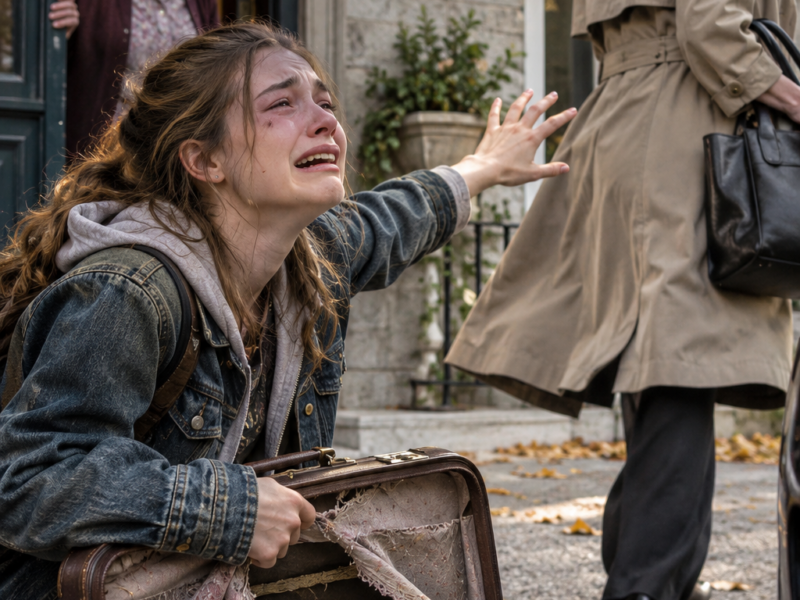
At 16 My Mom Left Me at a Boarding House With One Suitcase—She Never Checked What Was Sewn Inside
At 16 My Mom Left Me at a Boarding House With One Suitcase—She Never Checked What Was Sewn Inside
The last thing my mother gave me before abandoning me was a green suitcase, six hundred dollars, and a sentence I would spend the next twelve years trying to understand.
“Your new family doesn’t have room for you, Beatrice.”
She said it on a sidewalk in Toledo, Ohio, on a hot August afternoon, with one hand already resting on the open door of her husband’s car. She wasn’t crying. She wasn’t angry. She didn’t even look particularly uncomfortable. Her voice was calm, practical, almost bored, as though she were explaining why an oversized piece of furniture couldn’t fit through a doorway.
I was sixteen years old.
Behind her, my stepfather, Roger, sat behind the steering wheel with the engine running. My stepsister, Avery, was in the back seat, staring at her phone. Neither of them looked at me.
My mother placed the suitcase beside my shoes, kissed the side of my head, and climbed into the passenger seat.
The car pulled away before I could think of anything worth saying.
Twenty-four hours later, they were flying to Dublin, Ireland, to begin their wonderful new life together.
I learned this because Avery posted a photograph from the airport. The three of them were smiling beneath the departure board, holding expensive coffees, looking like the beginning of a happy family vacation.
The caption said, “Finally, a family of three.”
I stared at those five words until the screen blurred.
I wasn’t in the photograph. I wasn’t going to Ireland. I was sitting on a stained mattress in a boarding house, surrounded by walls that smelled of old cigarettes, holding a borrowed phone because my mother had disconnected mine.
There was something else I didn’t know that night.
Something my mother had never intended me to discover.
Hidden inside the lining of my grandmother’s old suitcase was a faded daycare emergency-contact card. Written on it was the name of a man I had never heard of, along with a telephone number bearing a Michigan area code.
When I eventually called that number, a man answered on the second ring.
He didn’t say hello.
Instead, he spoke six words that made my blood run cold.
“I’ve been waiting twelve years for this.”
Then he asked a question no one else had bothered to ask me.
“Beatrice, are you safe? Does your door lock?”
To understand why that question mattered, and why a complete stranger would drive through the night to find me, I need to take you back to the morning my mother left.
Our house in Perrysburg had already been emptied.
The movers had arrived two days earlier and loaded everything Roger’s company was shipping overseas. By Saturday, the living room contained nothing except bare carpet marked with pale rectangles where our furniture had stood. The kitchen cupboards were open and empty. The walls looked strangely naked without photographs.
I remember walking through the hallway, studying the last few cardboard boxes.
Roger’s boxes were labeled DUBLIN.
Avery’s boxes were labeled DUBLIN.
Even the kitchen utensils had a destination written across them in my mother’s familiar handwriting.
Nothing had my name on it.
I thought this was an oversight. I had always been the last person considered when family decisions were made, but I still believed there would be a suitcase waiting somewhere, perhaps already packed with my clothes.
Instead, my mother appeared carrying an old green canvas suitcase from the basement.
It had belonged to my grandmother, Ruth, who died when I was six.
The corners were worn, and one handle had been repaired with brown thread. It smelled faintly of damp concrete and dust.
“Just the one bag, B,” my mother said. “Mrs. Pruitt’s room isn’t very large.”
I looked at her.
“Who is Mrs. Pruitt?”
“We’ll explain in the car.”
That should have frightened me.
But by sixteen, I had developed a dangerous habit of accepting things before understanding them.
In our house, questioning my mother meant being called difficult. Disagreeing with Roger meant hearing that he worked hard to provide for us. Complaining about Avery meant being reminded that she had already suffered through her parents’ divorce.
So I had learned to become quiet.
Quiet children rarely get what they need, but sometimes they convince themselves that remaining invisible is the price of belonging.
I packed my clothes into the suitcase.
I remember hesitating over a framed photograph of my grandmother. My mother had already removed it from my dresser and put it in a box of things she planned to donate.
I slipped the photograph between two sweaters.
Then I carried the suitcase outside.
Avery was waiting in the back seat. She had headphones in and didn’t speak as I climbed beside her.
Roger started driving.
My mother waited until we reached the highway before explaining that the apartment in Dublin had only two bedrooms.
Roger’s employer, she said, was paying for a family of three because that was what he had entered on the relocation paperwork.
Changing the arrangements would be complicated.
Besides, I was nearly finished with high school. Moving to another country would disrupt my education. I would probably hate Ireland anyway. It was better for me to stay in Ohio, where I was familiar with everything.
They had found a nice room for me.
The rent was paid in advance.
They would send money.
We would reassess the situation after a year.
She delivered this explanation while looking through the windshield.
I watched the back of her head and wondered when she had stopped considering herself my mother and started thinking of me as a logistical problem.
Finally, I asked, “When are you coming back?”
“We’ll see how the year goes.”
I wanted to ask whether I could visit them for Christmas.
I wanted to ask whether she would call me every evening.
I wanted to ask why Avery was allowed to go and I wasn’t.
But something in the silence of that car warned me that none of those questions would receive an answer.
The boarding house was an old brick building on Monroe Street in downtown Toledo. Its porch leaned toward the sidewalk, and the paint around the windows had begun to peel.
Roger stopped at the curb.
He didn’t turn off the engine.
My mother got out and opened the trunk. I followed her, carrying the strange feeling that I was watching my own life happen from somewhere far away.
She lifted the suitcase onto the pavement and reached into her handbag.
Inside a white envelope were thirty twenty-dollar bills.
She counted them carefully before handing them to me.
“Six hundred dollars. Don’t waste it.”
I looked at the envelope.
“Mom, I don’t understand.”
She sighed.
“Beatrice, your new family doesn’t have room for you. That’s not cruelty. It’s square footage.”
For years afterward, I could remember the exact sound of her voice when she said those words.
She sounded completely convinced that she was being reasonable.
A woman stood behind the boarding house’s screen door, watching us. She wore a thick cardigan despite the heat.
My mother kissed me.
Then she left.
I watched the car disappear around the corner.
Only when the sound of its engine faded did I realize I had no idea what I was supposed to do next.
The woman opened the screen door.
“You Beatrice?”
I nodded.
“I’m Dorothy Pruitt. Come inside before you cook out there.”
Dorothy was seventy-three, widowed, and not particularly interested in making strangers comfortable. She had managed the boarding house since her husband died, and she spoke as though every word cost money.
She led me upstairs to room four.
There was a narrow bed, an old dresser, and a window facing the brick wall of the neighboring building.
The door had a lock, but the mechanism was broken.
The bathroom was shared with three other tenants.
I stood in the middle of the room, holding my suitcase.
“How long did my mother pay for?”
“Through February.”
I swallowed.
“Did she come here before?”
“Back in June. Looked at the room. Paid cash.”
June.
Two months earlier.
My mother had been planning this for two months.
I remembered her coming into my bedroom one evening in June and sitting on the edge of my bed. She had asked about my health-class assignment, which involved researching our family’s medical history.
At the time, I thought she was making an effort to talk to me.
Now I wondered whether she had already selected the room where she intended to leave me.
Dorothy showed me the downstairs kitchen, the communal refrigerator, and a prepaid telephone tenants could use in emergencies.
Then she went back to her crossword puzzle.
I returned upstairs and sat on the mattress.
For several hours, I did nothing.
I kept expecting someone to call. My mother, perhaps, realizing she had made a terrible mistake. Roger, apologizing for how things had happened. Even Avery, admitting that the airport photograph had been cruel.
Nobody contacted me.
By nine that evening, I couldn’t stand the silence.
A man named Lyle lived in room two. He worked nights in a restaurant and smoked cigarettes behind the house.
I found him on the back steps and asked to borrow his phone.
He handed it over.
I typed my mother’s number from memory.
“Can I call you?”
Forty minutes passed before she replied.
“Flight is tomorrow night. Busy. Love you.”
I read the message twice.
Then I returned the phone.
Upstairs, the suitcase sat beside my bed.
Something about the sight of it made me furious.
It was old, ugly, and completely inadequate for the life I had just been forced into. Everything I owned was inside it, while my mother was preparing to board an international flight.
I picked it up and threw it across the room.
It struck the floor with a dull thud.
The lid sprang partly open.
Then I heard a tearing sound.
At first, I thought I had broken the suitcase.
I knelt to examine it and discovered that a section of the interior lining had come loose.
The fabric was hand-stitched.
Behind it was a narrow hidden pocket.
Something yellowed and rectangular had slipped halfway out.
I pulled it free.
It was an old index card.
Across the top, in faded blue ink, were the words LITTLE SPROUTS LEARNING CENTER.
Underneath was an emergency-contact form.
The child’s name was Beatrice Harmon.
Age four.
My name.
My age twelve years earlier.
The first contact was my mother, Melinda Harmon. Beneath her name was an old telephone number.
The second contact had originally been my grandmother, Ruth Harmon, but someone had crossed out her name.
Beside it, in handwriting I immediately recognized as my grandmother’s, were two words.
Owen Fletcher.
Underneath was a Michigan telephone number.
I stared at the card.
I had never heard that name.
I turned it over.
On the back, in my grandmother’s looping handwriting, was a message.
“The man who carried you out. He will come. Grandma Ruth.”
For a long time, I couldn’t move.
The words seemed to belong to a story everyone else knew except me.
Carried me out of what?
Why had my grandmother hidden this card?
And why had my mother never mentioned Owen Fletcher?
At twenty minutes before midnight, I went downstairs.
Dorothy was sitting at the kitchen table with her crossword.
“Can I use the phone?”
She pointed toward the toaster.
I picked up the prepaid flip phone and dialed the number.
It rang once.
Twice.
A man answered.
“I’ve been waiting twelve years for this.”
My breath caught.
“Who is this?”
He didn’t answer immediately.
Instead, his voice became urgent.
“Are you safe?”
“I think so.”
“Does your bedroom door lock?”
I looked toward the stairs.
“No.”
There was silence.
Then he asked where I was.
I told him everything in a rush. The boarding house, Monroe Street, my mother’s departure, the suitcase, the daycare card.
He listened without interrupting.
Finally, he said, “I’m in Grand Rapids. It’s about three hours away. I can be there before dawn.”
I gripped the telephone.
“Why would you come here?”
“Because you called.”
“But who are you?”
“I used to live next door to you. A long time ago.”
I glanced down at the handwriting on the card.
“What did my grandmother mean? The man who carried me out?”
“You deserve to know that,” he said. “But not over a telephone, and not from someone you haven’t met.”
He told me he would park across the street and wait until morning.
He wouldn’t knock in the dark.
I could decide whether to speak to him when the sun came up.
Just before hanging up, he asked something that made my knees feel weak.
“Beatrice, how’s your shoulder?”
My left shoulder.
The one with the long, pale scar.
My mother had always said I received it when I was four, after pulling an oven door down on myself.
I had no memory of the accident.
I had never questioned the explanation.
But a stranger three hours away somehow knew about the scar.
I pulled my shirt collar aside and looked at the damaged skin.
For the first time in my life, I wondered whether the story I had been told was true.
I barely slept.
At seven the next morning, I looked through my window.
A gray pickup truck was parked across the street.
A man sat behind the wheel with his head resting against the seat. His hands were folded loosely over the steering wheel.
He had kept his promise.
He had driven through the night and waited.
I went downstairs.
Dorothy was already on the porch, blocking his path.
The man was tall, broad-shouldered, and gray at the temples. He wore jeans, a dark jacket, and an expression of exhausted patience.
In one hand, he held a paper cup of coffee.
Dorothy demanded to know why a grown man would drive three hours to see a teenage girl he supposedly hadn’t spoken to in twelve years.
He answered quietly.
“Because nobody else came.”
He showed her his identification.
His name was Owen Fletcher, and he worked for the Grand Rapids Fire Department.
He also provided the telephone numbers of his station and his supervisor.
Dorothy called both before allowing him inside.
I watched all of this from the doorway.
He made no effort to rush her.
When she finally stepped aside, he looked at me.
For a moment, neither of us spoke.
Then he said, “Hello, Beatrice.”
There was something strange about hearing my name spoken by a man who seemed grateful simply to see me standing there.
He explained that he had once lived at 314 Alder Street in Toledo.
My mother and I had lived next door, at number 312.
There had been a fire.
He had gotten me out.
That was why he knew about my shoulder.
I looked at his hands.
Across his palms and fingers, the skin was shiny and uneven, marked with old scars.
I assumed they came from years of firefighting.
I didn’t yet understand what I was seeing.
“Was my mother there?” I asked.
He looked down at his coffee.
“That’s something we need to talk about another day.”
I wanted to shout.
Everyone kept deciding which parts of my own life I was allowed to know.
Instead, I asked if he was going to take me away from the boarding house.
“No,” he replied. “Not today. I’m a stranger to you, and you’re sixteen. We need to handle this properly.”
He had brought me a prepaid cellphone.
He had already entered his number.
He also paid Dorothy to have the broken lock replaced that afternoon.
Then he promised to return the following Saturday.
“And the Saturday after that,” he added. “As long as you want me to.”
I stared at him.
“Why?”
He thought for a moment.
“Because somebody should show up.”
That was the beginning.
Not a dramatic rescue. Not a courtroom confrontation. Not a stranger sweeping into my life and making everything perfect.
Just a man who drove six hours round-trip every Saturday because he had made a promise.
The first thing I did was email my mother.
I told her that Owen Fletcher had found me.
I explained that he said he had once been our neighbor and that there had been a fire.
She answered almost immediately.
“Stay away from that man. He is the reason you have that scar. He was supposed to be watching you, and he fell asleep. He nearly got you killed.”
I read the message again and again.
Then I called Owen.
When I read him her words, he remained silent for so long that I thought the connection had failed.
Finally, he said, “She told you that?”
“Is it true?”
He took a breath.
“I’m not going to argue with your mother through you. But I want you to ask her one question.”
“What question?”
“Ask her where she was that night.”
So I did.
My email contained only four words.
“Where were you, Mom?”
She didn’t respond for nine days.
When she finally did, she wrote about Avery settling into university, Roger’s new office overlooking the river, and how beautiful Dublin looked in autumn.
She asked whether I was eating properly.
She did not mention the fire.
She did not answer my question.
That silence troubled me more than an angry denial would have.
Meanwhile, Owen continued visiting.
Every Saturday, his gray pickup appeared outside the boarding house.
He brought groceries, replaced my broken window latch, and helped me obtain state identification.
He never entered my bedroom.
He never demanded personal information.
He never pressured me to trust him.
When I asked about the fire, he simply told me that some truths were too important to explain while I was standing in a place that didn’t feel safe.
The biggest problem was school.
Without a parent or guardian present, enrolling became complicated.
Owen helped obtain a document allowing another adult to handle school and medical matters for me.
My mother initially refused to sign it.
Then I contacted Roger directly.
I explained what the boarding house was really like and that the lock on my door had been broken.
Apparently, my mother had described the place to him as a supervised room in a respectable widow’s home.
He hadn’t bothered to inspect it.
But once he learned the truth, he demanded she sign the paperwork.
The authorization arrived in October, bearing my mother’s signature and an official notarization from Dublin.
Attached was a yellow note.
“This changes nothing.”
I kept that note.
At the end of October, I left Dorothy’s boarding house.
By then, arrangements had been made for me to live with Owen, with my mother’s authorization covering the necessary school and medical decisions.
Dorothy returned the unused portion of my prepaid rent.
Before I left, she gripped my arm.
“If he turns out wrong, you call me.”
Then she narrowed her eyes.
“And if he turns out right, you call me anyway.”
I promised.
Owen drove me to Grand Rapids.
His home was a modest brick house on a quiet residential street, with a maple tree in the front yard and a detached garage.
He showed me a room at the end of the hallway.
There was a bed, a dresser, a lamp, and a window overlooking the backyard.
The sheets were brand new.
I could still see where the packaging had folded them.
“How long has this been a bedroom?” I asked.
“Since Tuesday.”
I looked at him.
He shrugged.
“Bought the furniture after we knew you were coming. No point pretending I had it ready for years.”
That answer made me trust him more than any grand declaration could have.
My mother had spent years telling polished stories that became less believable the closer I examined them.
Owen told me things exactly as they were.
Life with him was quiet.
He taught at the fire academy and kept a disciplined schedule.
He made coffee every morning and left the hallway light on at night.
He learned which foods I liked and made sure the refrigerator contained them.
If he wanted to speak to me while I was in my room, he knocked on the doorframe and waited outside.
I wasn’t accustomed to having boundaries respected.
Sometimes I found myself waiting for the other half of his kindness—the complaint, the accusation, the reminder that I owed him something.
It never came.
One afternoon, I discovered an old red toolbox on his garage workbench.
Inside, above the neatly arranged tools, lay a small piece of gray fabric.
Before I could examine it, Owen entered and closed the lid.
I didn’t think much about it at the time.
But a few weeks later, while looking for a screwdriver, I found the toolbox open again.
This time, I picked up the gray object.
It was a child’s sock.
Tiny. Faded. Worn almost transparent at the heel.
I could fit the entire thing in my palm.
It had been carefully washed and folded, then kept among the tools as though it were something precious.
I had no idea why a middle-aged firefighter would keep a child’s sock.
I put it back exactly where I found it.
That Thanksgiving, we ate chicken instead of turkey.
Owen said a whole turkey for two people was unnecessary.
We sat across from each other at his kitchen table, eating in comfortable silence.
Then I pulled the collar of my sweater aside, exposing the scar on my shoulder.
“Tell me what happened.”
He looked at the scar.
For a long time, he said nothing.
Then he reached across the table and gently rested his hand near the damaged skin.
His palm felt strangely similar to my shoulder.
Rough. Tight. Uneven.
“When you’re ready,” he said.
“I am ready.”
He shook his head.
“When you can hear the truth without needing me or your mother to be the villain.”
I pulled my sweater back into place.
For the first time, I noticed how severe the scars on his hands really were.
They weren’t simply marks left by an occupational accident.
They looked like the scars of someone who had gripped something burning and refused to let go.
That night, lying in my new bed, I thought about the tiny gray sock.
And I began to suspect that Owen Fletcher had been carrying a memory much heavier than anything in his toolbox.
By the following spring, I was seventeen.
I had grown comfortable enough in his house to call it home, but the questions about my childhood remained.
In April, Owen drove me to Toledo so I could visit Dorothy.
After lunch, while he went to a hardware store, I told Dorothy I wanted to take a walk.
I didn’t tell her where.
I walked to Alder Street.
The neighborhood looked ordinary.
At number 312 stood a newer house with bright white siding. A plastic slide sat in the yard, and a different family’s car occupied the driveway.
Number 314, Owen’s former home, had a rental sign in the window.
I stood between the two properties, trying to imagine flames, fire engines, and a four-year-old girl being carried through smoke.
Nothing came back.
Then a woman spoke from the porch of number 316.
“You’re Melinda’s daughter.”
Her name was Gail Sorensen.
She had lived on that street for decades.
When she learned why I had come, she invited me inside.
At her kitchen table, she told me the story everyone in the neighborhood believed.
My mother had been working a double shift.
She had asked Owen, the firefighter next door, to watch me.
He agreed.
But instead of paying attention, he went home and fell asleep.
A portable heater caught fire.
By the time anyone realized what was happening, the house was burning.
Owen eventually rescued me, but only after I suffered a terrible injury.
“He never even apologized,” Gail told me. “Sold his house and left town. Your poor mother was devastated.”
I sat motionless.
Then Gail added something that made my stomach tighten.
“He kept one of your little socks afterward. A gray one. People thought it was strange.”
The sock.
The one in Owen’s toolbox.
Gail watched me carefully.
“Your mother blamed herself for trusting him. I can’t imagine how she survived it.”
I thanked her and left.
During the three-hour drive back to Grand Rapids, I barely spoke.
Eventually, I asked Owen whether he had been responsible for watching me on the night of the fire.
“No.”
“Then why does everyone say you were?”
“Because your mother told them that.”
“Why would she lie?”
He didn’t answer.
His silence infuriated me.
I felt as though I had spent my entire life being protected from information I had a right to know.
“Please,” I said. “Just tell me one thing. Not another question. Not something I have to ask my mother. One thing that’s true.”
He pulled onto the highway shoulder and turned on the hazard lights.
Then he faced me.
“I was never asked to watch you, Beatrice.”
He paused.
“Nobody was.”
Those last two words would haunt me.
Nobody was.
At the time, I thought he was simply denying responsibility.
I didn’t understand that he had given me the most important clue in the entire story.
For the next week, I barely spoke to him.
He didn’t retaliate.
He didn’t demand gratitude.
He simply continued making breakfast, leaving food in the refrigerator, and allowing me the space to be angry.
Then, one afternoon in the school library, I searched for information about obtaining old fire department records.
I found a public-records request form.
I entered the address.
312 Alder Street.
I entered the date I had calculated from the information Gail provided.
November 2002.
Under the section asking why I wanted the report, I typed five words.
“I was the child involved.”
Two weeks later, an email arrived containing three scanned pages.
I was too frightened to open it immediately.
For two days, the attachment sat in my inbox.
Then, during lunch on a Tuesday, I sat alone at a library computer and clicked the file.
The first page was a standard incident report.
November 14, 2002.
1:12 a.m.
Residential structure fire.
Portable electrical heater.
Then I reached the narrative.
It stated that a neighbor, Owen Fletcher, had entered the burning house through the rear door before emergency crews arrived.
He located a four-year-old girl hiding in an upstairs bedroom closet.
He carried her through a window onto an adjacent roof, where firefighters assisted in bringing them to safety.
The child suffered second-degree burns to her left shoulder when burning ceiling material fell.
The neighbor suffered second-degree burns to both hands.
Then I read the line that changed everything.
“No adult present on arrival.”
And directly beneath it:
“Mother arrived 06:50.”
I stared at the numbers.
The emergency call had been dispatched shortly after one in the morning.
My mother had not arrived until almost seven.
For more than five hours, the firefighters, police officers, and hospital staff had dealt with the consequences of a fire she hadn’t even been present to witness.
I turned to the supplemental statements.
Owen’s account was brief.
He had heard a smoke alarm and noticed signs of fire next door.
He had entered the property, found me in the closet, and removed me.
He stated that he had not been asked to supervise me and had not known I was home alone.
Then came my mother’s statement.
She claimed to have arranged for Owen to watch me while she worked a double shift.
Underneath was a police note.
Her claim had not been corroborated.
Both employers confirmed that she had not been scheduled to work.
No criminal charges had been referred.
I read those words until the letters lost their meaning.
My mother had left me alone in a house when I was four years old.
A fire had started.
Owen had heard the alarm and entered the building to save me.
He had suffered serious burns carrying me to safety.
And afterward, my mother had blamed him.
An entire neighborhood had believed her.
For thirteen years, the man who saved my life had carried the reputation of being responsible for nearly ending it.
I couldn’t stop looking at the line about the closet.
I had no memory of hiding there.
But as I sat in the library, I suddenly felt a strange tightness in my chest.
I imagined a small girl, frightened by smoke and heat, doing the only thing she knew how to do.
Hiding.
Waiting.
Then a man she barely knew reaching into the darkness and pulling her out.
I printed the report.
When I arrived home, Owen was working in the garage.
I walked to the workbench and laid the pages in front of him.
He looked down.
Then he opened a drawer and removed his own copy.
The paper was yellowed, folded, and stained with coffee.
He had kept it all those years.
“You knew,” I whispered.
“Yes.”
“Why didn’t you show me?”
He considered the question.
“Because I wanted you to find the truth somewhere that didn’t depend on believing me.”
I began crying.
He didn’t try to stop me.
Instead, he opened the red toolbox.
He removed the little gray sock and placed it on top of the report.
Then he told me where it came from.
It had been on my foot that night.
While carrying me through the upstairs window, he felt it slip off.
After the fire was extinguished, he returned to the house and found it among the debris.
It was one of the few things he could identify as belonging to me that hadn’t been destroyed.
He had considered giving it to my mother.
But he was afraid she would throw it away.
So he kept it.
At first, he told himself it was temporary.
Then months passed.
Then years.
Eventually, keeping that little sock became something he no longer questioned.
I picked it up.
It was almost weightless.
Yet knowing what it represented made it feel heavier than anything I had ever held.
“Where was my mother?” I asked.
He looked at me sadly.
“I don’t know.”
“Then why won’t you tell me everything?”
“Because the report tells you what happened to you. It doesn’t tell you where she went.”
I studied his face.
“And you never found out?”
He shook his head.
“Not in a way I could prove.”
That was the first time I understood that truth and suspicion weren’t the same thing.
Owen had spent years being falsely accused.
He refused to do the same to someone else.
Even my mother.
The next important piece arrived from someone I never expected.
Avery.
Two days after Christmas, she sent me a message from a number I had deleted but still recognized.
“I’m in Michigan. Can I see you? Please don’t tell Mel.”
She was twenty by then and had returned from Dublin for the holidays.
I hadn’t seen her since the day she sat in the back seat while my mother abandoned me.
Part of me wanted to refuse.
Instead, I gave her Owen’s address.
She arrived in a rental car on a gray Tuesday afternoon.
Standing on the porch, she looked nervous and older than I remembered.
We sat at the kitchen table.
Before removing her coat, she apologized.
For the photograph.
For the caption.
For not looking up when the car pulled away from Monroe Street.
She admitted my mother had suggested the words “Finally, a family of three.”
Avery had posted them because she was young, excited about moving overseas, and too selfish to understand what they meant to me.
“I deleted it later,” she whispered.
I nodded.
But I didn’t tell her it was okay.
Some things can be forgiven without being made harmless.
Then she said something that made the room seem to tilt.
“There’s a third bedroom in Dublin.”
I stared at her.
“What?”
“The apartment. There are three bedrooms. Mel uses one for her yoga mat and treadmill. She calls it her office.”
I couldn’t speak.
My mother had told me there was no space.
She had stood on that sidewalk and explained that abandoning me was a matter of square footage.
All along, an empty bedroom had been waiting overseas.
The realization hurt more than I expected.
I had spent nearly two years trying to understand why I didn’t fit into my mother’s new life.
Now I knew that physical space had never been the problem.
She had simply decided she didn’t want me there.
Avery began crying.
I went to make coffee because I didn’t know what else to do.
When I returned, she was examining the fire report I had left on the table.
She read the date aloud.
“November fourteenth.”
Then she looked up.
“That’s Dad’s birthday.”
I froze.
Roger’s birthday.
I knew it fell in November, but I had never connected the exact date to the fire.
Avery took a photograph of the report with her phone.
She said she wanted to remember it.
I let her.
Neither of us understood what would happen next.
A few weeks later, Owen was suspended from teaching.
An anonymous complaint had been filed with both the fire department and county child protective services.
The complaint alleged that a seventeen-year-old girl was living with an unrelated adult man who had previously demonstrated negligence toward her.
Attached was my mother’s old statement about the fire.
Not the complete report.
Only her accusation.
Chief Haskell, the training division supervisor, placed Owen on paid administrative suspension while the allegations were reviewed.
When he came home that afternoon, his academy badge was resting on the kitchen table.
He explained what had happened before I could hear it from someone else.
I immediately knew who was responsible.
My mother.
She had discovered that I possessed evidence contradicting her story, and rather than explain herself, she had once again targeted the man who had protected me.
I wanted to call her.
I wanted to scream.
Owen stopped me.
“Tell the truth when they ask. That’s all.”
A child protective services investigator named Janet Ferris visited later that week.
She interviewed me privately at the kitchen table while Owen waited in the garage.
I told her everything.
The boarding house.
The broken lock.
The old suitcase.
The weekly visits.
The signed authorization.
The fire report.
When she asked whether Owen had ever made me feel unsafe, I told her about the first night.
“He drove three hours to find me, then slept in his truck because he promised not to knock until morning.”
Janet wrote something in her notebook.
For six weeks, the investigation continued.
Owen stayed home.
The teaching schedule normally hanging in the kitchen remained blank.
He repaired the gutters, reorganized the garage, and pretended he wasn’t worried.
But I could see the strain.
Sometimes I found him sitting alone at the table late at night, staring at his burned hands.
My mother had taken his reputation once before.
Now she was trying to do it again.
I began to realize something disturbing.
Back in 2002, she had blamed Owen because acknowledging the truth could have cost her custody of me.
Now she was blaming Owen because the truth could cost her marriage.
And the same false accusation served both purposes.
But there was one person whose involvement in the original events had never been investigated by anyone in our family.
Roger.
I knew Roger had started dating my mother around the time of the fire.
He had married her several years later.
For more than a decade, he had repeated her story about the negligent firefighter whenever anyone asked about my shoulder.
But what if he knew something without realizing it?
I sent him an email.
I attached the complete report.
Then I wrote:
“I’m not asking you to take sides. I’m asking you to read page three and tell me if you know anything about that night.”
Twenty-six hours passed before he answered.
His reply was brief.
“I need to check something.”
I didn’t know it then, but that email had set off a chain of events my mother could never control.
Years later, Roger told me exactly what happened.
He was twenty-nine years old in November 2002.
He had been divorced for about a year and lived alone in an apartment in Maumee, twenty minutes from our house on Alder Street.
He had been dating my mother for approximately two months.
She told him she was a devoted single parent who worked constantly to provide for her little girl.
He admired her for it.
On the evening of November fourteenth, she came to his apartment to celebrate his birthday.
They had dinner.
They talked late into the night.
For the first time in their relationship, she stayed over.
The next morning, at approximately six thirty, her telephone rang.
She answered, became visibly distressed, and hurried to dress.
She told Roger her mother had called about an emergency at the house.
Then she left.
A week later, she finally told him about the fire.
But she changed the date.
She claimed the fire had happened the weekend before his birthday, while he was visiting his brother.
She said she had trusted a neighbor to watch me and that the man had fallen asleep.
Roger had believed every word.
He had held her while she cried.
He had never thought to question the timeline.
For thirteen years, he told people about that birthday as the night he realized he loved her.
The night she stayed.
The night everything changed.
He even kept the birthday card she had written at his kitchen counter.
It said:
“Happy 29th. I’m glad I was here. M.”
When my mother filed the complaint against Owen, she asked Roger to write a supporting letter.
To persuade him, she forwarded a copy of her statement from 2002.
A statement bearing the date November fourteenth.
Roger read it.
Then he remembered his birthday.
He remembered my mother arriving at nine that night.
He remembered waking beside her the following morning.
He remembered the telephone call at six thirty.
And he realized that something was terribly wrong.
He requested the fire report independently.
When the document arrived, he compared the recorded arrival time with his memories.
Mother arrived 06:50.
Twenty minutes after leaving his apartment.
He still had the birthday card.
He had proof that the woman he married had been with him when her four-year-old daughter was trapped inside a burning house.
But he also knew something worse.
She had told him an elaborate lie that made another man responsible.
And he had helped keep that lie alive for more than a decade.
Without confronting my mother, Roger booked a flight to the United States.
On a Saturday afternoon in February, he appeared on Owen’s porch in a business coat, carrying two pieces of paper.
I was standing in the hallway when Owen opened the door.
Roger looked at him for a long moment.
Then he said, “I owe you an apology, and I don’t know where to begin.”
Owen stepped aside.
“Come in. Beatrice is home.”
We sat at the kitchen table.
Roger placed the birthday card beside the fire report.
For the first time, I heard the complete story of where my mother had been that night.
She had not been working.
She had not arranged a babysitter.
She had been celebrating Roger’s birthday.
She had left me home alone.
I looked from the card to the report, then back again.
The dates matched.
The times matched.
The truth was no longer a question of whom I trusted.
It was sitting on the table in front of me.
Roger’s voice shook as he explained that he had never known.
“I thought she told me the truth, B.”
I believed him.
But believing him didn’t erase the memory of his car pulling away from the boarding house.
He must have seen that in my expression because he lowered his eyes.
“I should have paid attention to what was happening to you,” he said. “Even before I knew any of this.”
Owen sat quietly.
Then he asked Roger something I will never forget.
“Did she ever ask what happened to my hands?”
Roger looked at Owen’s scarred palms.
His face changed.
“No.”
It was such a small answer.
But it seemed to reveal the whole truth of the preceding thirteen years.
My mother had never needed to understand what Owen suffered.
She had only needed him to carry the blame.
Roger asked whether he could call her on speakerphone.
He wanted me to hear the conversation.
I agreed.
It was evening in Dublin.
My mother answered on the third ring.
She sounded cheerful.
“Hi, sweetheart. How are the meetings?”
Roger told her he wasn’t attending meetings.
He was in Grand Rapids.
At Owen Fletcher’s house.
The silence was immediate.
Then she began speaking quickly.
She said she had done what she needed to do in 2002 to keep her daughter.
If she had admitted leaving me alone, the authorities might have taken me away.
She said Owen understood that.
She insisted everything had been necessary.
Roger let her finish.
Then he spoke.
“You didn’t lie to keep Beatrice, Melinda.”
Another silence.
“You lied to keep me.”
She demanded to know what he meant.
He told her about the birthday card.
The report.
The recorded time.
The employers who confirmed she hadn’t been working.
For a few seconds, we heard only faint static.
Then she asked whether I had told Roger all of this.
“No,” he replied. “The documents did.”
Her voice became cold.
And suddenly I heard the woman from the sidewalk again.
The woman who could abandon her daughter while explaining that cruelty was merely a matter of space.
“Beatrice,” she said sharply, “you did this.”
I had not spoken during the entire conversation.
Now I looked at the papers on the table.
The birthday card.
The incident report.
The lie that had followed me since childhood.
And I answered.
“I didn’t do anything, Mom. I read.”
She hung up.
The click was quiet.
For a moment, nobody moved.
Then Owen stood and made coffee.
It was such an ordinary thing to do after such an extraordinary conversation that I almost laughed.
Instead, I cried.
Not because my mother had been exposed.
Not because Roger finally understood.
I cried because I had spent so many years believing that my life was something people could discard, rearrange, or explain away.
And now, sitting at a kitchen table with two men who had chosen to face the truth, I finally understood that I had never been the problem.
The following morning, Roger contacted Chief Haskell.
He provided the documents and explained what he knew.
He also spoke with Janet Ferris.
By the first week of March, the child protective services investigation was closed.
The allegation against Owen was unsubstantiated.
The fire department ended its review.
A few days later, I turned eighteen.
The authorization my mother had signed was no longer necessary.
For the first time, I had complete legal control over where I lived.
I could have moved into my own apartment.
I could have returned to Toledo.
I could have gone anywhere.
I stayed with Owen.
When he returned to the fire academy, Chief Haskell handed him his badge.
She told him the records had supported him all along.
He smiled when he repeated that to me.
But there was sadness behind it.
For thirteen years, the truth had been available to anyone willing to read three pages.
It had simply been easier for people to believe a story.
Roger began divorce proceedings later that year.
My mother returned from Dublin and rented an apartment in Toledo.
I learned this through Dorothy, who still called me regularly.
Avery spent the summer at Owen’s house.
She slept on the couch, and every morning Owen folded her blanket before she woke.
He didn’t complain about the extra person.
He simply bought a larger carton of milk.
In the evenings, Avery and I sat outside talking.
Sometimes we discussed our childhood.
Sometimes we discussed Ireland.
Sometimes we said nothing at all.
One night, she admitted that my mother blamed me for the collapse of the marriage.
“She says you turned everyone against her.”
I looked toward the garage.
“Did you believe her?”
Avery shook her head.
“I told her all you did was show us a piece of paper.”
Then she smiled sadly.
“Funny, isn’t it? She always wanted a family of three.”
I looked at Avery, then at the kitchen window where Owen was washing dishes.
For the first time, the words from that airport photograph didn’t hurt.
We had become a family of three.
Just not the one my mother imagined.
In October, my mother called.
I was sitting at the kitchen table filling out an application for a fire science program at the local community college.
My phone lit up.
Mom.
I watched it ring.
Owen was at the counter.
“You going to answer?”
“Not today.”
He nodded.
“Maybe someday?”
I considered the question.
“That’s my decision now.”
He smiled a little.
“Yes, it is.”
I returned to my application.
I wish I could tell you that everything became simple after that.
It didn’t.
Healing from abandonment isn’t a straight road.
Some days I felt grateful.
Other days, furious.
Sometimes I wondered why my mother had been capable of loving Avery and Roger in ways she couldn’t love me.
Sometimes I dreamed about the boarding house, waking with the sensation that my bedroom door wouldn’t lock.
But the difference was that I no longer faced those feelings alone.
Owen never tried to replace my mother.
He never asked me to call him Dad.
He was simply there.
At graduations.
During difficult examinations.
When I was sick.
When my first car broke down.
When I got my first job.
And gradually, I stopped measuring family by blood and began measuring it by who stayed.
I studied fire science.
Then fire investigation.
I became fascinated by the way physical evidence could contradict the stories people told.
A burned wall could reveal where a fire started.
An electrical outlet could expose a false explanation.
A damaged door could prove whether someone had tried to escape.
Fire, I discovered, left its own kind of testimony.
And if you understood how to listen, buildings could tell the truth long after the people inside them stopped talking.
By June 2026, I was twenty-eight years old and working as a fire investigator for the city of Grand Rapids.
My job involved examining damaged properties, reviewing statements, and determining what had happened.
I loved it.
I was good at it.
And every time someone asked where I learned to be so careful with evidence, I thought of Owen.
He retired that summer.
He was fifty-eight, and the old burns on his hands bothered him increasingly during cold weather.
He joked that he had explained wind direction to so many recruits that he could probably deliver the lecture in his sleep.
During his final week at the academy, I helped him clear out his office.
There were binders, training manuals, framed certificates, and photographs of recruits who had passed through his classes over the years.
Under his desk sat the old red toolbox.
I hadn’t seen it in a while.
He had moved it from the garage years earlier.
I opened the lid.
The gray sock was still there.
Carefully folded.
Exactly as I remembered.
But beneath it lay something I had never seen.
A sheet of paper folded into quarters.
The edges were worn, and the creases had become soft from years of handling.
When I unfolded it, I recognized the handwriting immediately.
My grandmother’s.
The letter was dated March 2003.
Four months after the fire.
Owen had been standing in the doorway carrying a box of binders.
When he saw the paper in my hands, he stopped.
“I was going to give you that today,” he said softly. “Go ahead.”
I began reading.
My grandmother had written to him after visiting Grand Rapids.
She knew the story my mother had spread throughout Alder Street.
And unlike everyone else, she hadn’t believed it.
She had gone to Owen’s house and asked what really happened.
He told her.
Then she wrote him a letter.
She offered to return to Toledo and explain the truth to every neighbor who had blamed him.
She said he deserved his reputation back.
She said it was wrong that he had saved her granddaughter’s life and been punished for it.
And she promised that if he wanted her to speak publicly, she would.
I turned the page over.
On the back, in Owen’s careful handwriting, was a draft of his reply.
It was only a few lines.
“Don’t.
“If they learn she was alone, someone may call the county. They could take her away.
“Tell Beatrice when she’s old enough to carry the truth.
“I’ll keep the number.”
I read the last sentence again.
“I’ll keep the number.”
Suddenly, everything became clear.
The daycare card.
The hidden suitcase lining.
My grandmother’s message.
The telephone call on that terrible night in August.
Owen hadn’t been waiting twelve years for someone to clear his name.
He hadn’t been hoping the neighbors would apologize.
He hadn’t been waiting for revenge against my mother.
He had been waiting for me.
He had chosen to carry the accusation because he feared that exposing my mother’s negligence would leave a little girl without her mother.
My grandmother, who knew how to find him, had kept his contact information safe.
And somehow, before she died, she had hidden it in the suitcase she hoped would eventually reach me.
I stood in Owen’s office holding the letter.
All those years, I had thought he was simply protecting me from a painful truth.
Now I understood how much that decision had cost him.
His neighbors had turned against him.
He had moved away from the street where he lived.
People had repeated the story of his supposed negligence for more than a decade.
He could have stopped much of it by showing people the report.
He hadn’t.
Because he was worried about what might happen to me.
I looked at him.
“Was I old enough?”
He set the box of binders down.
His expression softened.
“You requested that report yourself,” he said. “That’s when I knew.”
I felt tears rising.
For once, I had no questions.
No missing pieces.
No desperate need for someone to explain why I had been abandoned or why I had been saved.
I knew.
Owen’s last class took place on a Friday afternoon.
Twenty-two recruits sat in blue shirts at long tables.
I watched from the back of the room, wearing my investigator’s jacket.
He delivered his final lecture the same way he had delivered hundreds before it.
Calmly.
Precisely.
Without wasting words.
Near the end, a young woman raised her hand.
“Sir, what’s the first thing you check when you arrive at a structure fire?”
Owen looked at her.
“Exits. Wind direction. Roof conditions. And whether anyone’s telling you the truth about who’s inside.”
I remembered hearing those exact words when I was sixteen.
Back then, I hadn’t understood why they sounded so personal.
Now I did.
He paused.
Then he reached into his jacket pocket.
He removed a small gray sock.
It looked impossibly tiny in his scarred hand.
The recruits stared.
He held it up for a few seconds.
Then he said, “This is why you go in.”
He didn’t explain the story behind it.
He didn’t need to.
He was holding proof that somewhere, on the other side of a wall of smoke, there might be a child who couldn’t save herself.
A child who needed someone to come.
I slipped out of the classroom before the lecture ended.
I stood by a hallway window and watched the trees moving in the summer wind.
For the first time since I was sixteen, I wasn’t waiting for an answer.
There was nothing left to uncover.
My mother still lives in Toledo.
In 2024, she called me, and I answered.
We spoke for four minutes.
I told her I was doing well.
She told me she was fine.
There was no dramatic reconciliation.
No tearful confession.
No apology that erased the past.
I don’t know whether we’ll speak again.
That decision belongs to me.
Avery visits every Thanksgiving.
We make a proper turkey now.
Owen insists three people can justify buying one.
He still complains about how long it takes to cook.
Avery still laughs at his terrible jokes.
And I still keep my grandmother’s green suitcase in the closet of my bedroom.
I had the torn lining repaired, but I left a small opening where the hidden pocket used to be.
Inside it, I keep the original daycare card.
The one bearing Owen Fletcher’s name.
The one my grandmother hid because she believed that one day, I might need someone who would come when I called.
Sometimes I take it out and trace the faded handwriting.
I think about my mother standing on the sidewalk, explaining that there wasn’t enough room for me.
I think about the six hundred dollars.
The broken lock.
The airport photograph.
The tiny girl hiding in a burning closet.
And the man who carried her through a window, burning his hands while refusing to let her go.
For most of my childhood, I believed love was something I had to earn by being quiet, agreeable, and easy to keep.
I believed that if I asked too many questions or needed too much, people would leave.
But Owen taught me something my mother never could.
Love doesn’t always arrive with speeches.
Sometimes it arrives in a gray pickup truck before dawn.
Sometimes it pays for a lock without asking for thanks.
Sometimes it buys new sheets on a Tuesday because a frightened girl is moving in on Saturday.
Sometimes it keeps a tiny sock for twenty-four years because letting go of that last small piece of a child’s life feels impossible.
And sometimes it carries a terrible truth in silence, waiting until the person who needs it is strong enough to discover it for herself.
When my mother abandoned me, she thought she was closing the door on an inconvenient chapter of her life.
She thought six hundred dollars and an old suitcase were enough to send me away.
She never checked the lining.
She never discovered the name hidden inside.
And she never imagined that the man she had spent twelve years erasing from my life was already waiting for the chance to find me again.
My mother once told me that her new family didn’t have room for me.
In one sense, she was right.
There wasn’t a place for me in the life she had chosen.
But somewhere in Michigan, there was a man with a modest brick house, a spare bedroom, a red toolbox, and two scarred hands.
He didn’t know when I would come.
He didn’t even know whether I would ever call.
He just kept the number.
And when I finally did, he answered.
He came.
And this time, someone stayed.
THE END