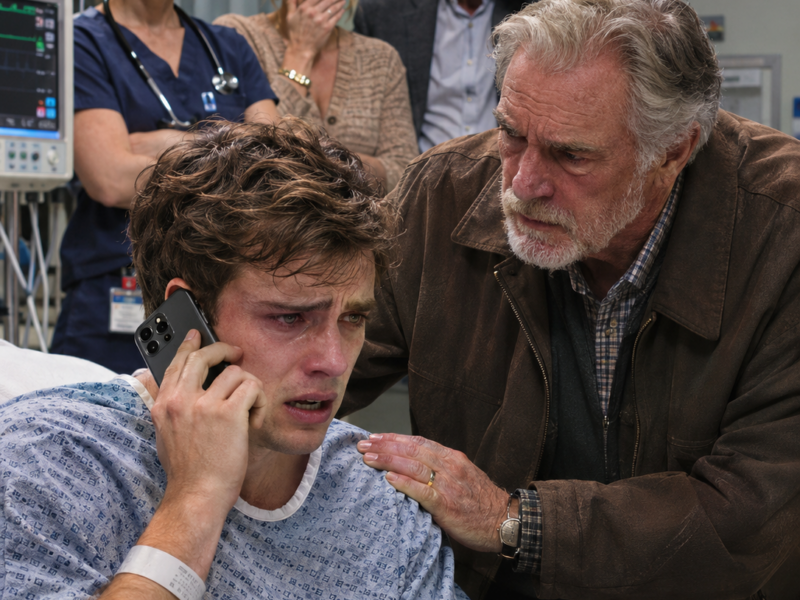
At 11:45 PM, My 10-Year-Old Grandson Called Me From the ER, Crying, “Grandpa, Mom Collapsed, and Dad Won’t Let Me See Her!” When I Rushed to the Hospital, My Own Son Blocked Me From Seeing His Dying Wife and Snapped, “Go Home, Old Man. I Call the Shots Now!” But When a Nurse Secretly Showed Me Her Toxicology Results, I Realized Something Was Terribly Wrong. Then My Grandson Revealed What His Father Had Hidden in the Neighbor’s Trash—and What I Discovered Next Left Me Frozen…
At 11:45 PM, My 10-Year-Old Grandson Called Me From the ER, Crying, “Grandpa, Mom Collapsed, and Dad Won’t Let Me See Her!” When I Rushed to the Hospital, My Own Son Blocked Me From Seeing His Dying Wife and Snapped, “Go Home, Old Man. I Call the Shots Now!” But When a Nurse Secretly Showed Me Her Toxicology Results, I Realized Something Was Terribly Wrong. Then My Grandson Revealed What His Father Had Hidden in the Neighbor’s Trash—and What I Discovered Next Left Me Frozen…
Part 1
The phone rang at 11:45 p.m., and the moment I heard my ten-year-old grandson whisper my name, I knew something terrible had happened.
“Grandpa, please come. Mom is in the hospital. Dad won’t tell me what’s wrong, and I’m scared.”
His voice was trembling so badly that I could barely understand him. Behind his words, I heard the distant sounds of hospital equipment, people talking, and someone calling for a nurse.
“Eli, sweetheart, where are you?”
“Midwest Mercy Hospital. I’m hiding near the emergency room. Dad told me not to call anyone, but Mom collapsed, Grandpa. She was shaking on the floor, and there was something coming out of her mouth.”
I sat upright in bed.
For forty years, I had worked as a thoracic surgeon at that very hospital in Indianapolis. I had watched people die, performed operations that lasted sixteen hours, and delivered more terrible news to grieving families than I cared to remember.
But nothing in those forty years prepared me for hearing my grandson cry like that.
“Listen carefully, Eli. Stay somewhere safe. Don’t go anywhere with anyone until I arrive. I’m coming.”
“Grandpa?”
“Yes, buddy?”
“Dad is acting really strange. I think something bad happened to Mom.”
The call ended.
I was seventy-two years old, two years into retirement, and my knees no longer moved as quickly as they once had. But that night, I dressed faster than I had in decades.
Fifteen minutes later, I was driving through a violent rainstorm toward the hospital where I had spent most of my adult life.
My daughter-in-law, Nora, was thirty-eight years old. She was a brilliant medical researcher, the kind of woman who could spend fourteen hours studying a scientific problem and still come home smiling because her son had drawn her a picture.
She was also the reason my son, Preston, had become a wealthy businessman.
Three years earlier, Preston had approached me with an ambitious proposal. He wanted to establish a biotechnology company specializing in neurological treatments.
He understood business, investments, and negotiations.
Nora understood science.
I provided the startup capital.
I had spent decades saving money, living carefully, and investing wisely. When my only son asked me to help him build a company, I believed I was investing in my family’s future.
I gave him millions, retained sixty percent ownership, and trusted him to manage the business responsibly.
Looking back, that trust was the greatest mistake of my life.
Nora had recently developed a revolutionary neurological treatment that could potentially change the lives of patients suffering from degenerative brain diseases.
Her research was attracting enormous attention.
A major pharmaceutical company was reportedly interested in acquiring the technology for hundreds of millions of dollars.
Everything should have been wonderful.
Instead, my grandson was sitting alone in an emergency room, terrified, while his mother fought for her life.
When I reached Midwest Mercy, I abandoned my car near the emergency entrance and hurried inside.
The waiting room was crowded.
I spotted Eli immediately.
He sat in a metal chair near the corner, wearing his pajamas and clutching a small blue backpack. His face was pale, his eyes swollen from crying.
When he saw me, he jumped up.
“Grandpa!”
He ran into my arms.
I held him tightly, feeling his little body shaking against my chest.
“Where’s your father?”
“He went through those doors. He told the security guard not to let me follow.”
I looked toward the restricted corridor.
“Stay here, Eli. I’ll find your mother.”
A security guard stepped into my path when I approached.
“Sir, authorized personnel only.”
“My name is Dr. Gerald Crane. I was chief of thoracic surgery here for forty years. My daughter-in-law is a patient, and I need to speak with her attending physician.”
The guard hesitated.
Before he could answer, a familiar voice called my name.
“Dr. Crane?”
I turned.
Donna Mitchell, a veteran charge nurse who had worked beside me for nearly twenty years, stood at the nursing station.
The moment she recognized me, her expression changed.
Her clipboard slipped from her hand and struck the floor.
“Gerald,” she whispered. “We had no idea you were the grandfather.”
Something about her voice frightened me more than Eli’s phone call.
“Donna, what’s happening?”
She glanced nervously toward the corridor.
“Your son told the medical team that Nora had no other family nearby. He specifically requested that nobody else be allowed access.”
“Why?”
Instead of answering, Donna handed me a printed medical report.
“Read this.”
I examined the results.
My eyes stopped at the toxicology findings.
No alcohol.
No sleeping medication.
No narcotics.
Yet Preston had apparently told the doctors that Nora had been drinking heavily and had taken an overdose of sleeping pills.
“That makes no sense,” I said.
Donna nodded.
“There’s something else.”
She pointed toward the blood chemistry results.
Nora’s glucose level had fallen to a terrifyingly low concentration. Her symptoms resembled severe insulin shock, but the medical team could not explain what had caused it.
“She’s not diabetic,” I whispered.
“I know.”
“Does she have access to insulin?”
“Not according to her history.”
I stared at the report.
Nora had suffered violent seizures. Her blood pressure had collapsed, and her organs were beginning to fail.
Someone had introduced something into her body.
Something dangerous.
And the only adult who had been home with her was my son.
I looked toward the intensive care corridor.
“Where is Preston?”
“Room four.”
Before Donna could stop me, I started walking.
I had barely reached the doorway when Preston appeared.
He wore an expensive gray suit, his tie loosened around his neck. His face showed the perfect expression of a devastated husband.
“Dad,” he said. “What are you doing here?”
“Eli called me.”
For one brief moment, I saw something flash across his eyes.
Not relief.
Not gratitude.
Anger.
Then it disappeared.
“Poor kid,” Preston sighed. “He’s frightened. I told him not to worry you.”
“Your wife is critically ill, Preston. Why didn’t you call me?”
“The doctors are handling everything.”
“I want to see Nora.”
He stepped directly in front of the doorway.
“That’s not possible.”
I stared at him.
“Excuse me?”
He reached into his jacket and unfolded a document.
“Nora signed a medical power of attorney last week. I’m her sole medical decision-maker. I’ve instructed the hospital not to release her records or allow unauthorized visitors.”
I examined the paper.
There was a notarized signature at the bottom.
“Why would Nora sign something like this without telling anyone?”
“Because she’s my wife.”
His voice hardened.
“And you need to remember that you’re retired, Dad. You don’t run this hospital anymore.”
“Preston, move.”
“No.”
He leaned closer.
“Go home, old man. Your days of controlling everything are finished.”
For a moment, I couldn’t speak.
This was the boy I had taught to ride a bicycle.
The teenager I had helped through college.
The man I had trusted with millions of dollars.
And now he was looking at me as though I were an inconvenience standing between him and something he desperately wanted.
Dr. Kettner, the attending physician, approached us.
“Gerald, I’m sorry you’re seeing your family under these circumstances.”
“How bad is she?”
His expression darkened.
“Her heart is unstable. Her kidneys are showing signs of injury, and we’re concerned about progressive organ failure. We’re doing everything possible.”
Preston immediately placed a hand over his face.
Then he asked a question that made my blood run cold.
“Doctor, if things continue getting worse, when can we discuss removing life support?”
I turned toward him.
Nora had been hospitalized for less than two hours.
Her doctors were still investigating what had happened.
Yet her husband was already asking when they could let her die.
Dr. Kettner looked uncomfortable.
“We are not at that stage, Mr. Crane. Her condition is critical, but we are continuing treatment.”
“Of course,” Preston murmured. “I only want what’s best for her.”
I watched him carefully.
His tears never fell.
His hands never shook.
And when Dr. Kettner walked away, Preston looked at me with an expression I would never forget.
It was almost a smile.
That was when I understood something terrible.
If I confronted him without evidence, he would use the medical power of attorney to keep me away from Nora.
He could tell security that I was confused, unstable, or interfering with treatment.
And the hospital might believe him.
I had spent forty years operating on critically ill patients. During that time, I learned that emotion could destroy even the best surgical plan.
So I did something that went against every instinct in my body.
I lowered my head.
“You’re right, Preston,” I said quietly.
He blinked.
“What?”
“I’m old. I’m tired. And I’m frightened. You’re her husband. I should let you handle this.”
His shoulders visibly relaxed.
“I’m glad you understand.”
“I’ll take Eli home. He shouldn’t spend the night here.”
“Good idea. Keep him away from the hospital.”
He patted my shoulder.
“You take care of Eli, Dad. I’ll take care of Nora.”
I walked away before my expression betrayed me.
Twenty minutes later, Eli and I were driving through the rain.
For several miles, neither of us spoke.
Then he touched my sleeve.
“Grandpa?”
“Yes?”
“Mom didn’t take sleeping pills.”
I glanced toward him.
“How do you know?”
“Because I was there.”
He swallowed.
“Mom was working in her office. She was really excited because she said she’d solved a big problem with her research.”
I listened carefully.
“Dad came in and brought her a green smoothie. He said she needed vitamins because she’d been working too hard.”
“Did she drink it?”
Eli nodded.
“Dad stood next to her and watched until she finished the whole glass.”
My hands tightened around the steering wheel.
“Then what happened?”
“She started shaking. She dropped her pen and fell off her chair.”
His voice cracked.
“Dad told me to go to my room. When I tried to help Mom, he screamed at me.”
I felt sick.
“Did he call an ambulance?”
“Yes. But he locked my bedroom door first.”
I took a slow breath.
“Eli, I need you to remember everything. Did your father do anything else?”
The boy went completely silent.
Then he whispered something that changed everything.
“When the ambulance came, Dad carried the blender outside.”
“Where?”
“To Mr. Garnett’s house next door.”
“Why?”
“I watched through my bedroom window. He opened Mr. Garnett’s trash can and threw the whole blender pitcher inside. Then he pushed it under the garbage bags.”
I stared through the windshield.
My son had hidden evidence while his wife was fighting for her life.
And he had never realized that his ten-year-old son was watching.
I reached over and squeezed Eli’s hand.
“You did the right thing telling me.”
“Is Mom going to die?”
I wanted to promise him she wouldn’t.
But I had spent too many years in medicine to make promises I couldn’t guarantee.
“I’m going to do everything I can to bring your mother home,” I told him.
When we arrived at my house, I carried Eli into the guest bedroom and tucked him beneath a warm blanket.
Within minutes, exhaustion overcame him.
I stood beside his bed, watching him sleep.
Then I whispered a promise.
“I won’t let your father destroy this family.”
I went downstairs, retrieved a flashlight, gloves, and several clean storage bags, and returned to my car.
There was evidence sitting in a neighbor’s trash can.
By morning, it might be gone forever.
But what I didn’t know was that finding that blender would lead me to something far more horrifying.
Something that proved Preston wasn’t merely planning to murder his wife.
He was planning to send his own father to prison for the crime.
Part 2
At 2:30 a.m., I stood behind my son’s house, searching through his neighbor’s garbage in the pouring rain.
Then my fingers touched cold glass.
I pulled out Nora’s blender pitcher. Green residue remained around the blades.
I sealed it carefully and entered Preston’s house using my spare key.
His office was locked, but I remembered where he hid the backup key.
Inside, everything looked immaculate.
Then I noticed a thick book sitting crookedly on the shelf.
I opened it.
The pages had been hollowed out.
Inside lay a small amber vial and a specialized syringe.
I examined the label.
It identified a restricted experimental cardiac compound capable of producing symptoms resembling severe insulin shock.
My hands started shaking.
Then I read the purchaser information.
Dr. Gerald Crane.
My name.
My retired medical credentials.
My identification number.
Preston had used my identity to acquire the substance that had nearly killed Nora.
If investigators traced the purchase, they would come directly to me.
Suddenly, headlights swept across the office window.
A car door slammed outside.
Preston was home.
I heard the front door unlock.
There was only one possible escape.
The office window.
I climbed onto the rain-soaked roof of the sunroom just as Preston entered the hallway.
Then I heard him stop outside the office.
The doorknob turned.
And I realized I was trapped.
Part 3
For the first time in more than forty years, I genuinely thought I might die.
Not on an operating table.
Not from some terrible disease.
But on the slippery roof of my own son’s house, clutching evidence that could destroy him.
I pressed my body against the wet shingles as the office light switched on behind me.
Through the narrow opening in the window, I could hear Preston moving around.
A drawer opened.
Something struck the desk.
Then came the unmistakable sound of liquid pouring into a glass.
My son was having a drink.
His wife was lying unconscious in intensive care, and he had returned home to pour himself whiskey.
I heard him approach the bookshelf.
A heavy book scraped against the wood.
My heart nearly stopped.
He was checking the hollowed-out hiding place.
I waited for him to discover the missing vial.
Instead, he gave a quiet sigh.
A moment later, the book slid back onto the shelf.
The lights went out.
Preston left the room.
I remained motionless for another minute before cautiously moving toward the edge of the roof.
Below me was a ten-foot drop into some decorative shrubs.
At seventy-two, I knew exactly what a fall could do to the human body.
But I had no choice.
I lowered myself over the gutter, hung there until my shoulders burned, and let go.
I landed badly.
Pain exploded through my left knee.
For several seconds, I couldn’t breathe.
Then I forced myself upright and limped through the darkness toward my parked vehicle.
When I finally reached the driver’s seat, I pulled the amber vial from my pocket.
My name stared back at me.
Dr. Gerald Crane.
Forty years of medical service.
A career built on protecting human life.
And my son had turned that reputation into the foundation of a murder conspiracy.
I knew I couldn’t simply walk into a police station holding an illegally acquired chemical bearing my own credentials.
I needed someone who understood criminal investigations, corporate fraud, and the consequences of evidence obtained under dangerous circumstances.
At 4:00 a.m., I called Conrad Waverly.
Conrad was a forensic attorney with an extraordinary reputation for unraveling complicated financial crimes.
Ten years earlier, I had removed a malignant tumor wrapped around his pulmonary artery.
The surgery had taken fourteen hours.
When he recovered, he told me that if I ever needed him, I should call.
He answered after four rings.
“Gerald? It’s four in the morning. What’s wrong?”
“My son is trying to murder his wife and frame me for it.”
Silence.
Then Conrad said, “Where are you?”
“Keystone Diner. Meridian Street. Bring your laptop.”
Twenty minutes later, we sat across from each other beneath the flickering fluorescent lights of a nearly empty restaurant.
I placed the sealed vial on the table.
Conrad studied the label.
His expression changed.
“Gerald, this is extremely serious.”
“I know.”
“Where did you get it?”
I told him everything.
Eli’s phone call.
Nora’s collapse.
The false story about alcohol and sleeping pills.
The medical power of attorney.
The blender hidden in the neighbor’s garbage.
And the experimental chemical purchased using my medical credentials.
Conrad listened without interrupting.
When I finished, he folded his hands.
“Your son has a motive we haven’t identified yet.”
“The company,” I said.
“Maybe. But killing his wife and sacrificing his father is an extraordinary risk. He must believe the payoff is enormous.”
I explained Nora’s research.
Her neurological treatment had reached a critical stage, and a major pharmaceutical conglomerate was showing serious interest.
The patent could be worth hundreds of millions.
Conrad opened his encrypted laptop.
“I helped structure the original investment agreements when you financed Preston’s company. I still have access to certain financial records as counsel for your ownership interests.”
He began examining the ledgers.
Minutes passed.
Then his expression hardened.
“Gerald, something is very wrong.”
“What?”
“The company is being dismantled.”
He turned the screen toward me.
Accounts had been emptied.
Research equipment had been transferred into unrelated subsidiaries.
Outstanding debts were being reorganized.
And the company’s single most valuable intellectual property asset had disappeared from its records.
“Nora’s patent,” Conrad said quietly. “It was transferred yesterday.”
I stared at him.
“Transferred where?”
“A private holding company called Apex Horizon Limited. Registered in the Cayman Islands three weeks ago.”
I felt the room spinning.
“Nora would never authorize that.”
“Someone submitted an authorization using her digital credentials.”
“Can we prove it wasn’t her?”
“Possibly. We need the transaction records.”
We drove to Conrad’s private office, where he opened archived legal documents and obtained the patent transfer paperwork.
The signature appeared authentic.
So did the biometric verification.
Then Conrad pointed to the timestamp.
11:30 p.m.
I read it again.
11:30 p.m.
The approximate time Nora had collapsed.
I remembered Eli’s words.
Dad stood there and watched until she drank the whole glass.
My stomach twisted.
“He didn’t need to forge her biometric signature,” I whispered.
Conrad looked at me.
“What do you mean?”
“He waited until she was unconscious.”
The horrifying explanation came together.
Preston had brought Nora the poisoned smoothie.
After she collapsed, he could have used her thumb to approve the transfer on a biometric scanner.
While she was convulsing on the floor, her husband had been stealing the most important achievement of her career.
Conrad went pale.
“That’s monstrous.”
“Find out who owns Apex Horizon.”
He examined the corporate records.
Preston owned fifty-one percent.
The remaining forty-nine percent belonged to someone named Celeste Vane.
I recognized her immediately.
Celeste was Nora’s vice president of research.
She oversaw the chemical synthesis laboratories.
She had worked beside Nora for years.
Nora considered her a trusted colleague.
I remembered seeing Celeste at company events, always standing near Preston, always laughing a little too warmly at his jokes.
Suddenly, details I had dismissed became impossible to ignore.
“She’s helping him,” I said.
Conrad nodded.
“She has laboratory access, and she’s a beneficiary of the stolen patent. We need to determine exactly what she did.”
I leaned against the desk.
There were now two people involved.
My son and the woman who had betrayed Nora’s professional trust.
They had established an offshore company.
They had stolen a valuable patent.
They had obtained a dangerous experimental compound using my identity.
And Nora was dying in a hospital bed.
Conrad began assembling the evidence into a formal report.
“We need law enforcement involved immediately,” he said.
“I agree. But we also need to stop Preston from influencing Nora’s medical care.”
“Then we need more than financial records.”
I looked at the clock.
It was nearly 5:30 a.m.
The hospital would be entering its morning shift.
Preston would soon have another opportunity to pressure the doctors.
“We need to know what he plans to do next.”
Conrad contacted an investigator named Dex, a former intelligence specialist who handled corporate security investigations.
After reviewing the ownership documents and the urgency of the situation, Dex helped arrange monitoring of corporate communications. He also explained the legal risks of obtaining private conversations without proper authorization.
Conrad started seeking emergency judicial approval while preserving the records already available to us.
By 7:45 a.m., we were waiting for Preston to make his next move.
I decided to give him a reason to talk.
At 8:15, I called my son.
He answered almost immediately.
“Dad? How are you feeling?”
I allowed my voice to tremble.
“Terrible, Preston. I haven’t slept.”
“You should rest.”
“I can’t handle any more responsibility. Not with Nora dying.”
There was a pause.
“What are you saying?”
“I’m thinking about transferring my remaining sixty percent ownership in the company to you.”
Silence.
Then he spoke with a sudden softness that disgusted me.
“Dad, you don’t have to make decisions while you’re upset.”
“I want out, Preston. You can take everything. I’ll focus on Eli.”
“If that’s what you really want, I’ll arrange the paperwork.”
“Today?”
“Absolutely. We can finish it by noon.”
I could almost hear him smiling.
“You’ve done enough for this family, Dad. Let me take care of things.”
I ended the call.
Conrad looked at me.
“He took the bait.”
“Yes.”
At 9:30, Dex contacted us with an update. Preston had entered his executive office, and Celeste had joined him shortly afterward.
A recorded corporate communication obtained through the investigation was then brought to our attention.
When Conrad played it, I heard Celeste’s voice.
“Did he agree?”
Preston laughed.
“The old fool is handing over his entire stake.”
“And Nora?”
“She’s still alive. But not for long.”
I gripped the edge of the desk.
Celeste sounded anxious.
“What if the toxicology department discovers the compound?”
“Then they investigate my father,” Preston replied. “His credentials purchased it. His name is on everything.”
There was a pause.
Then my son said something that made me feel as though the ground had vanished beneath my feet.
“By tomorrow, Nora will be dead, Dad will be facing prison, and we’ll have eight hundred million dollars.”
Celeste laughed.
“And Eli?”
“He’ll get over it. Children always do.”
I sat completely still.
Of everything my son had said, those final words hurt the most.
Eli wasn’t an obstacle on a balance sheet.
He was Preston’s child.
A terrified little boy who loved both his parents.
And his father was willing to leave him motherless for money.
Conrad stopped the recording.
“Gerald?”
I couldn’t answer immediately.
Then I said, “Get this to the authorities. Every second matters.”
He was already reaching for his phone.
I stared at the screen displaying the financial transfers.
I had believed that the worst part of this nightmare was discovering that my son was capable of murder.
But hearing him casually dismiss his own child revealed something even darker.
He was prepared to destroy every person who loved him.
And he believed none of us could stop him.
Part 4
At 10:00 a.m., the countdown began.
Conrad had gathered enough financial evidence to demonstrate that corporate money had been used in connection with the suspicious chemical purchase.
The transaction had been routed through the biotechnology company’s accounts.
My stolen medical credentials appeared in the acquisition records.
Celeste’s laboratory department had access to the relevant experimental materials.
And the offshore patent transfer was linked directly to Preston and his accomplice.
Conrad was preparing emergency applications to preserve the company’s assets and prevent any further transfers.
But money was no longer my greatest concern.
Nora was still unconscious.
Her organs were failing.
And Preston had already expressed his intention to withdraw life-sustaining treatment.
“There’s something else,” I told Conrad.
He looked up.
“When I funded the company, I insisted on an investor protection clause.”
“I remember.”
“Section eight, subsection C.”
Conrad opened the original agreement.
He scrolled down and stopped.
His eyebrows rose.
The clause permitted the original investor to seek emergency restraints against corporate assets if company resources were used to facilitate criminal conduct.
Preston had always assumed the money I provided was a gift.
He had never taken the time to understand the legal structure.
I had retained control specifically to protect our family’s investment.
Now the protection I created years earlier might help prevent a criminal fortune from being transferred overseas.
Conrad immediately contacted the appropriate financial authorities and prepared a request for an emergency asset freeze.
The process required supporting evidence and judicial review.
But the records were substantial.
By late morning, the necessary emergency orders were moving forward.
The offshore holdings were being flagged.
The accounts connected to the suspicious transactions were placed under restriction.
And the attempted sale of Nora’s patent faced immediate legal scrutiny.
Preston’s financial empire was beginning to collapse.
Yet I felt no satisfaction.
Because the woman he had tried to murder was still lying in intensive care.
“I need to get back to the hospital,” I said.
Conrad looked at his watch.
“Gerald, you need to coordinate with the investigators.”
“Then coordinate with them. I’m going to Nora.”
I picked up my coat.
My injured knee throbbed when I stood.
“Be careful,” Conrad warned. “Your son is dangerous, especially if he discovers the financial freeze.”
“I know.”
“Don’t confront him alone.”
I headed for the door.
Outside, the rain was still falling.
My phone vibrated as I climbed into the car.
A message from Preston.
Dad, Nora’s condition has deteriorated. The doctors don’t believe she’ll recover. I’ve decided to let her go peacefully at noon. Please stay home with Eli. I love you.
I stared at the final sentence.
I love you.
For years, I had heard those words from my son.
When he graduated.
When he got married.
When I gave him money.
When he needed help with another business problem.
I had always believed them.
Now they looked like another carefully calculated lie.
I started the engine.
The drive to the hospital should have taken twenty minutes.
Heavy rain and traffic made it much longer.
At 11:15, my phone rang.
Donna.
“Gerald, where are you?”
“On my way.”
“Your son is escalating.”
My heartbeat quickened.
“What happened?”
“He’s demanding that the attending physician withdraw Nora’s ventilator support immediately.”
“Tell Dr. Kettner to stop. There is evidence of deliberate poisoning. The hospital needs to initiate an emergency review of the proxy’s authority.”
“We’ve raised concerns,” Donna replied. “But Preston is becoming aggressive.”
“Where is he now?”
“He’s in Nora’s room.”
I heard voices shouting in the background.
Then Donna spoke again.
“Gerald, he just locked himself inside.”
“What?”
“He’s threatening to remove her breathing tube himself if the doctors don’t follow his instructions.”
My heart slammed against my ribs.
“Call hospital security. Call the police. Tell them this is an immediate threat to a patient.”
“We’re doing that now.”
The line went dead.
I drove through the rain with only one thought in my mind.
Please, Nora. Stay alive.
When I arrived, emergency personnel were already gathering near the entrance.
I hurried inside.
“Dr. Gerald Crane,” I told the receptionist. “My daughter-in-law is in intensive care, and her husband has threatened to interfere with her life support.”
She recognized my name and immediately contacted the floor.
I climbed the stairs, ignoring the pain shooting through my left leg.
On the third floor, I encountered Dr. Warren Aldrich.
I had mentored Warren when he was a young physician.
He was now the hospital’s chief toxicologist.
“Gerald,” he said, looking concerned. “Donna told me there were allegations of poisoning.”
I handed him the sealed evidence.
The amber vial.
The syringe.
The recovered blender pitcher.
“These were found at my son’s property and in a neighboring trash container. The police need to document their origins. I believe the substance is connected to Nora’s condition.”
Warren examined the label carefully.
His expression changed.
“We need to verify this immediately.”
“She’s running out of time.”
He called for urgent toxicological analysis and ordered the laboratory to compare the suspected compound with Nora’s available samples.
Then he hurried toward the laboratory.
I continued toward room four.
The corridor was crowded with nurses, security personnel, and hospital administrators.
Through the glass, I could see Preston standing near Nora’s bed.
Dr. Kettner was speaking to him.
Preston was shouting.
I pushed toward the doorway.
“Get me in there.”
A security officer stopped me.
“Sir, we need you to remain calm.”
“My son is threatening that patient’s life.”
“We’re handling the situation.”
I looked through the glass.
Nora’s face was pale.
Her ventilator continued its mechanical rhythm.
Preston moved closer to the equipment.
Something inside me broke.
I grabbed the fire extinguisher mounted on the corridor wall.
Before anyone could stop me, I swung it into the glass panel of the door.
The crash echoed through the hallway.
Security alarms erupted.
Glass scattered across the floor.
I stepped through the damaged opening and entered the room.
“Get away from her!”
Preston spun around.
For the first time, I saw genuine terror on his face.
Then he recovered.
“Security!” he shouted. “My father is having a mental breakdown!”
I ignored him.
“Dr. Kettner, do not withdraw support. There’s evidence that Nora was deliberately poisoned.”
Preston laughed bitterly.
“He’s insane. Look at him. He just destroyed a hospital door.”
“Your father has raised allegations that require investigation,” Dr. Kettner replied.
“He’s the one who purchased the drug!” Preston shouted.
Then he pointed at me.
“Check the registry. His name is on the order. He’s trying to blame me because he made some terrible medication mistake.”
I felt the eyes of everyone in the room turn toward me.
This was his final defense.
He had prepared it from the beginning.
“Yes,” I said calmly. “My credentials were used. Without my permission.”
Preston shook his head.
“Listen to him. He’s confused. He’s old. He’s losing his mind.”
I looked directly into his eyes.
“You used my identification because you knew investigators would trace the substance back to me.”
“Prove it.”
“Your company’s purchase records. The offshore accounts. The patent transfer.”
His expression tightened.
I stepped closer.
“And the recording of you discussing Nora’s death with Celeste.”
For the first time, Preston said nothing.
His eyes widened.
Then he lunged toward me.
I wasn’t prepared for the force of it.
He shoved me backward.
My injured knee gave way.
I struck the wall and collapsed to the floor.
Pain tore through my leg.
Preston turned toward the ventilator.
“Finish it!” he shouted at Dr. Kettner.
But the doctor didn’t move.
At that moment, Warren appeared in the doorway.
“Stop everything!”
He entered carrying the laboratory findings.
“We have identified a highly unusual experimental compound in the recovered sample. It is consistent with the toxicological abnormalities we’re seeing.”
Preston’s face drained of color.
Warren continued.
“We’re initiating an emergency treatment protocol. The patient has a potentially reversible toxic exposure.”
Dr. Kettner immediately turned toward Nora.
The medical team began preparing the necessary medications and supportive treatment.
Preston stepped forward.
“No! I’m her medical proxy!”
Warren stared at him.
“A medical proxy does not authorize you to obstruct emergency treatment for suspected poisoning.”
Preston’s composure shattered.
He tried to force his way toward the equipment.
I pushed myself upright, grabbed his jacket, and pulled him away from the bed.
We struggled.
My knee screamed.
He was younger and stronger, but desperation gave me strength I hadn’t felt in decades.
Two security officers rushed inside.
They separated us and restrained Preston.
He shouted that everyone would regret this.
He threatened lawsuits.
He screamed that he owned the company and could destroy the hospital financially.
Nobody listened.
Warren and Dr. Kettner focused entirely on Nora.
The minutes that followed were among the longest of my life.
I watched the cardiac monitor.
Her rhythm remained unstable.
Her blood pressure was dangerously low.
The staff administered treatment and carefully adjusted her life-support equipment.
Warren watched the changing readings.
Then he looked at the attending physician.
“Her pressure is responding.”
Dr. Kettner nodded.
“Continue.”
Another minute passed.
Then another.
The heart rhythm began to stabilize.
Nora’s oxygen levels improved.
Her circulation strengthened.
I felt my knees weaken again, but this time it wasn’t from pain.
It was relief.
Warren looked toward me.
“Gerald, she’s responding to treatment.”
“Will she live?”
“She’s still critically ill, but we have a real chance now.”
I closed my eyes.
For the first time since Eli had called me, I allowed myself to breathe.
Then footsteps filled the corridor.
Conrad entered with several federal investigators and local officers.
Preston stared at them.
“What is this?”
Conrad stepped forward.
“Preston Crane, your financial transactions are under investigation. The authorities also have evidence related to the attempted poisoning of your wife.”
My son gave a desperate laugh.
“You’re all making a mistake.”
An investigator began explaining the allegations.
Preston pointed at me.
“He’s framing me!”
I took my phone from my pocket.
“You wanted everyone to believe I was responsible,” I said.
Then I played the recording.
Celeste’s voice filled the room.
“Did the old fool agree?”
And then Preston’s.
“He’s handing me his sixty percent.”
The recording continued.
His plan to remove Nora’s support.
His intention to have her cremated.
His confidence that investigators would blame me.
And the eight hundred million dollars he expected to collect.
Nobody spoke when the recording ended.
Preston looked around desperately.
“That was obtained illegally! You can’t use that!”
Conrad responded calmly.
“Questions about admissibility will be resolved in court. The investigators also have independent financial records, the chemical acquisition trail, and evidence of the unauthorized patent transfer.”
Preston’s shoulders sagged.
Then the officer placed handcuffs around his wrists.
The metallic click was quiet.
But to me, it sounded like the end of an entire lifetime.
My son looked at me with tears forming in his eyes.
“Dad, please.”
I remained silent.
“I’m your son.”
I looked toward Nora.
The monitors were still beeping.
She was alive.
Then I turned back to him.
“You knew Eli might lose his mother.”
He started crying.
“You don’t understand.”
“I understand everything.”
He reached toward me.
“Dad, don’t let them take me.”
But this time, I stepped away.
And for the first time in my life, I let someone else take responsibility for Preston Crane.
Part 5
The arrest of my son should have felt like victory.
Instead, standing beside Nora’s hospital bed, I felt an exhaustion so deep that I could barely remain upright.
The police had taken Preston away.
Investigators were examining the company’s financial records.
Celeste Vane had been detained after authorities discovered her involvement in the suspicious chemical transactions and offshore company.
Conrad was coordinating the legal response.
But none of it mattered as much as the woman lying in front of me.
Nora was still unconscious.
Her face remained pale.
The doctors had stabilized her condition, but the damage caused by the toxic exposure required careful monitoring.
I pulled a chair beside her bed.
Then I took her hand.
“I’m here, sweetheart,” I whispered.
The room was quiet except for the equipment and the rain against the windows.
I had spent forty years watching heart monitors.
I knew what every change in their rhythm might mean.
For the next several hours, I watched those lines as though my own life depended on them.
My mind kept returning to Preston.
I remembered the first time I held him as a newborn.
He had been small enough to fit against my chest.
My wife, Margaret, had smiled through tears and told me that he had my eyes.
We raised him in a warm home.
We gave him opportunities.
We encouraged him to be ambitious.
When Margaret died, Preston was the only immediate family I had left.
I loved him with everything I possessed.
Perhaps that was why I had ignored so many warning signs.
The way he blamed others whenever business went wrong.
His impatience with people who couldn’t benefit him.
His belief that wealth and status made him superior.
I used to call it ambition.
Now I understood the terrible difference between wanting success and believing that other people existed only to serve your success.
Nora had never shared those values.
She loved her work because she wanted to help patients.
She often told me that if her treatment helped even a fraction of the families devastated by neurological illness, all the sleepless nights would be worthwhile.
Preston saw the same research as a financial transaction.
To Nora, it represented hope.
To Preston, it represented eight hundred million dollars.
And when the money became more important than her life, he decided she was expendable.
I looked at her pale face.
“I’m sorry,” I whispered.
I wasn’t sure whether I was apologizing for my son, for my blindness, or for every moment I had mistaken his selfishness for strength.
Perhaps all three.
Then I felt something move.
A slight pressure against my fingers.
I leaned forward.
“Nora?”
Her hand moved again.
Her eyelids fluttered.
I stood immediately and pressed the call button.
“Nora, can you hear me?”
Her eyes opened slowly.
Confusion crossed her face.
She tried to move, frightened by the unfamiliar equipment around her.
“Don’t try to speak,” I said gently. “You’re at Midwest Mercy. You’ve been very ill, but the doctors are helping you.”
Her eyes settled on mine.
Recognition appeared.
Then fear.
She tried to lift her hand.
I understood immediately.
“Eli is safe.”
A tear slipped from the corner of her eye.
“He’s at my house. He’s sleeping, and he’s perfectly safe.”
Her hand squeezed mine.
“You’re going to see him again,” I promised.
Dr. Warren Aldrich entered with a respiratory therapist.
He examined Nora and smiled slightly.
“Welcome back.”
Over the following hours, the team reduced her support as her condition improved. Eventually, when the doctors were satisfied that she could breathe safely on her own, they removed the breathing tube.
Her first words came out as a weak whisper.
“Eli?”
“He’s safe, Nora.”
She closed her eyes in relief.
Then she asked another question.
“Preston?”
I sat beside her.
There was no gentle way to explain what had happened.
So I told her the truth.
I explained the chemical poisoning.
The stolen medical credentials.
The attempted transfer of her patent.
The offshore company.
Celeste’s involvement.
And the evidence that had led to their arrests.
Nora listened without interrupting.
When I finished, she stared toward the window.
For several minutes, she said nothing.
Then she whispered, “I knew something was wrong.”
I leaned closer.
“What do you mean?”
“Preston had been asking questions about my research. About who controlled the patents if something happened to me.”
My stomach tightened.
“He wanted me to sign new documents. He said investors needed them.”
“Did you sign?”
“No. I told him I wanted my own attorney to review everything.”
She looked at me.
“He was furious.”
I lowered my head.
“He tried to take it anyway.”
Nora began crying.
But what broke my heart wasn’t the tears themselves.
It was the question she asked next.
“Did Eli see what happened to me?”
I hesitated.
“Yes.”
She covered her face.
“Oh, God.”
“He called me, Nora. He was incredibly brave.”
She cried harder.
“He shouldn’t have had to be brave. He’s ten years old.”
I moved my chair closer.
“I know.”
For a long time, neither of us spoke.
Then she reached for my hand.
“Gerald, thank you.”
“You don’t need to thank me.”
“Yes, I do. You saved my life.”
I shook my head.
“Eli started it. He refused to stay silent when his father told him not to call anyone.”
She nodded slowly.
“My little boy.”
I told her that Preston and Celeste were under investigation and that Conrad was working to protect her research.
The offshore assets had been frozen.
The suspicious patent transfer was being challenged.
Her intellectual property was no longer available for Preston to sell without scrutiny.
Nora listened carefully.
Then she said something I hadn’t expected.
“I don’t want to lose my research.”
“You won’t.”
“I’ve spent years on it. There are patients waiting for something like this.”
I looked at her.
Even after nearly dying, she was thinking about the people her work might help.
That was when I realized how completely different she was from my son.
He had been willing to destroy lives for money.
She wanted to use money to improve lives.
And I made another promise.
“Whatever happens to Preston’s company, your research will continue.”
The following weeks were difficult.
Nora remained hospitalized while her body recovered.
Eli visited as often as the doctors allowed.
The first time he saw his mother awake, he ran straight to her bed.
“Mom!”
She wrapped her arms around him carefully.
They held each other for a long time.
I stood near the doorway, pretending to study the flowers on a side table because I didn’t want them to see me crying.
Eventually, Eli pulled back.
“Mom, I called Grandpa even though Dad said not to.”
Nora brushed the hair away from his forehead.
“I’m glad you did.”
“I thought he’d be mad.”
She looked at him with an expression filled with sadness and love.
“You never have to keep a secret when someone is in danger, sweetheart. Never.”
He nodded.
“Grandpa said I was brave.”
“You were.”
Then Eli asked the question we had all been dreading.
“Is Dad coming home?”
Nora closed her eyes briefly.
When she opened them, she spoke gently.
“No, sweetheart. Your father did something very wrong, and the police are dealing with it.”
“Does he still love us?”
For a moment, she couldn’t answer.
I could see her struggling to find words that wouldn’t damage him more than he had already been hurt.
Finally, she said, “Your father’s choices are not a reflection of how much you deserve to be loved.”
Eli looked confused.
So she held him closer.
“You are loved, Eli. Very, very much.”
He rested his head against her shoulder.
And in that moment, I knew that healing our family would take much longer than saving Nora’s life.
The criminal investigation continued for months.
Financial specialists uncovered the offshore transactions.
Laboratory records connected Celeste to the unauthorized acquisition of experimental materials.
Digital forensic experts established that my medical credentials had been misused.
The patent transfer records became a central part of the case.
The evidence showed that Preston and Celeste had constructed an elaborate scheme to eliminate Nora and control her research.
The prosecution also presented testimony concerning Preston’s attempts to interfere with Nora’s medical care.
When the case finally reached court, I attended every important hearing.
I watched my son enter the courtroom wearing a dark suit.
He looked thinner.
Older.
For the first time in his life, he seemed unable to control the people around him.
During the trial, the prosecutors described the planned financial payout.
Eight hundred million dollars.
An amount so enormous that people in the courtroom whispered when they heard it.
But when I looked at Nora sitting beside me, I wondered how anyone could believe that money was worth more than a human life.
The evidence against Preston was overwhelming.
After the proceedings concluded, he was sentenced to twenty-five years in prison.
Celeste received a twenty-year sentence for her role in the conspiracy.
I remember the moment the judge finished speaking.
Preston turned toward me.
For one brief second, his expression reminded me of the little boy who used to run into my arms whenever he was frightened.
Then he mouthed a single word.
Dad.
I looked at him.
There was a time when I would have done anything to protect him.
I had paid his tuition.
Helped buy his home.
Financed his company.
Defended him when other people questioned his decisions.
But I could no longer confuse protecting my son with protecting him from the consequences of his actions.
I lowered my eyes.
The officers led him away.
I have not visited him in prison.
Perhaps someday I will feel differently.
But I cannot forget that he tried to murder the mother of his child and make me responsible for her death.
Some betrayals change the shape of love forever.
In the months that followed, Conrad helped Nora establish a new independent biotechnology company.
The legal disputes over her research were resolved, and she regained control of her intellectual property.
I invested in the new business.
But this time, I made sure the company was structured around the person who had actually created its value.
Nora.
She became its founder and chief executive.
Her neurological treatment continued through further development and regulatory review.
Eventually, the medication received approval and began reaching patients who had spent years hoping for a new option.
Watching Nora speak about her research at a medical conference was one of the proudest moments of my life.
She stood before hundreds of scientists and physicians, explaining the work she had nearly died trying to complete.
When the audience applauded, she glanced toward the front row.
Eli was sitting beside me.
We stood together.
And as Nora smiled, I realized that Preston had failed in the most important way possible.
He had tried to erase her future.
Instead, she had built one stronger than anything he ever imagined.
Exactly one year after the night Eli called me, we gathered in my backyard on a beautiful autumn afternoon.
The rainstorm had become a distant memory.
The trees were turning gold.
A gentle breeze moved through the grass.
Eli, now eleven years old, stood several yards away holding a football.
“Grandpa, catch!”
He threw it toward me.
I reached out and caught it against my chest.
My knee still complained sometimes, especially in cold weather.
But I was grateful simply to be standing there.
“You’re getting stronger,” I called.
He grinned.
“Mom says I might make the school team!”
From the porch, Nora laughed.
“I said you could try out, sweetheart!”
He threw his head back and laughed.
It was a wonderful sound.
A sound I had feared we might never hear again.
I tossed the football back.
Then I looked toward Nora.
She was sitting at the patio table with research documents spread before her, enjoying the afternoon sunshine.
She looked healthy.
Confident.
Happy.
For a moment, I thought about Margaret.
My late wife would have loved Nora.
She would have adored Eli.
And I knew she would have been devastated by what Preston had become.
I wondered what she would have said to me if she were standing there.
Perhaps she would have told me that a father’s love can survive even when his trust cannot.
Perhaps she would have reminded me that protecting innocent people sometimes means making choices that break your own heart.
I will never know.
But I know what I learned.
For most of my life, I believed that family meant standing beside the people who shared your blood.
I believed loyalty required forgiveness, patience, and sacrifice.
And sometimes it does.
But loyalty should never require us to ignore cruelty.
Love should never force us to protect someone who is deliberately destroying other lives.
Preston was my son.
Nothing will change that biological fact.
But biology did not give him the right to hurt Nora.
It did not give him the right to terrify Eli.
And it certainly did not give him the right to use my name and reputation to conceal a crime.
I spent forty years repairing damaged hearts.
I understood that sometimes the only way to save a life was to remove what was destroying it.
Yet the hardest operation of my career wasn’t performed inside a hospital.
It was the decision to separate my family from the man I had raised.
I lost my son.
That truth will always hurt.
But Nora survived.
Eli still has his mother.
And the research Preston tried to steal is now helping people who desperately need it.
Sometimes I think back to that first phone call.
11:45 p.m.
A frightened little boy whispering from a hospital waiting room.
“Grandpa, please come.”
He had no idea what his courage would set in motion.
He didn’t know about corporate fraud, hidden chemicals, offshore bank accounts, or medical power of attorney documents.
He only knew that his mother was in danger.
And when someone told him to remain silent, he chose to ask for help.
That decision saved her life.
“Grandpa!”
Eli’s voice pulled me back to the present.
The football was flying toward me again.
I caught it and laughed.
“What happened?” he teased. “Were you sleeping?”
“Just thinking, buddy.”
“About what?”
I looked at Nora.
Then I looked at the boy standing before me.
“About how lucky I am.”
Eli smiled.
“You’re lucky because I’m really good at football.”
I laughed so hard my knee nearly gave way.
“That’s exactly why.”
He ran toward me, and I wrapped an arm around his shoulders.
From the porch, Nora called us inside for lunch.
As we walked toward the house, Eli slipped his hand into mine.
“Grandpa?”
“Yes?”
“Remember when you told me everything was going to be okay?”
I stopped.
“I remember.”
He looked up.
“You were right.”
I squeezed his hand.
For a moment, I couldn’t speak.
Because the truth was, I hadn’t known whether we would survive that night.
I had been terrified.
I had made decisions I never imagined a father would have to make.
And there were moments when I thought I would lose everything.
But standing in the autumn sunlight, with my grandson beside me and Nora waiting at the door, I finally understood something.
We hadn’t gotten our old family back.
That family was gone.
What we had built in its place was different.
Smaller, perhaps.
But stronger.
It was a family where love wasn’t measured by money, where trust wasn’t demanded simply because of a shared surname, and where no one had to remain silent to protect another person’s lies.
I looked down at Eli.
“Come on, buddy. Your mom’s waiting.”
We walked toward the house together.
And for the first time in a very long time, I wasn’t thinking about what my son had taken from us.
I was thinking about everything we still had.
Because the greatest revenge against someone who tried to destroy your family isn’t watching them lose their fortune or their freedom.
It’s watching the people they tried to break find happiness again.
And as I heard Eli laughing beside his mother, I knew that was exactly what we had done.