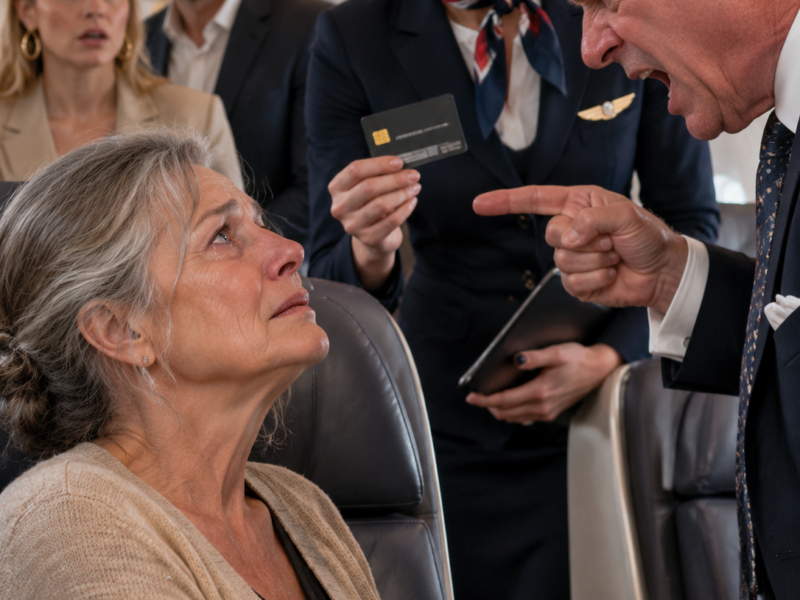
After Six Years of Being Erased by My Own Son, I Boarded a Business-Class Flight and Came Face-to-Face With Him and the Wealthy Father-in-Law Who Had Turned Him Against Me. “Are You Sure You’re in the Right Cabin? Economy Is Back There!” Godwin Sneered, While My Son Sat Silently Beside Him. I Didn’t Argue—I Simply Handed My Boarding Pass to the Flight Attendant. The Moment She Read My Title, Both Men Went Pale, But Neither Knew the Truth I Had Been Carrying for Six Years…
After Six Years of Being Erased by My Own Son, I Boarded a Business-Class Flight and Came Face-to-Face With Him and the Wealthy Father-in-Law Who Had Turned Him Against Me. “Are You Sure You’re in the Right Cabin? Economy Is Back There!” Godwin Sneered, While My Son Sat Silently Beside Him. I Didn’t Argue—I Simply Handed My Boarding Pass to the Flight Attendant. The Moment She Read My Title, Both Men Went Pale, But Neither Knew the Truth I Had Been Carrying for Six Years…
Part 1
Six years after my son cut me out of his life, I found myself standing in the business-class cabin of an airplane, holding a boarding pass while the man who had helped destroy our relationship stared at me with open contempt.
Godwin Pettigrew, my son’s father-in-law, looked me up and down, noticed my modest suit and worn leather shoes, and gave a mocking laugh.
“Are you sure you’re in the right cabin, Junius? Economy class is back there.”
My son, Thurston, sat beside him. He heard every word, yet he said nothing.
I didn’t argue. I didn’t defend myself. I simply handed my boarding pass to the flight attendant.
She scanned it, looked at the name on her screen, and immediately straightened her posture.
“Mr. Osborne, Director of Technical Safety. It’s an honor to welcome you aboard, sir.”
The smile disappeared from Godwin’s face.
My son’s mouth fell open.
But before I tell you what happened on that flight, you need to understand how a father and son who once loved each other could become strangers sitting six feet apart.
Six years earlier, I was fifty-one years old. I had spent twenty-four years working as an aircraft maintenance mechanic in Pennsylvania. My hands were rough, my fingernails rarely stayed clean, and my toolbox was older than my son.
I wasn’t wealthy. I didn’t own a mansion or drive an expensive German car. I lived in a modest house, drove an aging sedan, and took pride in earning everything I had through honest work.
I had also spent years attending evening classes and earning supervisory certifications. I believed that a person’s worth wasn’t measured by the price of his clothes but by the quality of his character.
My wife had passed away four years before the events I’m about to describe. After her death, Thurston became the most important person in my life.
He was twenty-six, handsome, ambitious, and newly married to Zora Pettigrew.
I was genuinely happy for them. I wanted my son to build a beautiful life, even if that life eventually took him far beyond the little house where he had grown up.
What I didn’t understand was how quickly another man would convince him that his father was something to be embarrassed about.
That man was Godwin Pettigrew.
Godwin owned a successful aviation supply company. He had expensive properties, influential friends, and a particular talent for making everyone around him feel that they owed him something.
His daughter, Zora, was a kind woman, and I had hoped her marriage would bring our families closer.
Then came the evening that changed everything.
I drove forty minutes through the Pennsylvania hills to attend dinner at Godwin’s impressive stone colonial home. I brought a bottle of red wine and wore the best suit I owned.
Zora greeted me warmly.
“Mr. Osborne! Come in. We’ve been waiting for you.”
“Please, sweetheart, call me Junius. You’ve been married to my boy for two years. You don’t need to make me sound like a bank manager.”
She laughed and took the wine.
Then Thurston appeared.
“Hey, Dad.”
He gave me a quick pat on the shoulder.
That was all.
I remembered carrying that boy on my shoulders through county fairs, sitting beside his bed when he had a fever, and teaching him how to recognize the sound of a failing engine.
Now he greeted me like an old colleague he had unexpectedly encountered at an airport.
I swallowed the disappointment and followed him inside.
Godwin sat at the head of a long oak dining table. A prime rib roast occupied the center, surrounded by crystal glasses and expensive silverware.
He looked at my suit and smiled.
“Junius! The man of the hour. Is that the suit you wore to the wedding, or does the airline issue those now?”
Everyone laughed.
I smiled politely.
“Same suit, Godwin. It hangs on me better than some of the compliments around this table.”
His smile tightened.
He poured himself wine and continued.
“A man should dress for the life he wants, not for the one he spends flat on his back underneath an airplane.”
Thurston laughed louder than anyone.
I looked at my plate.
For a moment, I wondered when my son had started believing that humiliating his father was an acceptable way to impress another man.
Dinner continued until Godwin noticed a metallic rattling sound coming from a ventilation grille near the sideboard.
He looked at me.
“Junius, you’re handy with machines. Would you mind taking a look? The repair company wants two hundred dollars just to inspect it.”
Zora immediately objected.
“Daddy, he’s our guest.”
“He’s family,” Godwin replied. “Family helps family. Isn’t that right, Thurston?”
My son stared at his plate.
I could have refused. Instead, I pulled out a chair, climbed up, and tightened the loose screw.
“There you go. Nothing serious.”
Godwin applauded twice.
“Ladies and gentlemen, the man has earned his dinner!”
More laughter followed.
I sat down, pressing my trembling hands against my thighs.
Then I finally spoke.
“Those hands have kept a roof over my son’s head and food in his stomach for twenty-six years. I’m not ashamed of them.”
Thurston slammed his fork against his plate.
“Dad! Don’t embarrass me in front of my wife’s family anymore!”
The words hurt more than anything Godwin had said that evening.
I looked directly at my son.
“You’ve made yourself clear.”
After dinner, we moved into Godwin’s study for coffee and brandy.
I had been waiting for that moment all evening.
Inside my jacket was a small velvet box. I took it out and placed it in front of Thurston.
“I brought you something, son.”
He opened it.
Inside was his mother’s old wristwatch.
It was gold, but years of use had softened its shine. The leather strap was worn, and the little second hand continued moving faithfully.
“Your mother wore this every day,” I explained. “She wound it every morning before breakfast. She used to say a watch was a promise you made to the day.”
Thurston picked it up.
For a brief moment, I saw the little boy I remembered.
“That’s Mom’s watch,” he whispered.
“Every picture of her has that thing on her wrist,” I said. “She even used it to time your contractions when you were born. Between every pain, she kept checking the dial and telling me exactly when to get the car ready.”
He smiled.
“That’s exactly what she would do.”
I thought the moment might finally bring us closer.
Then Godwin opened another velvet box.
Inside was a magnificent Swiss watch worth fourteen thousand dollars.
“Fourteen thousand,” he announced. “Sapphire crystal, excellent movement. A man in your position needs something that makes an impression.”
He placed it beside my wife’s watch.
“Try it on, son.”
Thurston looked at the expensive watch, then at the old one.
Within seconds, he had put his mother’s gift into his pocket and fastened Godwin’s watch around his wrist.
“Look at this, Dad! Feel how heavy it is!”
I forced a smile.
“It suits you, son.”
But something inside me had broken.
A father can spend years raising a child, yet his heart will still celebrate when that child smiles, even if the smile is directed at someone who has just humiliated him.
I left that house carrying an empty velvet box.
The following Tuesday, Thurston called me with exciting news.
“Godwin offered me a position at Pettigrew Aviation Supply! Ninety-five thousand dollars a year, bonuses, and a company car!”
I congratulated him, but I asked one question.
“What’s the catch?”
His excitement immediately disappeared.
“Why can’t you just be happy for me, Dad? Godwin believes in me. He sees my potential.”
I apologized and told him I was proud.
He started the following Monday.
At first, everything seemed wonderful. He received an impressive office, a leased SUV, and a senior management position. Godwin introduced him to influential people and praised him as the future of the company.
But the more successful Thurston became, the less time he had for me.
Sunday visits became occasional telephone calls. Then those calls became shorter.
Whenever I asked about his work, he repeated Godwin’s philosophy.
“A man is known by the rooms he walks into, Dad.”
I once asked him what room he thought I belonged in.
He changed the subject.
Still, I never stopped loving him.
Then, one Thursday evening, he arrived at my house carrying a folder filled with technical documents.
“Dad, I need your eyes on something. Twenty minutes. That’s all.”
I welcomed him inside and made coffee.
He spread the paperwork across my kitchen table.
The documents concerned a shipment of aircraft hydraulic components scheduled for delivery to a regional airline.
At first glance, everything appeared routine.
But after examining several pages, I noticed something seriously wrong.
“Thurston, where’s the manufacturer’s certificate of conformance?”
He looked uncomfortable.
“That’s all the supplier sent.”
“And the complete traceability records?”
“They’re trying to locate those.”
I removed my glasses.
“Then you cannot release this shipment.”
He rubbed his forehead.
“Godwin promised the carrier everything would be ready Friday.”
“An airplane part isn’t a piece of furniture, son. Every component must have a verifiable history. If something fails at thirty thousand feet, nobody will care how expensive your office was. They’ll examine the paperwork, and your signature will be on the release.”
He sat down heavily.
“What am I supposed to do?”
I opened my laptop and wrote a short professional email recommending that the shipment be held until all missing documentation could be verified.
No accusations. No personal comments. Just facts.
He read it twice.
“Thanks, Dad.”
Before leaving, he hugged me.
It was the first genuine hug I had received from him in months.
I stood in the doorway smiling long after his car disappeared.
I thought perhaps I was getting my son back.
I couldn’t have been more wrong.
The shipment was delayed by a week. Godwin was furious. He publicly humiliated Thurston during a management meeting, mocking the fact that his father, an ordinary mechanic, had advised him to challenge company operations.
Then Godwin did something far worse.
He took my original email, inserted three fabricated sentences into the middle, and created an altered screenshot.
The added sentences made it appear that I had deliberately tried to sabotage the company to humiliate Godwin.
He sent that screenshot to my son.
And my son believed him.
Part 2
That Sunday, Thurston stormed into my kitchen with the forged document.
“Read what you wrote, Dad!”
I immediately recognized the two paragraphs I had sent him. But between them were three sentences I had never written.
“Son, that’s been altered. Let me show you the original.”
He refused.
“You’re just a mechanic! What right do you have interfering in my career?”
He walked out, leaving the forged document on my floor.
I tried calling him the next morning. He blocked my number.
Then came a message: “Do not contact me again. We’re done.”
I wrote him a long letter, enclosed the original email, and mailed it.
I never knew that the letter would arrive at his house only to be hidden in a drawer by Zora, following her father’s instructions.
For six years, I believed my son had read my explanation and rejected me.
I had no idea that the truth was still sitting unopened in his own home.
Part 3
After Thurston disappeared from my life, I discovered that a man could remain alive while feeling as though an essential part of him had been buried.
I still went to work every morning. I still repaired aircraft components, checked inspection records, and drank black coffee from the same old thermos.
But my house became unbearably quiet.
The bedroom where Thurston had grown up remained untouched. His childhood model airplanes still hung from fishing line above the bed. Sometimes, when I opened the door, they moved gently in the draft, as if someone had just walked past.
I told myself I had to respect his decision.
A father who keeps forcing himself into his adult child’s life is not protecting the relationship. He is trying to control it.
So I stopped calling.
I also stopped visiting his house.
But I never stopped waiting.
On his birthday, I bought a card. I wrote a few sentences, addressed the envelope, and placed a stamp in the corner.
Then I stared at it for nearly an hour.
I couldn’t bring myself to send it.
If he had read my letter and decided he never wanted to hear from me again, another card might only feel like an intrusion.
I removed the stamp and placed the card inside a shoebox in my closet.
The following year, I did the same thing.
And the year after that.
Eventually, the box contained six birthday cards that had never reached my son.
Work became my refuge.
One winter, a hydraulic pump arrived at our maintenance facility with a discrepancy between its physical identification tag and its accompanying records.
The serial numbers didn’t match.
Most people would have called it a clerical mistake. I saw something more serious.
A component’s paperwork was its biography. It documented where it had been manufactured, who had inspected it, which facilities had handled it, and whether every stage of its journey could be verified.
Without that history, a perfectly good component could become impossible to approve.
I remembered the shipment that had caused my son to turn against me.
I remembered the missing certificates, the incomplete records, and the forged accusations.
I decided I would never allow another young employee to be trapped in the same situation.
For six weeks, I reviewed two years of maintenance records. I discovered that nearly one in thirty folders contained some kind of discrepancy.
My proposal was simple.
Every critical component record would be checked twice by two different employees against the physical identification tag before entering the system.
No exceptions.
The department manager initially complained that it would increase labor costs.
I answered, “It might increase the time required to inspect a component, but it could prevent an accident. I’ll take that trade every time.”
They approved a ninety-day trial.
The results were remarkable.
Errors nearly disappeared. Other maintenance bases requested copies of my procedure, and eventually the verification system became part of the airline’s official maintenance program.
My name appeared at the bottom of the manual.
It wasn’t a large achievement in the eyes of the public, but it mattered to the people who worked around aircraft.
I was promoted to quality supervisor.
Later, I became technical manager responsible for records and compliance.
My responsibilities expanded, and I began training flight crews and cabin attendants in safety procedures.
I enjoyed those training sessions.
I taught young attendants that a checklist wasn’t an insult to their intelligence.
“A checklist is what respect looks like when it’s written down,” I would tell them. “You check the door that has never failed because the one time it fails will not send you a calendar invitation.”
They laughed, but they remembered.
One young attendant named Susannah Blackstone particularly impressed me.
She asked questions, took careful notes, and seemed genuinely interested in understanding why every procedure mattered.
At the end of one training session, she approached me.
“Mr. Osborne, I think I’ll remember what you said for the rest of my career.”
I smiled.
“Then make sure you use it when nobody is watching. That’s when it matters most.”
I had no idea that I would meet her again years later.
Meanwhile, Thurston’s career continued progressing.
He became a senior operations manager at Pettigrew Aviation Supply. Godwin gave him increasingly important responsibilities, but the promised promotion to vice president never arrived.
Every time Thurston asked about it, Godwin offered another excuse.
“After the next contract.”
“Once we’ve expanded the warehouse.”
“After Washington.”
My son was becoming successful on paper, but he was increasingly dependent on the approval of a man who never intended to give him complete independence.
I didn’t know any of that at the time.
All I knew was that my son was absent.
By the fifth year of our separation, the airline offered me the position I had spent most of my working life pursuing.
Director of Technical Safety.
I was responsible for overseeing safety standards across the operation.
The promotion came with a substantial salary increase and a much larger office.
But I kept my old sedan.
I kept my lunch pail.
And I continued walking through the maintenance hangar whenever I could.
A title doesn’t change the fact that an airplane needs honest hands.
Then something unexpected happened.
The airline began migrating decades of archived departmental records into a new digital system.
My old emails were among the documents being recovered.
One Sunday evening, my longtime friend and colleague, Thurlow Fennell, called.
“Junius, put the coffee on. I’m coming over.”
His voice sounded unusual.
When he arrived, he carried two documents.
One was the forged printout Thurston had left on my kitchen floor six years earlier.
The other was the original email recovered from the company’s archive.
He placed them side by side.
“Read them,” he said.
I put on my glasses.
The first two paragraphs were identical.
But the original contained no additional sentences.
There was no mention of sabotaging Godwin. No desire to humiliate anyone. No reference to blood or revenge.
The forged version had been altered.
Thurlow pointed to the digital information attached to the archived original.
“Look at the metadata, Junius. The date, the time, the server history. It’s all intact.”
I stared at the documents.
For six years, I had believed my son had rejected the truth after reading my explanation.
But now I understood something devastating.
He had never actually seen the truth.
My letter had been mailed to his home, but the forged screenshot had been the only version of my email he had ever received.
I sat silently.
Thurlow placed a hand on my shoulder.
“Maybe now you can tell him.”
I shook my head.
“Not like this.”
He looked surprised.
“What do you mean?”
“I mean I’m not going to send him a document like a weapon. If he ever comes asking, I’ll show him everything. But I won’t chase him with evidence.”
We contacted an attorney named Luther Fallbrook.
He examined both documents and confirmed that the original could be preserved with its complete digital history.
He instructed us not to alter, forward, or circulate the archived evidence.
“We keep the original untouched,” he explained. “If the truth ever needs to be established, the record will speak for itself.”
I agreed.
I placed the documents in a secure file.
Then I added one more piece of paper.
It was a magazine article about Godwin Pettigrew.
The headline described him as a businessman who had built an aviation empire from nothing.
In the article, Godwin had praised Thurston while making a remark that made my stomach turn.
“The boy’s father gave him a wrench. I gave him a future.”
I cut out the page and placed it in the folder.
The truth, the lie, and the public version of the story.
All together.
I returned to work.
By the sixth year of our estrangement, my career had reached a point I never imagined when I first entered the hangar as a young mechanic.
The airline had asked me to deliver the keynote address at an aviation safety summit in Washington.
The conference would bring together airline executives, suppliers, technical managers, and senior safety personnel from across the industry.
My presentation concerned the verification standard I had developed.
I was proud of it.
But I had no idea that Thurston would be attending the same conference.
He was preparing to present a major supplier proposal on behalf of Godwin’s company.
Godwin had promised that once they returned from Washington, he would finally sign Thurston’s long-delayed promotion to vice president.
My son was thirty-two now.
He had spent six years believing that his father was a bitter mechanic who had tried to sabotage his future.
He had also spent six years trying to earn the approval of a man who had deliberately created that belief.
The evening before the conference, Thurston stood in Godwin’s office presenting his proposal.
Godwin listened carefully.
“Excellent work, son. Truly. The student surpasses the teacher.”
Thurston smiled.
“So I can present it to the carrier?”
“Of course. Washington first. You impress everyone there, and when we return, we sign everything.”
Godwin patted his shoulder.
“Just remember who gave you everything you have.”
Thurston smiled again, but something inside him had begun to change.
For the first time in six years, he thought about calling me.
He even opened his contact list and found the number he had blocked.
His thumb hovered over my name.
Then he put the phone away.
He wasn’t ready.
The following morning, Godwin, Thurston, and a business partner named Abner Chadwick arrived at the airport.
Godwin treated Thurston like an assistant rather than an executive.
He ordered him to carry his briefcase, collect the travel documents, and arrange transportation.
Abner eventually intervened.
“Godwin, the boy is an executive, not your valet.”
Godwin laughed.
“Family serves family.”
Thurston lowered his eyes.
“That’s right.”
He had repeated that sentence so many times that he no longer realized how much of himself he had surrendered.
Meanwhile, I was sitting at another gate, reviewing my keynote presentation.
The airline had arranged business-class seating for me as a courtesy to the keynote speaker.
I was wearing a burgundy tie Thurlow had insisted I bring.
I had no idea that the same flight would carry my son and the man who had separated us.
When the boarding announcement came, I gathered my folder and joined the line.
I was tired but calm.
My hands were steady.
And somewhere in the same airport, my son was carrying a briefcase that didn’t belong to him, preparing to board the same airplane.
Part 4
Godwin boarded first, followed by Thurston and Abner.
The business-class cabin was spacious, with wide leather seats and a quiet atmosphere.
Godwin looked around approvingly.
“At least this is how business travel should be done.”
He settled into his seat and instructed Thurston to arrange his briefcase.
Then he complained about the service, the cabin temperature, and the lack of immediate attention from the flight attendants.
At the aircraft door stood Susannah Blackstone.
She was no longer the young attendant who had attended my training session years earlier. She was now a senior flight attendant, trusted with managing the forward cabin.
She greeted the passengers professionally.
She remembered my lessons, but she didn’t yet know that I would be boarding her flight.
After Godwin settled into his seat, Thurston noticed a father and his teenage son walking down the aisle.
The boy was carrying their bags.
He placed his father’s duffel in the overhead compartment and asked whether he wanted the window or aisle seat.
“Window, champ,” the older man replied. “Somebody has to watch the wing for your mother.”
Thurston watched them disappear behind the curtain.
Something about the simple exchange disturbed him.
He remembered when I used to take him to airports as a child and explain how airplanes worked.
He remembered sitting beside me in my old sedan, asking questions about engines.
He remembered the sound of my voice.
Then Godwin interrupted his thoughts.
“Careful with that schedule, boy. Paper tears.”
Thurston looked down.
His hands had been gripping the conference folder so tightly that its corner was bent.
A few minutes later, I entered the aircraft.
I was near the end of the boarding line, carrying my keynote folder and boarding pass.
The jet bridge smelled of fuel and warm carpet.
Susannah stood at the entrance with her scanner.
When she looked up, her professional smile suddenly changed.
She recognized me.
“Mr. Osborne!”
I smiled.
“Good morning, Susannah.”
She scanned my boarding pass.
Then she straightened her shoulders.
“Mr. Osborne, Director of Technical Safety. It’s an honor to welcome you aboard, sir.”
Her voice carried through the cabin.
Antonia Harrington, the senior purser, appeared from the forward galley.
“Mr. Osborne, we’ve double-checked everything according to your standards.”
“Then I’m among friends,” I replied.
I noticed several passengers looking in my direction.
Then I saw him.
Thurston.
He was sitting beside Godwin.
For a moment, the entire airplane seemed to disappear.
My son was older than I remembered. His face had changed, and there were lines around his eyes that I had not been present to watch develop.
But I recognized him immediately.
Godwin saw me next.
His expression changed from confusion to disbelief, then quickly settled into the familiar look of contempt.
He examined my suit.
“Well, well. Are you sure you’re sitting in the right cabin, Junius? Economy is back that way!”
I heard Thurston inhale sharply.
He didn’t defend me.
He didn’t even look directly at me.
I simply thanked Susannah and walked to my assigned seat, which was directly across the aisle from my son.
I placed my folder in the seat pocket and fastened my belt.
I didn’t want a scene.
I had not spent six years rebuilding my life so I could use one airplane journey to humiliate another man.
But Godwin was determined to make the moment about himself.
Once the aircraft was airborne, he began explaining my position to Thurston.
“Don’t let the pageantry fool you, son. Airlines love giving old employees impressive titles. Director of this, manager of that. It doesn’t necessarily mean much.”
Thurston looked uncomfortable.
“People can hear you, Godwin.”
“Let them. The man’s a functionary with a grand letterhead. I’ve bought and sold companies that employ hundreds of men like him.”
Thurston finally said something.
“That’s my father.”
Godwin turned toward him.
“Is it? I thought we had established a different arrangement six years ago.”
I slowly closed my folder.
Then I stood.
I looked directly at my son.
“Six years ago, you were the one who told me never to contact you again.”
Thurston’s expression collapsed.
“I respected your decision every day since then,” I continued. “I’m not breaking that promise now. We happen to be on the same airplane. That’s all.”
I sat down again.
My hands shook briefly, but I pressed them against my folder.
Abner Chadwick, sitting across the aisle, finally spoke.
“That was a father’s voice, Godwin. I’d give anything to hear mine correct me one more time.”
Godwin ignored him.
When Susannah returned with drinks, Godwin attempted another tactic.
He quietly suggested that my title was merely honorary and that she should correct her earlier introduction if anyone asked.
Susannah remained perfectly composed.
“Sir, I don’t correct true things. Mr. Osborne’s name is on the safety program I was trained under. His standards are followed by crews throughout this airline.”
She placed his drink on the tray.
“Your scotch is exactly as requested.”
Then she walked away.
Godwin’s smile remained on his face, but his confidence had begun to disappear.
Thurston took out his phone.
He opened his photographs and searched through six years of memories until he found the screenshot that had destroyed our relationship.
He stared at it.
Then he looked toward me.
After a long hesitation, he stood and approached my row.
“Dad?”
I turned.
“Can I sit with you for a minute?”
I moved my folder.
“You’ve had a seat near me your whole life, son. Sit.”
He lowered himself into the aisle seat.
His hands were trembling.
“The email. The one about the shipment. Can you show me what you actually sent?”
I took out my phone.
I opened my Sent folder and found the original message.
I handed it to him.
He read it slowly.
Two paragraphs.
The missing documentation. The batch numbers. The recommendation to hold the shipment until the records were complete.
Nothing else.
He scrolled down.
Then scrolled again.
“That’s all?”
“That’s all there ever was.”
He looked at the screenshot on his own phone.
Three additional sentences appeared between the original paragraphs.
They described a deliberate plan to damage Godwin’s business and embarrass him publicly.
Thurston’s eyes filled.
“The picture has three more sentences.”
“I know.”
“You never wrote those?”
“No, son.”
He stared at the two screens.
For six years, he had believed a photograph was proof.
Now he was looking at the actual message, preserved in its original email account, with the date and history intact.
He began to cry.
“You were trying to protect me.”
I looked at him.
“I was trying to make sure you never signed your name to something that couldn’t be verified.”
He covered his face.
“I thought you were trying to destroy everything I had.”
“I tried to explain. You wouldn’t listen.”
He lowered his head onto the armrest.
I placed my hand gently on the back of his head, just as I had done when he was a little boy with a fever.
For a moment, I forgot that we were thirty thousand feet above the ground.
I forgot about the expensive cabin and the people around us.
All I could see was my son.
Then he whispered something that changed the entire conversation.
“The letter. You wrote me a letter, didn’t you?”
“Yes. I mailed it to your house. I included a printed copy of the original email.”
He looked up.
“I never received it, Dad. I swear. I never saw it.”
I stared at him.
“Then someone read it for you, or someone buried it for you.”
At that exact moment, Godwin appeared beside us.
“Thurston, come along. Abner is waiting.”
He noticed our phones.
His expression tightened.
“Whatever this is, it can wait until we land.”
Thurston returned to his seat.
But on the way, he noticed Godwin typing a message on his phone.
He glanced at the screen.
It read:
“Verena, quietly pull everything there is on Junius Osborne. Full background. Credit, properties, anything with a handle on it. Before we land.”
Thurston stopped.
He suddenly understood that Godwin wasn’t merely trying to protect his business.
He was trying to investigate the man he had spent six years describing as irrelevant.
Ten minutes later, Thurston returned to my seat.
This time he didn’t ask permission to sit.
He knelt in the narrow aisle and held out his phone.
“Put yours beside mine, Dad. Please. I need to see them together.”
I did.
The two documents appeared side by side.
On one screen was my original email.
On the other was Godwin’s altered version.
Thurston examined every line.
He recognized the exact place where the additional sentences had been inserted.
His shoulders began shaking.
“You were telling the truth the entire time.”
I nodded.
“I was.”
He pressed his forehead against the armrest.
Then he asked about the letter again.
I told him I had mailed it.
He repeated that he had never seen it.
For the first time, we both understood that something much bigger had happened inside the house he shared with Zora.
Godwin approached again, attempting to dismiss the evidence.
“Anyone can create a fresh email after six years. Screenshots don’t lie.”
I looked at him.
“The original has been preserved with its complete metadata by my attorney, Luther Fallbrook. The digital history is intact. Any qualified investigator can examine it through the proper channels.”
Godwin’s fingers tightened around his newspaper.
Thurston looked at him.
“Where did you get the screenshot you sent me?”
Godwin smiled.
“I told you what I believed was true.”
“Based on what?”
Godwin didn’t answer.
Instead, he reminded Thurston about the promised promotion.
“Washington first, son. When we land, everything gets signed.”
Thurston returned to his seat, but something had changed.
He no longer looked at Godwin the same way.
When we arrived in Washington, the first sign of trouble appeared at the hotel reception desk.
Thurston presented the company travel card.
The clerk looked at the screen and hesitated.
“I’m sorry, sir. This card appears to have been canceled.”
Thurston’s face reddened.
He calmly paid with his personal card and requested two copies of the receipt.
Godwin watched him.
Later, in a quiet hotel alcove, Godwin confronted him.
“You’ve had a shock today. Don’t let that man rewrite six years of your life.”
Thurston looked at him.
“And if I listen to the documents instead?”
Godwin’s expression hardened.
“Without me, you’d still be nothing but the son of an airplane mechanic.”
Thurston stood.
“You can take back the job. But you cannot make me believe a lie.”
He walked away.
And for the first time in six years, he unblocked my number.
That evening, he came to my hotel room.
He asked for Thurlow’s telephone number.
“I need to hear the truth from someone who isn’t you and isn’t Godwin.”
I gave it to him.
Thurlow explained everything: the archived email, the original metadata, the preserved records, and the attorney who had verified the documents.
Then Thurston asked the question that had been destroying him since the airplane.
“Did my father ever try to use that evidence against Godwin? Even once?”
Thurlow paused.
“Son, your father kept that evidence for five years. He never used it to hurt anyone. He wanted it preserved for the day you came asking. He waited for you.”
Thurston covered his face.
Meanwhile, Godwin had begun making his own calls.
He contacted Thurlow that night and suggested that his professional relationships could suffer if he remembered the old email too clearly.
Thurlow immediately documented the conversation and sent it to the attorney.
Godwin had just created another piece of evidence against himself.
The following morning, I delivered my keynote presentation.
My son sat in the third row.
I spoke about safety, accountability, and the importance of checking records before trusting them.
Near the end, I said something I had learned through both my profession and my personal life.
“Courage is the most expensive component in any system. Build the system so nobody has to buy it retail.”
The room rose in applause.
I looked toward the third row.
Thurston was standing.
He was clapping with tears running down his face.
Godwin remained seated for several seconds before offering four reluctant claps.
After the presentation, Thurston approached me.
“I’m going home tonight, Dad. There’s a letter in my house that I apparently never saw. I need to ask Zora about it.”
I nodded.
“Ask her plainly, son. Give her the chance to answer honestly.”
He left Washington that evening.
And for the first time in six years, my son was finally going home to discover the truth.
Part 5
When Thurston arrived home, Zora was waiting in the kitchen.
She had received a telephone call from her father earlier that day.
Godwin had instructed her to delete some old messages and get rid of an envelope hidden in their house.
But this time, Zora didn’t obey.
She had spent six years carrying a secret she knew was wrong.
When Thurston entered, he asked one question.
“Zora, did a letter from my father ever arrive at this house?”
She looked at him.
Then she began crying.
“Yes.”
He stood perfectly still.
“What?”
“Your father sent you a letter. Six years ago. It arrived in the mail. Your father handed it to me, and I put it in the drawer.”
Thurston sat down.
“Why?”
Zora explained everything.
Her father had been visiting their house that Saturday when the envelope arrived.
He took it from her hands and told her it was probably a desperate request for money.
He said I was trying to interfere with their marriage and destroy the peace they had finally achieved.
He told her not to show it to Thurston.
“He said you were finally becoming successful,” Zora whispered. “He told me that reading the letter would only reopen an old wound.”
Thurston looked at her.
“And you believed him?”
Zora lowered her eyes.
“I was afraid of him. He had helped us buy the house. He had given you the job. I thought if I disobeyed him, everything would fall apart.”
“Did you ever open it?”
“No.”
“Did you ever tell me?”
“No.”
She wiped her face.
“I knew it was wrong. I knew it was your father’s handwriting. I knew the envelope was addressed to you. But I put it away, and every year I became more afraid to bring it up.”
Then she added something that made Thurston understand how deeply Godwin had controlled their lives.
“I kept his messages. I still have the texts where he told me to hide the letter.”
Zora went to the study and opened the narrow drawer where they kept their tax documents.
Behind several old folders lay an envelope.
It was soft at the corners, but it remained sealed.
My handwriting was still visible.
OSBORNE.
Thurston picked it up.
He didn’t open it immediately.
“Some paper,” he said quietly, “you read with witnesses.”
Zora photographed the envelope and every old message from her father. She sent copies to her aunt Geraldine in Ohio for safekeeping.
Then they agreed to visit Godwin the following morning.
They arrived at the stone colonial with the envelope, the original email, the forged screenshot, and copies of the messages.
Godwin received them in his study.
He smiled as though nothing had happened.
“Well, the travelers have returned. Sit down. Whatever happened in Washington, we can put it behind us.”
Thurston placed a folder on the desk.
“We’re not here to discuss Washington. We’re here to discuss the truth.”
He arranged the documents in order.
First came the altered screenshot.
Then the original email.
Next came the archived record preserved by Luther Fallbrook.
Finally, he placed the unopened envelope on top.
“Open it,” he told Zora.
She carefully broke the seal.
Inside was my letter.
It was four pages long.
I had written that I was sorry for any harsh words I had spoken at dinner. I explained that the email included with the letter was the true and complete version of what I had sent.
I had not asked for money.
I had not asked for a job.
I had not asked anyone to punish Godwin.
I had simply asked my son to compare the original message with the screenshot and judge the truth for himself.
The final paragraph read:
“If you read nothing else I ever gave you, read the last page and let your own eyes decide. The porch light is on, son. It will always be on. You never need an invitation to come home.”
Zora finished reading.
Her voice broke.
She looked at her father.
“A begging letter, Daddy? That’s what you called it. He begged for one thing. He begged to be heard.”
Godwin leaned back.
“Ancient history. You two are being emotional.”
Thurston placed his hands on the desk.
“You inserted sentences into another man’s email and sent them to me under his name. Then you convinced my wife to hide his letter.”
Godwin stood.
“Everything you have is because of me! Your job, your house, your lifestyle! I can take it all away with one telephone call!”
Then his voice softened.
“Listen, son. Come back Monday. The vice presidency will be signed. I’ll increase your salary. We’ll forget this entire misunderstanding.”
Thurston stared at him.
“Put it in writing.”
Godwin blinked.
“What?”
“The promotion. The salary. Everything. Put it in writing and sign it.”
“You don’t ask your family for paperwork!”
Thurston slowly gathered the documents.
“That’s exactly what you taught me never to do. And it’s the most expensive lesson I’ve ever learned.”
Zora stood beside her husband.
“You don’t get to reach into my marriage anymore, Daddy. Not through me. Not ever again.”
They walked out.
Godwin remained standing in his study, unable to understand why the two people he had controlled for years were suddenly leaving without asking permission.
In the weeks that followed, Thurston began rebuilding his life.
He hired an attorney named Emmeline Windham to help him handle the situation professionally.
She reviewed the evidence and advised him not to turn the matter into a public spectacle.
“You don’t need revenge,” she told him. “You need an exit. Preserve the documents, protect yourself, and build a life that doesn’t depend on this man.”
Thurston resigned from Pettigrew Aviation Supply.
He also began searching for another position.
It wasn’t easy.
Godwin had connections throughout the industry, and rumors began circulating that Thurston was difficult to work with.
Two opportunities disappeared before he could accept them.
But eventually, a regional aviation services company offered him a position.
The salary was lower.
The office was smaller.
There was no company SUV or expensive executive lifestyle.
But the job was his.
Nobody demanded that he carry another man’s briefcase.
Nobody reminded him that he owed his career to someone else’s generosity.
He accepted.
Before leaving Pettigrew Aviation Supply, he returned the fourteen-thousand-dollar Swiss watch.
He carefully cleaned it, wrapped it, and placed a note inside the package.
“Godwin, this was never a gift. It was a price. I wore the receipt for six years, and I’m finished wearing it. The seat at your table that came with it is returned as well. Do not replace either.”
He mailed it with tracking and kept the receipt.
Then he went looking for something else.
His mother’s watch.
It had been lying in a drawer for six years.
He found it beneath some old collar stays and dead batteries.
The little gold watch was scratched, and its hands had stopped.
He took it to a watchmaker, who inspected it and told him it needed only cleaning and winding.
Then Thurston called me.
“Dad, it’s me. I have something of Mom’s, and something I need to say in person. Can I come over?”
I looked toward the kitchen window.
The porch light was on.
“Coffee’s black, son. Come home.”
He arrived that Saturday morning carrying his mother’s watch.
He had no expensive briefcase and no folder full of documents.
For the first time in years, he came to my house with nothing to prove.
We sat at the kitchen table.
He placed the watch between us.
“It’s been in a drawer for six years, Dad.”
I nodded.
“I know.”
He looked at me.
“I need to say something, and I don’t want you to interrupt.”
I waited.
“The dinner at Godwin’s house. The way I laughed when he insulted you. The way I treated your gift. The way I believed a man with money instead of my own father. The way I blocked your number and refused to listen.”
His voice began shaking.
“I made those choices. I don’t want to call them misunderstandings. I chose him. Every day, I chose the man who gave me expensive things over the man who had loved me before I had anything.”
He looked down at his mother’s watch.
“I’m sorry, Dad. I know saying it doesn’t repair six years.”
I reached for the watch.
He pushed it toward me.
“I had it cleaned. The watchmaker said it only needed someone to care whether it ran. Wind it, Dad. Please. I want to hear it running in this house.”
I picked it up.
My fingers recognized it immediately.
I wound the little crown carefully.
The balance began moving.
Then the second hand started ticking.
A familiar sound filled the kitchen.
I smiled through the tears.
“There’s your mother. On time, as usual.”
Thurston covered his face and began crying.
I let him.
When he finally looked up, he asked the question I had imagined hearing for six years.
“Can you forgive me?”
I took a deep breath.
“I can forgive you, son. But I cannot trust you completely yet.”
He nodded.
“That’s fair.”
“Trust isn’t a watch. You don’t wind it once and expect it to run forever. It’s something you build through ordinary days.”
I explained what I needed.
He would call when he said he would call.
He would visit when he promised to visit.
There would be no financial dependence between us.
And if he ever faced another situation where someone demanded that he choose between a wealthy man’s approval and his family’s love, he would make that decision with his eyes open.
“Those aren’t punishments,” I told him. “They’re standards.”
He smiled sadly.
“Checked twice?”
“Every single time.”
The months that followed were not dramatic.
They were ordinary.
And that was exactly what I needed.
Thurston began calling every Thursday evening.
Sometimes we discussed work. Sometimes we talked about the weather, the neighbors, or the old sedan he and Zora had purchased.
He started visiting on Sundays.
He helped me repair the gutters and replace a loose board on the porch.
One afternoon, he climbed a ladder to clean the storm windows.
I stood below holding it.
“You’re the Director of Technical Safety, Dad,” he said. “If you fall, the paperwork will bury us both.”
I laughed.
“That’s my line.”
“It’s a family religion. I’m practicing.”
Zora began visiting too.
She apologized for hiding my letter.
I listened.
I didn’t pretend that everything was suddenly perfect, but I respected that she continued showing up and taking responsibility.
She brought pies, helped with dinner, and eventually became comfortable enough to argue with me about how much gravy belonged on a proper serving of potatoes.
Those small arguments meant more to me than any expensive gift.
Godwin also attempted to return to their lives.
He sent messages about forgiveness and family.
He even offered Thurston a new executive position with a salary far higher than the one he had previously received.
This time, he put everything in writing.
Thurston read the offer twice.
Then he declined it in writing.
He called me afterward.
“He finally signed everything, Dad.”
“And?”
“I declined it. Signed.”
I laughed.
“Good man.”
A few days later, Godwin visited Thurston’s new workplace.
He expected to be welcomed into the building as though he still owned the place.
Instead, the receptionist asked him to sign the visitor log.
Thurston came downstairs and greeted him politely.
“You have two minutes of my break, Godwin. The rest of the day belongs to my employer.”
Godwin began talking about family, loyalty, and forgiveness.
At the two-minute mark, Thurston thanked him for coming and returned to work.
He didn’t shout.
He didn’t threaten.
He simply walked through the security door and let it close behind him.
That was the end of Godwin’s control over my son.
Then came December.
Thurston and Zora arrived at my house on a cold Sunday afternoon.
“We want you to come for Christmas Eve dinner,” Thurston said.
I looked at him.
“Are you sure?”
He nodded.
“Our house. Just us. No audience, no business, no Godwin. Zora’s cooking.”
Zora smiled.
“You only need to bring yourself, Junius. We have everything else.”
I agreed.
That evening, I went to my closet and took out the suit I had worn to Godwin’s dinner six years earlier.
The same suit he had mocked.
It still fit.
I brushed it carefully and hung it near the door.
On Christmas Eve, I drove to my son’s house.
I wore the suit.
My wife’s watch was ticking in my breast pocket.
When I reached the front steps, Thurston opened the door before I could knock.
He had been watching for me.
“You came, Dad.”
“I said I would.”
He laughed and took my coat.
The house smelled of rosemary, roasted meat, and freshly baked bread.
Zora had prepared an enormous dinner.
There were candles on the table, warm plates, and three places set carefully.
No one was trying to impress anyone.
We talked about Thurston’s new job, Zora’s aunt in Ohio, and the old sedan that had recently developed a strange noise.
Thurston carved the roast.
Zora and I argued about gravy.
For the first time in six years, I sat at my son’s table without feeling like an unwanted guest.
Then I remembered something.
I went to my car and returned carrying a shoebox.
It was the same box that had sat in my closet beside my good shoes for six years.
I placed it on the table.
“There’s something I want you to see.”
Thurston opened it.
Inside were six birthday cards.
One for every year we had been separated.
He picked up the most recent one.
“Every year?” he asked.
I nodded.
“I wrote them all. Addressed them. Put stamps on them.”
He looked at me.
“Why didn’t you send them?”
I hesitated.
“Because I thought you had already made your decision. I didn’t want to keep forcing myself into a life where I wasn’t welcome.”
He opened the card.
Inside, my handwriting read:
“Thurston, you are thirty-two years old, and I have not seen your face in six years. I am writing this at the table where I wrote the email. The porch light is on, and it is always on. I am still your father. That is the whole report. When you’re ready, son, check the door that’s never failed.”
He read it once.
Then again.
His voice broke.
Zora placed her hand on his back.
I sat across from him, and for the first time in years, I didn’t try to hide my tears.
My son reached across the table.
“Dad, I wish I had known.”
I held his hand.
“We can’t change what happened. But we can decide what happens tomorrow.”
He nodded.
Then he looked toward the empty chair at the end of the table.
“Sometimes I still wish Godwin could see this. I want him to understand what he destroyed.”
I thought about the expensive house, the fourteen-thousand-dollar watch, the cruel jokes, and the years we had lost.
Then I looked at my son.
“Listen to me, Thurston. I don’t need that man to bow his head. I don’t need him to admit that he was wrong. I don’t even need him to understand what he lost.”
I squeezed his hand.
“I only need you to understand that the person who truly loves you isn’t necessarily the person with the most money. The man who gives you an expensive watch isn’t automatically the man who cares about your time.”
Thurston looked at his mother’s watch beside my plate.
“I understand now, Dad.”
Outside, snow began falling over Pennsylvania.
The porch light shone through the window.
My wife’s watch continued ticking.
And my son was sitting across from me.
Six years earlier, I had left a wealthy man’s dining room with an empty velvet box and a broken heart.
That Christmas Eve, I sat at my son’s table wearing the same suit, with my wife’s watch beside my plate and my family gathered around me.
I had not taken anyone’s fortune.
I had not destroyed anyone’s company.
I had not needed a public victory.
The truth had finally reached the people who needed to hear it.
And the greatest revenge I could ever have imagined was watching my son open the front door and smile because he knew his father had come home.
There is something I learned during those six years.
Records can prove what happened, but they cannot do the loving for you.
I kept the original email. I preserved the forged screenshot. I documented everything.
Those records eventually opened the door.
But what brought my son back were the ordinary things that followed.
A telephone call on Thursday.
A visit on Sunday.
A repaired porch step.
A shared meal.
A birthday card finally delivered.
Trust is not rebuilt through one grand apology. It is rebuilt through small promises kept over and over again.
So if there is someone you love but haven’t spoken to in years, don’t let pride become the permanent owner of that silence.
Sometimes the person who hurt you needs to take the first step.
Sometimes you do.
But never confuse someone’s financial success with their character, and never allow another person to convince you that honest work makes you less valuable.
I spent twenty-four years repairing airplanes.
Godwin Pettigrew spent his life purchasing things he believed would make people respect him.
In the end, I discovered that a man’s greatest achievement isn’t the title printed on his business card.
It’s knowing that someone will be watching the road for his car, waiting for him to arrive, and keeping the porch light on.
That Christmas Eve, I finally understood what my wife had meant when she used to say that a watch was a promise you made to the day.
The watch was still ticking.
My son was home.
And tomorrow, we would begin another ordinary day together.
This time, we would check everything twice.
THE END