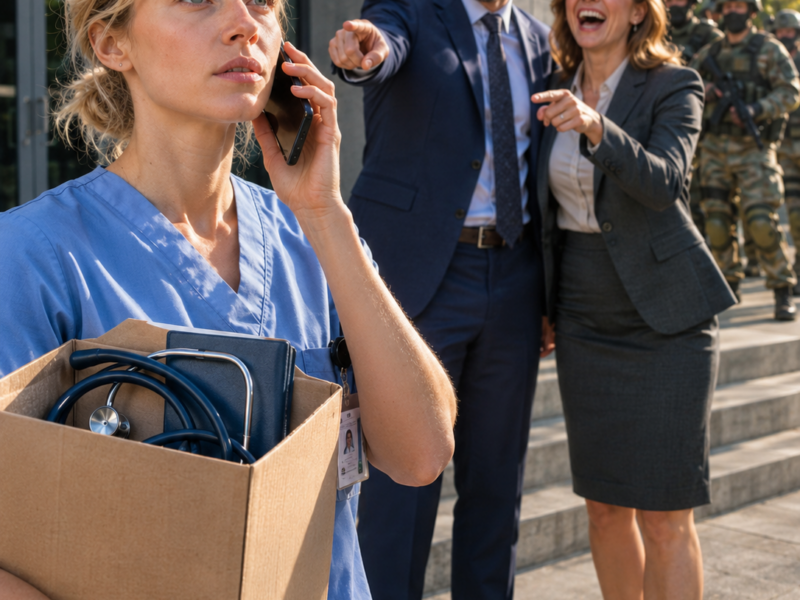
After Six Weeks as a Safety Nurse at a Military Defense Factory, I Was Fired in Front of 40 Employees for Reporting Dangerous Equipment Failures. My Boss Sneered, “A Band-Aid Nurse Doesn’t Get to Question Engineers,” and Nobody Defended Me. I Quietly Walked to My Car, Pulled Out a Secret Phone, and Said Six Words: “Fire Every One of Them. Now.” Minutes Later, Three Black SUVs Stormed Through the Gates, and My Boss Turned Pale When He Saw Who Was Coming to Meet Me…
After Six Weeks as a Safety Nurse at a Military Defense Factory, I Was Fired in Front of 40 Employees for Reporting Dangerous Equipment Failures. My Boss Sneered, “A Band-Aid Nurse Doesn’t Get to Question Engineers,” and Nobody Defended Me. I Quietly Walked to My Car, Pulled Out a Secret Phone, and Said Six Words: “Fire Every One of Them. Now.” Minutes Later, Three Black SUVs Stormed Through the Gates, and My Boss Turned Pale When He Saw Who Was Coming to Meet Me…
PART 1
The morning Gary Kessler fired me in front of forty employees, he had absolutely no idea that I was carrying enough evidence in my pocket to destroy his career, expose a multimillion-dollar defense scandal, and reopen an investigation the United States Navy had buried five years earlier.
He pointed directly at me during the safety briefing and announced, “This woman has been fabricating safety incidents to justify her own position.”
Nobody said a word.
Then he smiled and added, “A Band-Aid nurse has no business questioning engineers who actually understand how this equipment works.”
I stood there, holding my small black notebook, while forty people stared at the floor.
What Gary didn’t know was that I had spent six weeks documenting everything happening inside his facility.
And what he definitely didn’t know was that the man waiting for my phone call had four stars on his uniform.
My name is Emma Carter. I’m thirty-seven years old, and for most of my adult life, I’ve made a career out of being the person nobody notices until something goes terribly wrong.
Six weeks earlier, I had walked through the security gates of Halcyon Defense Systems carrying a lunch bag, a nursing certificate, and an employment file that made me look painfully ordinary.
Halcyon occupied a sprawling industrial complex outside the city, surrounded by reinforced fencing, surveillance cameras, and security guards who checked identification twice before allowing anyone inside.
The company manufactured specialized components for military communications systems. Everything about the facility suggested importance, from the armored delivery trucks to the enormous American flag hanging above the main production floor.
But underneath that impressive appearance was something far more dangerous.
A secret that had already cost four people their lives.
And I had come to uncover it.
My official position was on-site safety nurse and first-aid coordinator. I treated minor injuries, checked emergency equipment, updated medical records, and reminded workers to wear protective gear.
Nobody considered me important.
The engineers barely acknowledged my presence. Supervisors treated my office like an inconvenient supply closet. Management remembered my name only when someone needed a signature on an incident report.
That suited me perfectly.
Because while everyone assumed I was checking bandages and organizing medical supplies, I was quietly recording machine numbers, equipment malfunctions, altered safety reports, and conversations that certain executives believed nobody was listening to.
Every evening, I returned to my small apartment and reviewed the observations written inside a black notebook.
I never entered those details into Halcyon’s computer system.
I knew what happened to evidence stored on computers controlled by people with something to hide.
I’d learned that lesson five years earlier.
During my second week, I met a young technician named Danny Ruiz.
Danny was twenty-six, worked twelve-hour shifts, and seemed permanently worried about disappointing someone.
The first time he came into my office, he had a friction burn on his right forearm.
“It’s nothing,” he insisted. “I probably shouldn’t even be bothering you.”
I examined his arm.
“You’re not bothering me, Danny. Treating injured workers is literally why they hired me.”
He laughed nervously.
“Yeah, but Mr. Henley doesn’t like us reporting stuff. Says it makes the department look bad.”
My hands paused for half a second.
“Mr. Henley?”
“Craig Henley. Floor supervisor.”
I continued cleaning his burn.
“Does he tell everyone that?”
Danny shrugged.
“Pretty much. He says most incidents are operator mistakes anyway.”
Operator mistakes.
Two ordinary words that made something cold move through my chest.
I had heard that explanation before.
Five years earlier, those words had appeared in a report about the deaths of four people I loved.
I smiled gently at Danny.
“Well, mistakes happen. But reporting injuries is how we prevent worse ones.”
He nodded.
Before leaving, he mentioned his younger sister, Sofia, who was applying to college.
“She’s the smart one in our family,” he said proudly. “I’m just trying to help Mom pay her tuition.”
I remember looking at him and thinking how painfully young he seemed.
He had no idea that the equipment he worked beside every day might eventually kill him.
By my third week, I had identified a disturbing pattern.
Pressure-testing equipment in Bay Seven was experiencing irregular release cycles. The failures were brief, sometimes lasting only seconds, but they suggested a deeper structural problem.
More disturbing was the paperwork.
Every incident had been labeled operator handling error.
Different technicians.
Different dates.
Different operating conditions.
Exactly the same explanation.
One afternoon, a pressure rig released an unusual metallic shriek before shutting down.
I was restocking the medical cabinet when I heard it.
My stomach tightened immediately.
I knew that sound.
Not because I had worked at Halcyon before.
Because a similar malfunction had occurred during a classified military operation five years earlier, moments before everything in my life changed.
I walked toward Bay Seven.
Through the reinforced viewing window, I saw Danny standing beside the rig, gripping his arm.
“Danny!”
He turned.
“I’m okay, Emma. Just got surprised by the pressure release.”
I entered the bay and checked him.
His injury was minor.
The equipment malfunction was not.
“Has this happened before?” I asked.
Danny glanced toward the supervisor’s office.
“Sometimes.”
“How often?”
He lowered his voice.
“Three times this month. Maybe more.”
“And what happens afterward?”
“Henley signs the report. Maintenance resets the machine. We start again.”
“Does anybody inspect it?”
Danny hesitated.
“Not really.”
I looked at the pressure rig.
Its certification sticker indicated that the equipment had passed inspection only eleven days earlier.
An inspection that, according to the records I’d already examined, had never actually taken place.
That evening, I made another entry in my notebook.
Bay Seven. Pressure irregularity. Repeated failure signature. Certification discrepancy. Incident report altered.
Then I turned backward through the pages.
The pattern was unmistakable.
Someone wasn’t simply overlooking a dangerous defect.
Someone was deliberately concealing it.
Over the next two weeks, I watched Gary Kessler closely.
He was a polished man in his early fifties, always wearing expensive suits that looked absurdly out of place on an industrial production floor.
He spoke constantly about efficiency, deadlines, and protecting company contracts.
Safety was something he mentioned during inspections and ignored during production meetings.
At first, I suspected he was merely incompetent.
Then I overheard a conversation outside his office.
“We cannot afford another delay,” a male voice said through the partially open door.
Kessler answered sharply.
“You think I don’t understand that? Corporate wants those components shipped by Friday.”
“And the test results?”
“Handle them the same way we handled the previous batch.”
There was silence.
Then Kessler said something I would never forget.
“If we start admitting failures now, people will ask why we didn’t admit them five years ago.”
My blood went cold.
Five years.
He knew.
That was the moment I stopped wondering whether Halcyon’s current problems were connected to the tragedy that had destroyed my former life.
I needed proof.
And I needed it before another defective component reached an American service member.
I spent the following days checking shipping documentation, examining injury records, and comparing pressure-test data against official certification reports.
What I found was worse than anything I had expected.
The company had approved entire batches of components despite documented failures.
Some had already entered military supply channels.
Others were scheduled for shipment within days.
At least three executives appeared to have authorized the concealment.
Craig Henley had falsified incident reports.
A senior quality-control manager had approved defective equipment.
And Gary Kessler had signed the production release forms.
I could have confronted them.
I could have exposed my identity immediately.
But I had learned that accusations without secure evidence only gave powerful people time to destroy whatever threatened them.
So I waited.
I kept treating injuries.
I kept smiling politely.
And I kept writing.
On Wednesday morning, exactly six weeks after my arrival, I submitted a formal safety complaint.
It documented repeated equipment failures, discrepancies in certification records, and an urgent recommendation to halt production until independent inspectors examined Bay Seven.
I sent it directly to Kessler, copying the compliance department.
Then I returned to my office and waited.
By noon, nobody had responded.
At three o’clock, I noticed two executives entering Kessler’s office.
At four, my computer access was restricted.
At five, a security guard began following me through the building.
I went home knowing exactly what would happen the next morning.
Thursday’s emergency safety briefing was announced at 6:42 a.m.
No agenda.
All employees required.
When I entered the assembly area shortly before eight, I could feel the tension.
Danny caught my eye from across the room.
“Emma,” he whispered, “something’s wrong.”
I gave him a small smile.
“I know.”
At precisely eight, Gary Kessler stepped onto the platform.
He didn’t mention production numbers.
He didn’t discuss workplace safety.
Instead, he pointed directly at me.
“Emma Carter, step forward.”
Forty employees turned.
I remained where I was.
Kessler’s expression hardened.
“This woman has deliberately fabricated safety concerns, undermined management, and attempted to interfere with certified engineering operations.”
Danny looked shocked.
Someone near the back whispered, “What?”
Kessler continued.
“We have zero tolerance for employees who manufacture problems to make themselves appear indispensable.”
Then came the insult.
“A Band-Aid nurse doesn’t get to question engineers.”
He waited for laughter.
Nobody laughed.
“Your employment is terminated effective immediately. Clear out your locker and surrender your badge.”
For several seconds, I looked directly at him.
Five years earlier, I might have screamed.
I might have demanded answers.
I might have told everyone exactly who I was.
But grief had taught me something about patience.
And the Navy had taught me something about timing.
“Thank you for the opportunity, Mr. Kessler,” I said quietly.
His smile disappeared.
Perhaps he had expected tears.
Perhaps he wanted me to beg.
Instead, I turned and walked away.
Danny took half a step toward me, but I shook my head almost imperceptibly.
Not yet.
At the front desk, I surrendered my badge.
A cardboard box containing my belongings was already waiting.
Someone had written EMMA CARTER across the side in thick black marker.
I carried it through the gate.
Outside, the morning air felt cold against my face.
I placed the box in my trunk, climbed into my car, and closed the door.
Then I reached beneath the driver’s seat.
My fingers found a small phone wrapped in protective fabric.
It had never connected to Halcyon’s network.
I switched it on and dialed the only number stored inside.
The man answered immediately.
“Carter.”
I stared at the building.
“Admiral, it’s confirmed.”
A brief silence followed.
“All of it?”
“Every part. The defective components. The altered reports. The certification fraud. The connection to what happened five years ago.”
“Do you have the documentation?”
“Six weeks of it. Original notes. Dates. Names. Shipping numbers. Everything.”
His voice became quieter.
“And Kessler?”
“He fired me publicly forty minutes ago.”
Another silence.
Then the admiral asked, “Are you ready to authorize the next phase?”
I looked through the windshield at the same building where forty employees had just watched me being humiliated.
“Yes, sir.”
I took one breath.
“Fire every one of them. Now.”
“Understood,” he replied.
The call ended.
I set the phone beside me.
And just as I reached for my car keys, an emergency alarm sounded across the compound.
A voice crackled through the outdoor speakers.
“Medical emergency. Bay Seven. Technician unresponsive.”
Then came the name.
“Daniel Ruiz.”
My heart stopped for one terrible second.
Because I knew exactly what had happened.
And suddenly, the mission was no longer about exposing the people responsible for four deaths.
It was about preventing a fifth.
PART 2
I was out of my car before the announcement finished.
The security guard shouted that I no longer had clearance.
I ignored him.
Inside Bay Seven, Danny lay motionless beside the pressure rig.
His skin had turned gray.
Two technicians knelt beside him, shouting his name.
I dropped to my knees, checked his breathing and pulse, and immediately began CPR.
“Call emergency services! Bring the AED from the north wall!”
Someone ran.
I kept counting compressions.
Then Gary Kessler appeared.
“What is she doing here?” he demanded.
Nobody answered.
He stepped closer.
“Miss Carter, you’re trespassing. Security, remove her.”
I didn’t look up.
“Danny’s heart has stopped. Touch me, and you’ll be explaining to his mother why you interrupted CPR.”
Kessler’s face reddened.
“Curtis! Escort her out!”
The security guard approached and placed a hand on my shoulder.
“Curtis,” I said, continuing compressions, “you know what’s right.”
His hand slowly withdrew.
The AED arrived.
I followed its prompts, delivered the indicated shocks, and continued CPR until Danny finally regained a pulse.
His eyelids fluttered.
“Emma?” he whispered.
“I’m here, Danny.”
Then the building shook with the sound of approaching vehicles.
Three black SUVs entered the compound.
Behind them came a Navy tactical vehicle.
Armed personnel moved toward the entrances.
Gary stared through the windows.
“What the hell is happening?”
I gently held Danny’s hand.
And for the first time that morning, I allowed myself to smile.
PART 3
Gary Kessler had spent six weeks treating me like someone who barely deserved a place inside his building.
Now he stood frozen beside Bay Seven, watching armed military personnel move through the same security entrance he had ordered me to leave less than an hour earlier.
I could almost see the calculations happening behind his eyes.
He looked toward the windows.
Then toward the guards.
Finally, toward me.
“Emma,” he said, his voice suddenly less confident, “do you know what’s going on?”
I didn’t answer immediately.
Danny was still lying on the floor beside me, exhausted and frightened. His pulse had returned, but he needed hospital care.
I adjusted his position, watched his breathing, and reminded him that help was coming.
He squeezed my hand weakly.
“I thought I was dying,” he whispered.
I leaned closer.
“You’re still here. That’s what matters.”
He swallowed.
“Was it the machine?”
I looked toward the pressure rig.
The answer was written across six weeks of evidence.
“Yes, Danny.”
His eyes filled.
“I told Henley something was wrong.”
“I know.”
“He said I was imagining it.”
“I know that too.”
Outside, doors slammed.
Footsteps echoed through the main corridor.
A commanding voice announced that federal investigators were executing authorized search and preservation orders.
The production floor went silent.
Nobody laughed.
Nobody moved toward the exits.
For the first time since I arrived at Halcyon, the people in charge were not controlling the conversation.
A tall officer entered Bay Seven accompanied by two investigators.
He was dressed in tactical gear, but the insignia on his chest identified him immediately.
Commander Nathan Brooks.
I had known Nathan years earlier, before the mission that ended my military career.
He took one look at me kneeling beside Danny.
“Emma.”
“Patient stabilized. Possible cardiac arrest following equipment malfunction. Paramedics are inbound.”
Nathan nodded.
“Good work.”
Then he turned toward Kessler.
“Gary Kessler?”
Gary straightened his jacket.
“Yes. I’m the plant director. I demand to know who authorized this intrusion.”
Nathan displayed his credentials.
“This facility is subject to a federal investigation involving defense procurement fraud, falsified safety certifications, and suspected obstruction of an official investigation.”
Kessler blinked.
“That’s ridiculous.”
“Your cooperation is required.”
“I have lawyers.”
“You may contact them.”
Gary pointed toward me.
“This woman is a disgruntled former employee. She was terminated for misconduct this morning.”
Nathan looked at me briefly.
Then back at Gary.
“Mr. Kessler, I strongly recommend that you stop speaking about matters you don’t understand.”
I almost laughed.
Not because anything was funny.
Because I had spent five years waiting to hear someone say those words to a man who believed authority made him untouchable.
Within minutes, investigators had secured the server room, the quality-control department, and the loading dock.
Two containers scheduled for shipment that afternoon were sealed.
Production stopped.
Employees were directed to remain available for interviews.
One senior manager attempted to leave through a rear service gate.
He discovered that federal investigators were already waiting there.
Another employee tried to erase files from a workstation.
The attempt was documented before it could succeed.
Everything Gary had assumed he could control was being preserved.
Then the main corridor fell quiet.
I looked up.
A man in a dark naval dress uniform was walking toward us.
Four silver stars gleamed on his shoulders.
Admiral Marcus Hale.
The man who had believed me when everyone else decided I was lying.
He crossed the floor without acknowledging the stunned employees.
When he reached us, he looked first at Danny.
“Is he going to make it?”
“He has a pulse,” I answered. “He’s conscious, but he needs immediate hospital treatment.”
Hale nodded.
“Medical transport has priority.”
Then he placed a hand on my shoulder.
“Emma, it’s good to see you.”
Gary stared at us.
“You know her?”
Hale slowly turned.
“Yes, Mr. Kessler. I know her very well.”
Gary’s eyes moved between us.
“Who exactly is she?”
The admiral studied him for several seconds.
“She’s the person who just saved your employee’s life after you ordered security to remove her.”
Kessler opened his mouth.
Hale continued.
“And she’s the investigator who helped us uncover what your company has been hiding.”
A whisper moved through the crowd.
Danny looked at me.
“Investigator?”
I squeezed his hand.
“It’s complicated.”
The paramedics arrived moments later.
As they prepared Danny for transport, he caught my sleeve.
“Emma?”
“Yes?”
“You believed me about the machine.”
I felt something tighten behind my ribs.
“You were telling the truth.”
His eyes shone.
“Thank you.”
He was carried out before I could answer.
I watched until the stretcher disappeared through the doors.
Then I stood.
And for the first time that morning, I faced Gary Kessler without worrying about what would happen to the person beside me.
Admiral Hale addressed the employees.
“Everyone, I need your attention.”
The room became completely still.
“Six weeks ago, Emma Carter entered this facility as an on-site safety nurse. Her position was legitimate. Her medical qualifications are genuine. But her employment also formed part of an authorized investigation conducted in coordination with the Naval Criminal Investigative Service.”
People began looking at one another.
A technician near the back whispered, “NCIS?”
Hale continued.
“For six weeks, she documented equipment malfunctions, altered safety reports, falsified inspection records, and evidence of deliberate suppression of serious hazards.”
Gary shook his head.
“This is outrageous. She had no authority to investigate our proprietary systems!”
Hale looked at him.
“Mr. Kessler, your company manufactures components used by American military personnel. You don’t get to conceal defects behind the phrase proprietary systems.”
A woman from quality control covered her mouth.
The admiral raised the small notebook I had handed him.
“This contains a documented pattern of misconduct that your internal reporting system failed to preserve.”
He opened it.
“Dates. Machine numbers. Witness accounts. Certification discrepancies. Shipping records.”
His voice hardened.
“And connections to a fatal military equipment failure five years ago.”
My chest tightened.
There it was.
The sentence I had waited half a decade to hear spoken publicly.
Five years ago.
I was suddenly no longer standing inside Halcyon Defense Systems.
I was back inside a military transport helicopter, listening to my teammates laugh over the communication headset.
Back before the equipment failed.
Before the silence.
Before I learned that surviving could become its own kind of punishment.
Hale noticed my expression.
He lowered the notebook.
“Emma?”
I forced myself to breathe.
“I’m okay, sir.”
He studied me for a moment, then turned back toward the employees.
“The equipment involved in today’s incident belongs to the same component family linked to that earlier tragedy. Preliminary evidence indicates that warning signs were concealed instead of corrected.”
Someone gasped.
Hale continued.
“The two shipping containers scheduled to leave this afternoon have been stopped. Their contents will undergo independent examination.”
Gary took a step forward.
“You’re making accusations without understanding our production process.”
Hale’s expression remained unchanged.
“Your process is precisely what we’re investigating.”
Then Nathan approached and quietly handed the admiral a folder.
Hale opened it.
I watched his eyes move across the first page.
Something shifted in his face.
It was subtle, but I knew him well enough to recognize it.
He had found something unexpected.
He looked directly at Gary.
“Mr. Kessler, according to these records, the same component defect was reported internally five years ago.”
Gary went pale.
Hale continued.
“And someone authorized those reports to be removed from the final military disclosure package.”
The room seemed to lose its air.
Gary glanced toward the senior quality-control manager standing beside the exit.
The man’s expression changed instantly.
Not confusion.
Recognition.
Hale closed the folder.
“Which raises a very important question.”
He stepped closer to Gary.
“Who gave the order?”
Gary said nothing.
But his silence told me something I hadn’t known before.
He wasn’t the only person involved.
And somewhere above him was someone who had been protecting this secret for five years.
PART 4
There are moments when a single sentence can pull you backward through time so violently that the room around you disappears.
For me, it was Admiral Hale asking who had ordered the original defect reports to be removed.
Suddenly, I could smell burning insulation.
I could hear distorted radio static.
And I could see four faces I had spent five years trying not to remember every time I closed my eyes.
Five years earlier, I wasn’t working in a factory.
I was a Navy medical specialist assigned to a specialized operational support team.
There were five of us on that mission.
Commander Daniel Mercer, our team leader.
Lieutenant Rebecca Shaw, our communications specialist.
Petty Officer James Holloway, who could repair almost anything.
Chief Thomas Walker, the oldest member of our group and the closest thing we had to a father.
And me.
Emma Carter.
The medic.
We had worked together long enough to understand one another without words.
Daniel always carried extra batteries.
Rebecca drank terrible instant coffee and insisted it tasted better than anything sold in civilian cafés.
James had a wife and a newborn daughter.
Thomas talked constantly about retiring to a little cabin near the mountains.
They weren’t just colleagues.
They were my family.
Our assignment involved supporting a sensitive field operation using a newly certified pressure-sealed communications relay.
The component had been manufactured by Halcyon Defense Systems.
According to the paperwork, it had passed every required inspection.
During the first hours, everything worked.
Then the relay began behaving strangely.
Rebecca noticed it first.
“Emma, are you hearing that distortion?”
I adjusted my headset.
“Yeah. Sounds like interference.”
“No,” she said. “It’s something else.”
Minutes later, the signal deteriorated.
The relay’s pressure-sealed housing began failing under sustained operating conditions.
James tried to isolate the malfunction.
“Something’s wrong with the internal assembly,” he reported.
Daniel ordered an emergency communication check.
Then the relay failed completely.
Our connection to the extraction team disappeared.
The resulting confusion separated our group at the worst possible moment.
I remember Daniel ordering us toward an alternate extraction point.
I remember Rebecca trying desperately to restore communications.
I remember James shouting that the backup channel wasn’t responding.
And I remember Thomas pushing me toward cover when everything around us began collapsing into chaos.
After that, my memories became fragments.
A terrible impact.
Dust.
Pain.
Someone calling my name.
Then silence.
When I woke in a military hospital, I was told that Daniel, Rebecca, James, and Thomas were dead.
I was the only survivor.
I spent eight months recovering from my injuries.
But physical pain was nothing compared with the question that followed me everywhere.
Why had the relay failed?
I reviewed every technical report I could obtain.
I reconstructed the timeline.
I compared the component specifications with what Rebecca and James had reported before communications disappeared.
The evidence pointed toward a manufacturing defect.
Not operator error.
Not improper handling.
Not environmental interference.
A defect.
I wrote a detailed report and submitted it through the proper channels.
Three weeks later, an investigator informed me that the failure had been attributed to operator error.
I remember staring at the report.
“That’s impossible.”
The investigator looked uncomfortable.
“Those are the official findings.”
“They’re wrong.”
“Lieutenant Carter—”
“Rebecca reported a pressure fault before the relay failed. James identified an internal assembly problem. The certification data doesn’t match the operating conditions.”
He closed the folder.
“The investigation is complete.”
I spent the next four months appealing.
Every letter received a polite response.
Every meeting ended with someone promising to review the evidence.
Nothing changed.
Eventually, the word Halcyon disappeared entirely from the official findings.
Daniel, Rebecca, James, and Thomas were remembered as casualties of a failed operation.
Not victims of potentially defective equipment.
Their families were given explanations that never mentioned the component.
I couldn’t accept it.
The worst moment came when James’s widow, Melissa, asked me whether her husband had made a mistake.
We were sitting at her kitchen table.
Her daughter was asleep upstairs.
“Emma,” she whispered, “they told me the team mishandled the communications system.”
I felt physically sick.
“James didn’t mishandle anything.”
She stared at me.
“Are you sure?”
I reached across the table.
“Completely.”
She started crying.
“I knew it. He was so careful. He checked everything twice.”
I promised her I would keep searching.
Then I walked outside and broke down beside my car.
Because I had survived the mission, but I couldn’t protect the truth about the people who hadn’t.
Admiral Marcus Hale was the only senior officer who took my original report seriously.
He asked questions nobody else wanted answered.
He examined documents others had dismissed.
And when official channels failed, he told me something that kept me alive during the darkest months.
“Emma, the investigation may be closed. That doesn’t mean the truth has changed.”
I resigned from active military service two weeks later.
I returned to civilian nursing.
I tried to build an ordinary life.
But every time I heard a family member ask why someone had died, I thought about those four names.
Then, eighteen months before the events at Halcyon, Hale contacted me.
He had uncovered a pattern of suspicious equipment failures involving the same manufacturer.
The defect descriptions were disturbingly familiar.
So were the official explanations.
Operator error.
Improper handling.
Unverified user damage.
All variations of the same excuse.
He needed someone inside the facility.
Someone qualified to recognize injury patterns.
Someone familiar with the original component failure.
Someone management would underestimate.
“I’m sorry to ask this of you,” he said.
I didn’t let him finish.
“When do I start?”
Now, five years after the deaths of my teammates, I stood inside the factory responsible for their equipment.
And finally, someone was asking the right questions.
Gary Kessler had been escorted to a nearby conference room for questioning.
Investigators were reviewing company records.
I remained beside Admiral Hale.
Nathan approached us carrying a second folder.
“We found something,” he said.
Hale looked up.
“What?”
“A preserved archive. It appears to contain original quality-control correspondence from the year of the fatal incident.”
My heart began pounding.
“Does it identify who approved the shipment?”
Nathan hesitated.
“Yes.”
“Who?”
He glanced at Hale.
“Victor Langford.”
I knew the name immediately.
Victor Langford was Halcyon’s former vice president of operations.
He had since become a senior corporate executive with influence over multiple defense manufacturing contracts.
His public reputation was spotless.
He appeared in industry magazines.
He spoke at national conferences about military readiness.
He donated money to veterans’ organizations.
And according to the records Nathan had found, he had personally approved the release of the defective component batch five years earlier.
I felt anger rise through me.
Not the explosive kind.
Something colder.
Something that had waited patiently for years.
“Is he being investigated?” I asked.
Hale nodded.
“He is now.”
Nathan turned another page.
“There’s more. The original engineering team recommended suspending the contract.”
“Who overruled them?”
“Langford.”
“And Gary?”
Nathan looked at me.
“Kessler was copied on the correspondence. He knew about the defect before the components shipped.”
I closed my eyes.
Five years.
Five years of being told that I was confused.
Five years of being told that the reports were conclusive.
Five years of carrying guilt for surviving.
And the men responsible had known the truth all along.
I opened my eyes.
“Did they know people had died?”
Nathan’s silence answered before his words did.
“Yes, Emma.”
I looked toward the conference room where Gary sat.
“He knew?”
Hale spoke quietly.
“The records indicate that he received notification of the fatal incident and participated in subsequent discussions about the company’s exposure.”
I turned away.
For a moment, I couldn’t breathe.
I remembered Melissa holding her sleeping daughter.
I remembered Thomas’s wife asking whether he had suffered.
I remembered Rebecca’s mother touching the framed photograph beside her fireplace.
Those families had spent years searching for meaning.
And the people who could have told them the truth had chosen to protect a contract.
Hale approached.
“Emma.”
I shook my head.
“Don’t tell me to calm down.”
“I wasn’t going to.”
I looked at him.
“Then tell me we’re going to make this public.”
He held my gaze.
“We’re going to follow the evidence, preserve every record, and make sure the families receive accurate findings. The allegations will be pursued through the proper legal process.”
I nodded slowly.
It wasn’t the dramatic promise of revenge I might once have wanted.
But it was something better.
It was a path toward accountability that powerful men couldn’t simply erase.
A few minutes later, Nathan received a call.
His expression tightened.
“What do you mean he’s gone?”
Hale turned.
“Who?”
Nathan lowered the phone.
“Victor Langford. Investigators went to his office. He left shortly after we entered Halcyon.”
“Where is he?”
“We don’t know yet.”
Then Nathan added something that changed the entire atmosphere.
“His assistant says he took a private aircraft reservation folder and ordered several financial records destroyed before leaving.”
Hale’s jaw tightened.
He turned toward his team.
“Preserve the evidence. Notify the appropriate authorities. Every minute matters.”
I stared at him.
For five years, I had thought the most painful part of this story was already behind me.
I was wrong.
Because the man who had signed away my teammates’ safety was trying to disappear.
And he knew we were coming.
PART 5
Victor Langford’s attempt to disappear lasted less than four hours.
Investigators later established that he had left his corporate office after learning federal authorities were securing Halcyon’s facility.
He had taken personal documents, contacted legal advisers, and arranged transportation toward a private aviation terminal.
But the records he wanted destroyed had already been copied into systems beyond his direct control.
The investigation into his conduct was no longer dependent on one frightened employee or one missing folder.
It was supported by years of records, witness statements, original inspection reports, and the notebook I had carried in my pocket for six weeks.
By late afternoon, authorities had located Langford and secured his cooperation through the appropriate legal process.
I wasn’t present when they found him.
I didn’t need to be.
For years, I had imagined standing in front of the man responsible and asking him how much money four human lives had been worth.
But now that the truth was emerging, the only thing I wanted was for the evidence to survive.
Because I had learned something during those five years.
Anger could keep you moving.
It couldn’t bring anyone home.
And it couldn’t replace justice.
Back at Halcyon, the factory had changed beyond recognition.
The machines were silent.
Investigators were examining production records.
Employees who had once been afraid to speak were finally describing what they had witnessed.
One technician admitted that he had been instructed to ignore repeated pressure irregularities.
Another described being threatened with termination after questioning inspection results.
A quality-control employee produced copies of an internal memo warning that several components could fail under sustained operating conditions.
The memo had never reached the military procurement office.
Every statement added another piece to the picture.
What had looked like isolated carelessness was beginning to resemble a deliberate system of concealment.
Gary Kessler’s public humiliation of me that morning became part of the investigation as well.
Forty employees had witnessed it.
Several had recorded portions of the briefing.
His own termination notice described my safety reports as fabricated, despite internal documents showing that his department had been aware of the problems for months.
It was difficult to imagine a clearer example of retaliation against someone who reported a safety hazard.
Still, Hale reminded everyone that the evidence had to be examined carefully.
A criminal investigation wasn’t a television drama.
Accusations were not convictions.
And the outcome would depend on what investigators could prove, not what any of us wanted to believe.
I respected that.
Five years earlier, an official investigation had failed my teammates by reaching conclusions the evidence didn’t support.
I wasn’t going to demand another flawed process simply because this time the conclusions might favor me.
That evening, I visited Danny at the hospital.
His mother was sitting beside his bed.
She stood as soon as I entered.
“Are you Emma?”
I nodded.
She crossed the room and embraced me so tightly that I could barely breathe.
“Thank you,” she whispered. “Thank you for bringing my boy back.”
I stood there, suddenly unable to speak.
Then Danny called from the bed.
“Mom, you’re embarrassing her.”
His mother released me.
“I don’t care.”
Danny smiled weakly.
His face was still pale, but the doctors were cautiously optimistic. He was receiving treatment and undergoing tests to determine the full effects of the incident.
I sat beside him.
“How are you feeling?”
“Like a truck hit me.”
“That sounds about right.”
He gave a small laugh, then became serious.
“Emma, can I ask you something?”
“Of course.”
“Were you really working undercover?”
I considered the question.
“I was helping investigators understand what was happening at Halcyon.”
He looked down at his hands.
“So all those times you asked about the machines…”
“I was listening because I believed the problems mattered.”
He nodded slowly.
Then he looked at me.
“Did you ever actually care about us?”
The question hurt more than I expected.
Because beneath it was something I understood perfectly.
He was afraid that the kindness he’d received had been part of an assignment.
I leaned forward.
“Danny, I treated your injuries because you were hurt. I remembered your sister’s college applications because you were proud of her. And when I heard your name over that emergency speaker, I ran back into the building because you needed help.”
His eyes filled.
“Not because of an investigation?”
“No. Because you’re Danny.”
He turned his face toward the window.
After a moment, he whispered, “I’m glad you came back.”
“So am I.”
His mother took my hand again.
I stayed for another half hour.
We talked about Sofia’s college applications and Danny’s plans to return to work once he recovered.
I told him that whatever happened with Halcyon, he should never allow anyone to convince him that reporting unsafe equipment was disloyal.
He looked at me.
“They made us feel like we were causing trouble.”
“I know.”
“Everybody was scared of losing their job.”
“I know that too.”
He was quiet for a moment.
Then he said, “I wish someone had stood up for you this morning.”
I smiled gently.
“Someone did.”
He frowned.
“Who?”
“Curtis.”
Danny thought about it.
“The security guard?”
“He refused to pull me away from you.”
Danny nodded.
“Good.”
Then he added, “I think a lot of us should’ve done better.”
I didn’t disagree.
But I also understood that fear could make decent people act in ways they later regretted.
The important question was what they did once the truth became impossible to ignore.
Three days later, Curtis called me.
I had given him my number before leaving the hospital because Danny wanted to thank him.
Curtis sounded nervous.
“Miss Carter?”
“Emma is fine.”
He cleared his throat.
“I just wanted to apologize.”
“For what?”
“For standing there while Kessler fired you.”
I sat on the edge of my kitchen chair.
“Curtis, you weren’t the person who made that decision.”
“No, but I knew it was wrong.”
He paused.
“And I didn’t say anything.”
I looked toward the window.
Rain had begun falling across the parking lot.
“You said something when it mattered most.”
“What do you mean?”
“You took your hand off my shoulder. You let me keep helping Danny.”
He was silent.
Finally, he said, “I almost didn’t.”
“But you did.”
His voice broke slightly.
“I’ve been thinking about that all week.”
“So have I.”
Sometimes courage doesn’t look like charging through a door.
Sometimes it looks like a man refusing an order he knows is wrong.
And sometimes that small refusal gives another person enough time to save a life.
Over the following weeks, the investigation expanded.
Authorities reviewed additional contracts, manufacturing records, and safety certifications going back seven years.
Independent inspectors began examining equipment that had previously passed Halcyon’s internal approval process.
Several batches were placed under review.
Military customers received warnings through official channels.
The damaged reporting system was subjected to scrutiny.
And workers who had previously been afraid to speak were interviewed without Halcyon management controlling the conversation.
Gary Kessler was removed from his position.
Craig Henley was also removed from supervisory duties pending the outcome of the investigation.
Other executives faced administrative and legal consequences as evidence emerged.
Victor Langford’s role became a central focus of the case.
The entire process took longer than the dramatic arrival of those black SUVs might have suggested.
Real accountability often does.
There were interviews, legal reviews, expert examinations, and disputes over the meaning of records.
But the evidence continued to grow.
The most important development came when investigators located the original engineering warning issued before my teammates’ fatal mission.
The document stated that the communications relay’s pressure-sealed housing required further testing under sustained operating conditions.
It specifically warned against releasing the component for field deployment until those tests were completed.
The warning had been overridden.
The shipment had proceeded.
And the component failed under exactly the conditions the engineers had feared.
When Hale called to tell me, I couldn’t speak.
I sat on my kitchen floor with the phone against my ear.
For five years, I had been asking the same question.
Had we done something wrong?
Had Rebecca missed a warning?
Had James made a mistake?
Had Daniel trusted the wrong procedure?
Had Thomas died because we failed to recognize something obvious?
Now the evidence answered those questions.
We had followed the instructions provided.
The equipment had not performed as certified.
And people who knew the risk had allowed it to reach us anyway.
Hale waited quietly while I cried.
He didn’t interrupt.
He didn’t offer empty reassurance.
When I finally regained my voice, I asked one question.
“Can their families know?”
“Yes,” he said. “The findings still need formal review, but the families will be informed through the proper process.”
I covered my mouth.
“Thank you.”
He paused.
“Emma, there is something else.”
“What?”
“The original investigation is being formally reopened.”
I closed my eyes.
Five years.
It had taken five years for someone to officially recognize that the first explanation wasn’t good enough.
“Will their records be corrected?”
“If the new findings are confirmed, the necessary amendments will follow.”
I nodded even though he couldn’t see me.
“That matters.”
“I know.”
“It matters more than anything.”
The next several weeks were difficult.
I had assumed that finding the truth would make me feel better.
Instead, it brought everything back.
Every memory.
Every sound.
Every face.
I dreamed about the mission again.
Sometimes I woke convinced I could hear Rebecca calling my name.
Other nights, I imagined James knocking on my door with a joke about how badly I’d organized the medical supplies.
I visited the memorial where their names were engraved.
For the first time in years, I brought nothing with me.
No files.
No reports.
No unanswered letters.
I stood in front of the stone and spoke aloud.
“They found it.”
The wind moved through the trees.
“They found the original warning.”
My voice trembled.
“You weren’t responsible.”
I looked at each name.
Daniel Mercer.
Rebecca Shaw.
James Holloway.
Thomas Walker.
“I told you I wouldn’t stop.”
Then I cried.
Not because the grief was new.
Because for the first time, I no longer needed to prove that it had a reason.
A month later, I attended a private meeting with the families.
Admiral Hale and several investigators explained the findings that could legally be disclosed.
They described the recovered warning documents.
They explained why the original conclusion was under review.
And they outlined the process for correcting the official record.
Melissa Holloway sat across from me.
Her daughter, now old enough to ask difficult questions about her father, waited with a relative outside.
When the presentation ended, Melissa approached.
She held a photograph of James in his Navy uniform.
“Emma,” she whispered, “you told me he didn’t make a mistake.”
I nodded.
“You believed that even when nobody else would.”
I looked at the photograph.
“He was one of the best technicians I ever knew.”
She placed her hand over mine.
“I spent five years wondering if I should have believed the official report.”
“You didn’t have the information you deserved.”
Her eyes filled.
“I wish he was here to hear this.”
That sentence broke me.
Because there was no answer.
No legal finding, no disciplinary action, and no amount of money could give James another evening with his family.
Nothing could let Rebecca see the life she had planned.
Nothing could take Thomas to the mountain cabin he had dreamed about.
Nothing could give Daniel another chance to lead his team home.
Justice couldn’t undo death.
But it could stop people from hiding behind a lie.
And sometimes that was the only gift the living could still give the dead.
After the meeting, Hale asked whether I wanted to return to government service.
We were standing outside the building beneath a gray afternoon sky.
“You’d be valuable,” he said. “There are people who could use your experience.”
I smiled.
“I’m sure there are.”
He waited.
“But?”
I looked down at my hands.
For years, those hands had been associated with failure in my own mind.
They had treated injured service members.
They had written reports.
They had held photographs of people I couldn’t save.
And recently, they had performed CPR on a young technician who was now recovering at home.
“I think I want to go back to nursing,” I said.
Hale nodded.
“You’ve earned the right to choose.”
“I don’t know if anyone earns that.”
“Maybe not.”
He glanced toward the parking lot.
“You know, Emma, when I first asked you to enter Halcyon, I was worried.”
“About what?”
“That I was asking you to return to the worst part of your life.”
I looked at him.
“You were.”
He lowered his eyes.
“I know.”
“But you were also giving me a chance to help prevent it from happening to someone else.”
He nodded.
“And you did.”
For a moment, neither of us spoke.
Then he handed me an envelope.
Inside was a formal letter acknowledging my contribution to the investigation and the preservation of evidence.
I read it slowly.
My name appeared beside a description of the work I had done.
Not as a disgruntled employee.
Not as a nurse who fabricated incidents.
As someone whose observations had helped expose dangerous failures.
I folded the letter carefully.
“Thank you, sir.”
Hale smiled.
“You never needed my permission to know you were right.”
I looked at him.
“No. But sometimes it helps when someone else finally says it.”
Three weeks later, I returned to the small civilian clinic where I had worked before Halcyon.
The building smelled like disinfectant and fresh coffee.
The waiting room had uncomfortable chairs and a television that never seemed to work properly.
My coworkers welcomed me without asking too many questions.
For that, I was grateful.
I treated patients.
I checked blood pressure.
I changed dressings.
I listened to frightened people explain symptoms they didn’t understand.
It was ordinary work.
And after everything that had happened, ordinary felt extraordinary.
One afternoon, an elderly patient recognized me.
He was sitting on the examination table while I prepared a blood pressure cuff.
“Hold on,” he said. “You’re that nurse.”
I smiled politely.
“Which nurse?”
“The one from the defense factory. The one on the news.”
I continued adjusting the cuff.
“I’ve been mentioned in a few reports.”
He studied me.
“They said you helped expose a huge scandal.”
“I helped document some serious safety problems.”
“And you saved a young man’s life?”
“I was there when he needed medical help.”
The man shook his head.
“That’s a strange way to describe something remarkable.”
I laughed softly.
“It’s the way I see it.”
He became quiet.
Then he said, “My wife was a nurse for thirty-eight years.”
I looked up.
“She must have seen a lot.”
“She did. And she always said the best nurses notice things other people miss.”
I smiled.
“Your wife sounds like someone I would have liked.”
He nodded.
“She would’ve liked you too.”
As I finished taking his blood pressure, he asked one final question.
“Did you ever get an apology from the man who fired you?”
I considered it.
Gary Kessler had been removed from his position and was facing the consequences of the investigation.
But he had never personally apologized to me.
“No,” I answered.
The man frowned.
“Doesn’t that bother you?”
I thought about Danny recovering at home.
About the defective components stopped before shipment.
About the families finally receiving the truth.
About four names that would no longer be buried beneath an inaccurate official conclusion.
Then I shook my head.
“Not anymore.”
He smiled.
“Good.”
As he left, he paused at the doorway.
“One more thing, Nurse Carter.”
“Yes?”
“You know what’s funny?”
“What?”
“The people who think they’re the most important in a room are usually the ones who notice the least.”
I laughed.
He tipped his hat and walked away.
That evening, after the clinic closed, I sat alone in my office.
The black notebook lay inside my desk drawer.
Its pages were filled with dates, names, equipment numbers, and observations written in the small, precise handwriting I had used all my life.
For six weeks, nobody at Halcyon thought those pages mattered.
Gary Kessler had assumed they were meaningless scribbles from a nurse who didn’t understand engineering.
He had believed that publicly humiliating me would end the questions.
Instead, his decision exposed how desperate he was to prevent anyone from hearing the answers.
I opened the notebook to the final page.
At the bottom, beneath the last entry from Halcyon, I wrote one sentence.
The truth doesn’t become less important just because someone powerful refuses to hear it.
Then I closed the cover.
I thought about Daniel, Rebecca, James, and Thomas.
For the first time in five years, remembering them didn’t immediately fill me with guilt.
I remembered their laughter.
Their kindness.
Their ridiculous arguments over coffee and music.
I remembered who they had been before they became names in an investigation.
And I understood something I had been too consumed by grief to see.
My teammates had never wanted me to spend the rest of my life punishing myself for surviving.
They would have wanted me to live.
To help people.
To laugh again.
To find peace in the ordinary moments they had been denied.
I turned off the office light and stepped into the hallway.
Tomorrow, there would be more patients.
More emergencies.
More people needing someone to listen.
I didn’t know what the future held.
But I knew I would keep showing up.
Because sometimes the most important person in a room isn’t the one wearing the expensive suit.
It isn’t the person holding the microphone.
And it isn’t necessarily the one with the highest rank.
Sometimes it’s the quiet nurse standing in the corner, paying attention to a detail everyone else has decided doesn’t matter.
And sometimes, when everyone else chooses to look away, that person becomes the only reason the truth survives.
Five years earlier, I had lost four people because dangerous warnings were ignored.
At Halcyon, I finally helped make sure those warnings were heard.
I couldn’t change the past.
But I had helped protect someone else’s future.
And after everything I had endured, that was enough.