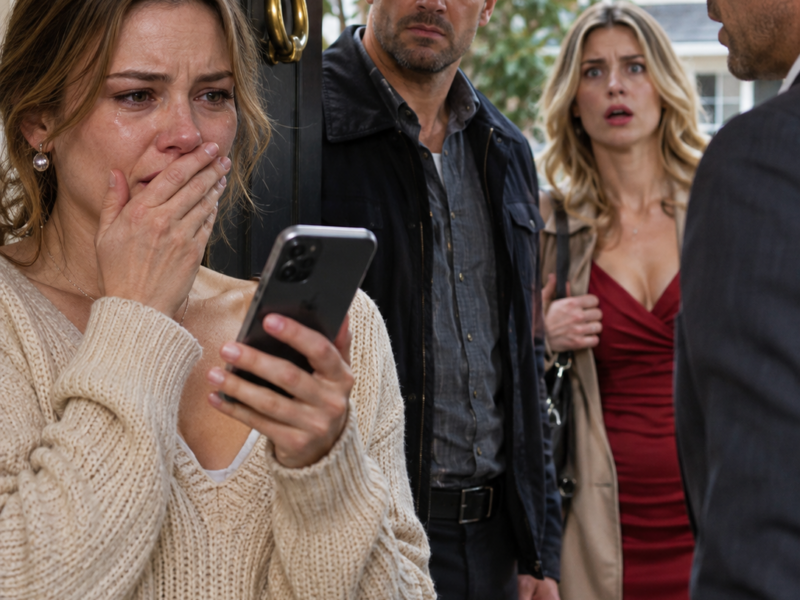
After Nine Years of Marriage, My Neurosurgeon Husband Texted Me, “Sign the Divorce Papers. Don’t Make This Ugly.” He Thought I Was a Financially Dependent Wife and Demanded I Clear Our Living Room for His Mistress. But When Her Husband Appeared at My Door Holding Evidence of $2.1 Million in Fraud, I Quietly Invited Him Inside. Six Weeks Later, My Husband Arrived to Sign Our Divorce Agreement, His Mistress Walked In Carrying Champagne, and My Lawyer Opened a Folder That Made Them Both Stop Smiling…
After Nine Years of Marriage, My Neurosurgeon Husband Texted Me, “Sign the Divorce Papers. Don’t Make This Ugly.” He Thought I Was a Financially Dependent Wife and Demanded I Clear Our Living Room for His Mistress. But When Her Husband Appeared at My Door Holding Evidence of $2.1 Million in Fraud, I Quietly Invited Him Inside. Six Weeks Later, My Husband Arrived to Sign Our Divorce Agreement, His Mistress Walked In Carrying Champagne, and My Lawyer Opened a Folder That Made Them Both Stop Smiling…
My husband sent me a text at 6:47 on a Thursday evening: “Sign the divorce papers. Don’t make this ugly.”
Nine years of marriage, and that was how Garrison Whitaker decided to end it. No conversation. No apology. Just eight pages of legal documents and a command he assumed I would obey.
What he didn’t know was that his mistress was married, her husband was about to knock on my door, and the company Garrison considered my insignificant little hobby was worth $14.2 million.
Even more extraordinary, that company supplied the medical equipment that helped make him one of Boston’s most celebrated neurosurgeons.
I stood in our Beacon Hill kitchen reading the agreement. Garrison wanted the Audi, our expensive furniture, and several paintings. But page six contained something far more important: both parties would retain assets registered in their individual names and waive claims to each other’s businesses.
He had written that clause himself.
I almost laughed.
For nine years, Garrison had never asked what I actually did for a living. He assumed my healthcare consulting business barely paid for vacations. He never knew about my commercial properties, investment portfolio, or multimillion-dollar hospital contracts.
He also never knew I had been investigating his affair for seven months.
It began at a hospital fundraiser in March.
Garrison was obsessive about cleanliness. He carried sanitizer everywhere and washed his hands after nearly every physical interaction, including touching me. Yet that evening, I watched him embrace a beautiful woman in a charcoal dress without reaching for his sanitizer.
“Cordelia, meet Ranata Greer,” he said brightly. “We went to high school together.”
His first love.
I watched him touch her arm again. He smiled at her in a way I hadn’t seen him smile at me for years.
That night, he returned home after midnight.
Three weeks later, I discovered suspicious transfers from our joint account. First $1,200, then $800. Within months, the transactions multiplied.
Instead of confronting him, I opened a spreadsheet.
By September, I had documented dozens of transfers totaling nearly $60,000. I had also discovered that Ranata’s identity seemed to disappear from public records before 2018.
A Delaware property filing revealed another surname. An old marriage record led me to Neil Foscott, a former business owner who had lost $85,000 after marrying a woman using that name.
“She took everything she could without destroying me completely,” Neil told me in a quiet diner. “Then she disappeared.”
His divorce had never been finalized.
That meant Ranata might still be legally married to him.
But Neil wasn’t the only victim.
One October afternoon, I noticed a dark sedan parked near our townhouse for the third time. My attorney traced it to a private investigator working for Otis Caldwell, a retired insurance director.
Otis had recently married a woman named Charlotte.
Charlotte was Ranata.
I realized someone else was investigating the same woman.
Sixteen days later, the doorbell rang.
A gray-haired man stood outside holding a thick folder.
“Mrs. Whitaker? I’m Otis Caldwell. I believe my wife is having an affair with your husband.”
I invited him inside.
At my kitchen table, Otis revealed that Charlotte had taken approximately $2.1 million from accounts he controlled. She had forged authorizations, invented investment opportunities, and transferred money through several institutions.
Then he showed me photographs of Charlotte meeting Garrison at a restaurant.
The pictures had been taken that afternoon, hours after my husband filed for divorce.
I listened quietly before retrieving my own evidence.
When I placed my spreadsheet beside his folder, Otis stared in disbelief.
“You already knew?”
“Most of it,” I answered. “But now we can prove something much bigger.”
The following morning, we met my attorney, Fletcher Pennington, and a federal investigator named Boyd Stanton.
Boyd examined the overlapping transactions, forged documents, multiple identities, and earlier victims.
He explained that building a prosecutable case would require additional statements and financial verification.
“We need approximately six weeks,” he said.
I looked at the divorce agreement lying beside my folder.
“I’ve already waited seven months.”
So I returned home and continued playing the obedient wife.
Garrison became increasingly impatient, demanding to know why I hadn’t signed. Meanwhile, his relationship with Ranata grew more obvious.
Then, in late November, I overheard him arguing with his bank.
He was trying to transfer another $250,000 into an investment account Ranata controlled.
The bank had flagged the transaction.
Garrison was furious.
He had no idea that the woman he trusted was preparing to leave him financially ruined.
And he had even less idea what awaited him on the morning our divorce papers would finally be signed.
Nine days before the signing, Ranata invited me for coffee.
She arrived smiling, dressed elegantly, and spoke as though she were generously helping me surrender my marriage.
“If you cooperate, Garrison will make sure you’re comfortable,” she said.
Then she made a remarkable admission.
“He’s number five for me. I know how to manage these exits.”
I remained expressionless.
My phone, positioned on the table, was recording our conversation as part of the investigation.
Ranata continued describing her previous relationships, never realizing how much she was revealing.
When she finally left, I forwarded the recording to Fletcher and Boyd.
By signing day, the investigators had assembled statements from several alleged victims, financial records, and evidence connecting Ranata’s different identities.
That morning, Garrison sent another message.
“Clear the living room tonight. Ranata will need the space.”
He was ordering me to vacate rooms inside a townhouse legally owned by me.
I didn’t respond.
At Fletcher’s office, Garrison arrived looking almost cheerful.
“Let’s get this finished,” he announced.
Fletcher began reading my financial disclosure.
The townhouse.
The investment accounts.
The commercial properties.
Then came my company’s valuation.
“Fourteen million, two hundred thousand dollars.”
Garrison stopped smiling.
“What?” he whispered.
“That’s not possible.”
I met his eyes.
“You never asked.”
Fletcher explained the property waiver Garrison had prepared and signed. Its implications were suddenly very different from what he had imagined.
Before Garrison could respond, the conference room door opened.
Ranata entered carrying champagne.
“I thought we should celebrate!”
Then she noticed Otis sitting beside two other men.
Her smile vanished.
Otis slowly stood.
“Hello, Charlotte.”
She dropped her champagne glass.
And when Boyd identified himself and described the federal fraud investigation, Garrison finally understood that his beautiful new beginning might have been a carefully constructed deception.
Fletcher played the recording from our coffee meeting.
Ranata’s confident voice filled the conference room.
“He’s number five for me.”
Garrison stared at her.
“You told me you loved me.”
She said nothing.
Federal agents escorted her away in connection with the investigation. The woman who had manipulated everyone around her finally had no prepared explanation.
But Garrison’s humiliation wasn’t finished.
Helen Norwood, the hospital’s procurement vice president, entered carrying another folder.
“Dr. Whitaker,” she said, “your wife’s company has supplied equipment, training programs, and research support to this hospital for years.”
He looked toward me.
“You paid for my department?”
“My company supplied it,” I corrected.
His expression crumbled.
When Fletcher explained that the substantial funds Garrison had voluntarily transferred to Ranata were his own financial responsibility under the proposed settlement, he lowered his head.
“Cordelia, please. We can fix this.”
I remembered the man who once saved my mother’s life. I remembered loving him desperately. I remembered nine years of learning to remain silent.
“You saved my mother,” I said. “I’ll always be grateful for that. But gratitude isn’t a marriage.”
I picked up the expensive fountain pen I had given him years earlier.
And I signed.
Garrison signed too, his usually steady surgeon’s hands trembling.
Ten days later, Ranata was facing federal charges, while Garrison had moved into a modest rental apartment. The hospital’s commercial partnership remained under review, but I ensured patients weren’t punished for his personal decisions.
I kept the townhouse, my business, and the life I had built.
One December afternoon, my doorbell rang again.
For the first time in years, I opened it without fear.
I had finally learned something that nine years of marriage almost made me forget.
Silence doesn’t always mean surrender. Sometimes it means you’re gathering the courage to choose yourself.
THE END