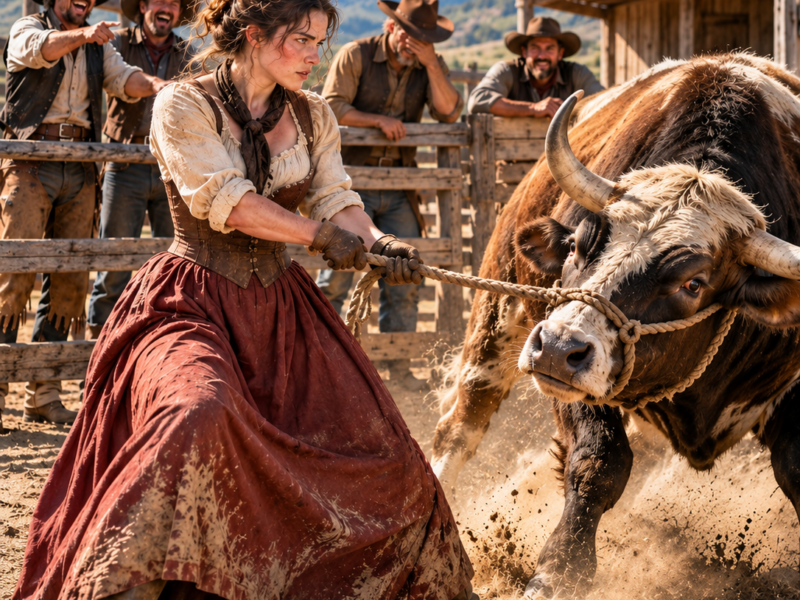
After 8 Years of Building Our Wyoming Ranch Together, My Husband Humiliated Me in Front of Every Ranch Hand When I Offered to Help With His $300 Black Stallion—Even After the Territory’s Best Horse Breaker Had Been Thrown Twice. “Don’t Embarrass Me in Front of These Men,” He Warned as They Laughed. But I Stepped Into the Pen Anyway and Discovered Something Everyone Had Missed. Then I Found a Hidden Letter From a Cheyenne Lender, and What It Revealed About Our Ranch Left Me Frozen…
After 8 Years of Building Our Wyoming Ranch Together, My Husband Humiliated Me in Front of Every Ranch Hand When I Offered to Help With His $300 Black Stallion—Even After the Territory’s Best Horse Breaker Had Been Thrown Twice. “Don’t Embarrass Me in Front of These Men,” He Warned as They Laughed. But I Stepped Into the Pen Anyway and Discovered Something Everyone Had Missed. Then I Found a Hidden Letter From a Cheyenne Lender, and What It Revealed About Our Ranch Left Me Frozen…
Part 1
The first time I watched my husband choose his pride over my safety, I was standing beside a wooden fence in Wyoming Territory, staring at a black stallion that had just thrown the most respected horse breaker in three counties into the dirt.
The second time was only a few minutes later, when I realized he would rather let an injured animal suffer than admit his wife might know something he didn’t.
But what happened after I opened that gate would expose a secret far more dangerous than a wild horse.
A secret that could cost us everything we had spent eight years building.
My name is Ruth Mercer, and until that Saturday morning, I believed the greatest threat to our ranch was a horse named Ash.
I was wrong.
The morning began with the kind of cold that settles inside your bones before the sun has properly risen. Frost covered the fence rails, and the mountains beyond our pasture looked almost blue beneath the pale October sky.
By nine o’clock, every ranch hand we employed had gathered around the breaking pen.
Nobody wanted to miss the spectacle.
Inside stood Ash, a magnificent black stallion with a white mark beneath his left eye and a temper that had already sent two men to the doctor.
He was beautiful in a way that made people forget beauty could be dangerous.
His coat shone like polished coal. His neck arched proudly, and his dark eyes followed every movement around him.
My husband, Thomas, had brought him home from Cheyenne two months earlier.
He called Ash our future.
I called him an expensive question nobody had bothered to answer.
Thomas had insisted that the stallion came from extraordinary bloodlines. With proper training, Ash could become one of the most valuable breeding horses in Wyoming.
We would charge stud fees. We would improve our own stock. We would finally have enough money to repair the house, replace our aging equipment, and survive another difficult cattle season.
At least, that was Thomas’s explanation.
He told me the horse had cost three hundred dollars.
Even that amount made my stomach tighten.
We had experienced a terrible summer. The creek had run shallow, the grass had turned brown, and cattle prices had fallen low enough to make experienced ranchers consider selling their land.
Three hundred dollars was not money we could afford to gamble.
But Thomas had already made the purchase before mentioning it to me.
That should have frightened me more than it did.
Instead, I reminded myself that marriages required patience.
I had been practicing patience for years.
Eight years earlier, Thomas and I had arrived in Wyoming with forty-one dollars, a wagon with a cracked axle, and more determination than good sense.
Our property was barely worth calling a ranch.
The house had two rooms. The barn leaned east whenever the wind blew west. Our first cattle were thin, stubborn creatures purchased from a man who seemed suspiciously pleased to be rid of them.
We worked from sunrise until the stars appeared.
Thomas built fences while I repaired harnesses.
He dug irrigation channels while I tended sick animals.
When a calf was born backward during a spring storm, I spent two hours kneeling in the mud helping deliver it while Thomas held a lantern.
We laughed afterward, exhausted and filthy, because the calf lived.
Those were the years when my husband looked at me like I was the best decision he had ever made.
He used to ask my opinion before buying horses, hiring men, or negotiating with neighbors.
Sometimes, when we were sitting at the kitchen table balancing our accounts, he would reach across the ledger and squeeze my hand.
“We’re going to build something worth keeping, Ruth,” he would say.
And I believed him.
I had grown up around horses in Missouri.
My father owned a modest livery stable, and although I was a girl, he never treated my curiosity as foolish.
He taught me how to recognize sickness, fear, exhaustion, and pain before they became obvious.
He showed me that a horse’s ears could reveal more than a man’s words.
Most importantly, he taught me something I would remember for the rest of my life.
“A horse doesn’t fight without a reason, Ruthie. You may not understand that reason, but that doesn’t mean it isn’t there.”
I carried those words into adulthood.
They saved more animals than I could count.
Unfortunately, they could not save my marriage from something I didn’t recognize until it had already taken hold.
As our ranch grew, Thomas changed.
It happened gradually.
At first, he stopped asking my advice when other ranchers were visiting.
Then he began correcting me in front of our employees.
If I offered a suggestion about feeding schedules or breeding stock, he would smile tightly and tell me he had already considered it.
Sometimes, he hadn’t.
When my advice proved correct, he became quiet and withdrawn.
I told myself he was tired.
Then I told myself he was worried.
Eventually, I stopped speaking unless someone specifically asked me a question.
I believed I was protecting his dignity.
Looking back, I was slowly surrendering my own.
And then Ash arrived.
From the beginning, something about that horse troubled me.
He was not vicious.
He never attacked merely because someone approached.
He did not bite the men who fed him or charge the fence when people passed.
But whenever someone tried to place a saddle across his back, he transformed.
His muscles tightened. His ears flattened. His breathing became frantic.
If a man attempted to tighten the cinch, Ash would rear so violently that the entire pen shook.
Thomas called him stubborn.
The ranch hands called him possessed.
I watched him quietly and wondered what he was trying to tell us.
After several failed attempts, Thomas hired Silas Boone.
Silas was nearly sixty, with gray whiskers, weathered hands, and thirty years of experience gentling horses that other men considered hopeless.
His reputation reached across Wyoming Territory.
If Silas couldn’t train a horse, people said, nobody could.
For three days, he observed Ash.
He moved carefully, spoke softly, and avoided unnecessary force.
I respected him immediately.
But Thomas was impatient.
A buyer from Cheyenne named Mr. Pruitt was arriving Saturday.
Pruitt owned several breeding operations and had expressed serious interest in Ash’s bloodline.
If Silas could demonstrate that the stallion was manageable, Thomas believed he could negotiate a profitable agreement.
Saturday came.
Pruitt arrived wearing a dark coat and carrying a silver pocket watch.
He watched the pen with the expression of a man accustomed to deciding whether other men’s dreams were worth his money.
Silas entered first.
For almost twenty minutes, everything went well.
Ash accepted the halter.
He walked several circles.
He even permitted Silas to lay a saddle blanket across his back.
Then Silas reached beneath his belly and began tightening the cinch.
Ash exploded.
The stallion lunged sideways, slammed into the rails, and threw Silas against the ground.
Someone screamed.
Thomas rushed forward.
Silas rolled away just before a hoof struck the place where his head had been.
He got up slowly, breathing hard.
Then, to everyone’s surprise, he approached Ash again.
He adjusted the saddle and attempted a second time.
The result was worse.
Ash twisted violently, knocking Silas face-first into the dirt.
For a moment, nobody moved.
Then the old horseman stood, retrieved his hat, and walked toward the gate.
He closed it behind him.
“That’s twice,” he said. “There won’t be a third.”
Thomas stared at him.
“You’re quitting?”
Silas brushed dirt from his coat.
“I’m refusing to get someone killed.”
Pruitt opened his pocket watch.
“I traveled two days to inspect a valuable stallion,” he remarked. “Apparently, I should have stayed home.”
Several ranch hands laughed nervously.
Thomas’s face darkened.
And that was when I noticed something.
Ash was standing near the center of the pen, trembling.
But he wasn’t staring at Silas.
He was watching the abandoned saddle.
Every time someone approached from his left side, he shifted his hindquarters away.
When he turned, he carried his weight strangely, protecting an area beneath his ribs.
I had seen that movement before.
Years earlier, my father had brought home a mare whose owner called her impossible. She had kicked every handler who attempted to groom her.
My father discovered an infected wound hidden beneath her coat.
Once the pain was treated, the mare became gentle enough for children.
I looked at Ash again.
My heart began beating faster.
“Thomas,” I said, “I don’t believe he’s fighting the saddle.”
My husband turned toward me.
“Not now, Ruth.”
“Look at his left side.”
One of the hands, a broad-shouldered man named Walter, chuckled.
“Mrs. Mercer thinks she’s going to explain horses to Silas Boone.”
Another man laughed.
“Maybe she plans to ask the stallion what troubles him.”
The laughter spread.
I could have ignored it.
I had ignored worse.
But Thomas didn’t defend me.
He didn’t even ask what I had noticed.
Instead, he glanced toward Pruitt.
“Ruth,” he said sharply, “stay away from that pen.”
Something inside me went very still.
I looked at the man I had married.
The man who once trusted me to help deliver calves in freezing rain.
The man who had watched me save horses other ranchers wanted destroyed.
He was standing there, embarrassed by the possibility that I might know something he didn’t.
And suddenly, I was more tired of being silent than I was afraid of the horse.
“I’m not going to ride him,” I said.
Thomas stepped closer.
“You’re not going near him.”
“I only want to examine him.”
“No.”
His answer came so quickly that I knew he hadn’t considered my words.
I looked at Ash.
The stallion stood trembling beneath the autumn sunlight, his breathing rough, his eyes filled with something I recognized immediately.
Fear.
Not hatred.
Not stubbornness.
Fear.
I reached for the gate.
Thomas grabbed my wrist.
“Don’t embarrass me in front of these men.”
That sentence hurt more than his grip.
For eight years, I had helped build his reputation.
I had worked beside him, sacrificed beside him, and worried beside him.
Yet he was afraid that my competence might make him look small.
I gently pulled my wrist free.
“Then don’t give them a reason to laugh at you,” I whispered.
And I opened the gate.
Behind me, someone muttered that I had lost my mind.
Ahead of me stood twelve hundred pounds of frightened muscle.
I stepped inside.
The gate clicked shut.
And every voice along the fence fell silent.
Part 2
I didn’t approach Ash immediately.
I stood beside the fence, breathing slowly, allowing him to study me.
He snorted, pawed the ground, and watched my hands.
I kept them relaxed.
Minutes passed.
Finally, he lowered his head.
I took one step.
He stayed still.
Another step.
He shifted sideways, protecting his left flank.
There it was again.
“Bring me the saddle blanket,” I called.
Walter hesitated, but Silas retrieved it.
I examined the underside and discovered dried blood near one edge.
My stomach dropped.
Moving carefully, I approached Ash’s shoulder.
He trembled when my fingers touched his coat.
I waited.
Then I slowly moved my hand along his ribs.
Beneath a patch of matted hair, I found a swollen wound, raw and inflamed exactly where the saddle pressed.
“Silas,” I called quietly. “Come see this.”
He approached the fence and stared.
His expression changed.
“Lord Almighty.”
I turned toward the men.
“He’s not fighting because he’s wicked. He’s fighting because every saddle hurts him.”
Silas removed his hat.
“I should have noticed.”
Thomas folded his arms.
“That doesn’t mean you can train him.”
I looked at him.
“No. It means we can finally stop hurting him.”
Nobody laughed.
But when Thomas turned away, I saw something in his expression that frightened me more than his anger.
He wasn’t relieved.
He looked terrified.
And I began wondering what he knew that I didn’t.
Part 3
The first morning I returned to Ash’s pen, my husband refused to speak to me.
He sat at the kitchen table drinking coffee, his eyes fixed on a stack of papers he closed the moment I entered.
I noticed.
I also noticed that he had stopped sleeping properly.
There were dark shadows beneath his eyes, and his hands trembled slightly when he lifted his cup.
But I had spent too many years interpreting his silence on his behalf.
This time, I decided he could explain himself when he was ready.
I gathered clean cloth, warm water, and the medicinal supplies I kept in the barn.
Outside, the air smelled of damp earth and wood smoke.
Ash stood near the far fence.
He raised his head when he saw me, but he didn’t approach.
That was fine.
Trust was not something I intended to demand from him.
It was something I intended to earn.
I began by sitting on an overturned bucket inside the pen.
For nearly an hour, I did nothing except remain where he could see me.
The ranch hands passed occasionally, exchanging amused glances.
Walter shook his head.
“Seems we’ve hired ourselves a horse sitter.”
I ignored him.
By noon, Ash had moved closer.
When I stood, he stepped away.
So I sat down again.
That became our first lesson.
The next day, he allowed me to approach his shoulder.
The day after that, he permitted me to examine the injured area without rearing.
The wound was worse than I initially suspected.
Repeated pressure had rubbed away the protective skin, leaving inflamed tissue beneath. Dirt and sweat had irritated it further.
Every attempt to saddle him had reopened the injury.
I cleaned the area as gently as possible and applied a dressing.
Ash shook violently the first time.
I stopped immediately.
I spoke to him in the same quiet voice my father had used with frightened horses.
“Easy, boy. Nobody’s trying to win a fight with you.”
His breathing slowed.
I continued.
By the end of the week, the swelling had begun to improve.
But healing the wound was only part of the problem.
Ash had learned to associate human hands, leather straps, and saddle blankets with pain.
Even after his body recovered, his fear would remain.
I knew that because I had seen it before.
My father once purchased a gelding that had been whipped whenever he refused to cross a wooden bridge.
Months later, the horse still trembled at the sound of wagons rolling across planks.
We could not erase his memories.
We could only give him enough better experiences that those memories stopped controlling him.
So I made a rule.
Nobody would bring a saddle into Ash’s pen until I believed he was ready.
Thomas hated it.
On the fifth evening, he followed me into the barn.
“You’ve been spending all day with that horse.”
“Yes.”
“And he still can’t be ridden.”
“His wound hasn’t healed.”
“Pruitt isn’t going to wait forever.”
I turned toward him.
“Then perhaps you should explain why you’re so desperate.”
His face tightened.
“We need the money.”
“We’ve needed money before.”
“Not like this.”
The words escaped before he could stop them.
I studied him.
“Thomas, what aren’t you telling me?”
“Nothing.”
I waited.
He looked toward the barn door.
“Just do what you can.”
Then he left.
I stood there holding a jar of liniment, listening to his footsteps fade.
For the first time, I felt a cold suspicion begin to settle inside me.
There were things happening on our ranch that I didn’t understand.
And my husband was determined to keep them that way.
Over the following days, Ash continued improving.
He began following me across the pen without a lead rope.
He learned that a touch on his shoulder did not mean punishment.
He permitted me to lift each hoof.
Sometimes he became frightened and moved away.
I always allowed him enough space to settle.
I never chased him into a corner.
There were setbacks.
One afternoon, Eli, our youngest ranch hand, accidentally dropped a metal bucket near the fence.
The crash startled Ash.
He spun violently, kicking dirt into the air.
I barely escaped behind a fence post before he charged past.
My heart hammered so hard I could hear it.
Walter came running.
“That’s enough, Mrs. Mercer! That animal’s going to kill you!”
Perhaps he was right.
Ash was still dangerous.
Understanding an animal’s fear did not make its strength harmless.
I stayed behind the post until Ash stopped running.
Then I stepped back into the open.
My knees were shaking.
“Eli,” I called, “take that bucket away.”
The young man obeyed.
Ash watched me from the opposite side of the pen.
I waited until his breathing slowed.
Then I walked toward him again.
That afternoon, something changed.
Not suddenly.
Not dramatically.
But when I stopped a few feet away, Ash took the final step himself.
He lowered his head and touched my palm with his muzzle.
For a moment, I couldn’t speak.
I thought of my father.
I thought of the little Missouri stable where I had first learned to recognize the difference between obedience and trust.
And I felt something return that I had almost forgotten.
Confidence.
Not the kind that demands attention.
The quiet kind that comes from knowing you are doing something right even when nobody applauds.
Silas Boone began visiting regularly.
He stood at the fence watching my work.
One morning, he asked why I kept removing the halter after Ash accepted it.
“Because I want him to know that allowing me near him doesn’t mean he loses control forever,” I explained.
Silas considered that.
Then he nodded.
“Your father teach you that?”
“Most of it.”
“He must have been a fine horseman.”
“He was.”
Silas smiled.
“Seems he raised another.”
I carried that compliment with me for the rest of the day.
Thomas, however, grew more difficult.
When Pruitt returned unexpectedly to inspect Ash, I was walking the stallion around the pen.
The buyer watched with obvious interest.
“He’s changed,” he observed.
Thomas gave a stiff smile.
“My wife’s been helping while we wait for someone qualified to finish the training.”
I stopped walking.
Helping.
Someone qualified.
The words struck harder than I expected.
Pruitt glanced toward me.
“She seems to have made progress.”
“She’s good at nursing animals,” Thomas replied. “But real training requires a professional.”
Silas stood only a few feet away.
He said nothing at first.
Then he cleared his throat.
“Mr. Mercer, I’ve trained horses for thirty years. Your wife noticed something I missed. Might be wise to let her finish what she’s started.”
Thomas’s face turned crimson.
The conversation ended awkwardly.
That night, my husband accused me of humiliating him.
“I didn’t say anything,” I replied.
“You let Boone make me look foolish.”
“I didn’t ask him to speak.”
“You could have stopped him.”
I stared at Thomas across the kitchen table.
“Would you have preferred I pretended I hadn’t helped the horse?”
He didn’t answer.
“Thomas, why does it upset you when someone recognizes my work?”
His jaw tightened.
“Because there’s more at stake here than your pride.”
I almost laughed at the cruelty of it.
“My pride?”
He pushed his chair backward.
“You don’t understand.”
“Then help me understand.”
But he walked outside.
I sat alone until the lamp burned low.
That was the night I began checking the ranch accounts more carefully.
I had always maintained the household ledger, but recently Thomas had been handling purchases and banking arrangements himself.
He said it was easier that way.
I had believed him.
Now I noticed missing entries.
Payments recorded without explanations.
Feed invoices settled later than usual.
A withdrawal from our winter reserve that I couldn’t remember approving.
When I asked Thomas about it the following morning, he dismissed the matter.
“Just business expenses.”
“Which expenses?”
“Ruth, I can’t explain every dollar I spend.”
“You used to.”
He looked away.
“Things are different now.”
That sentence followed me into the barn.
Things were different.
But not because our ranch had grown.
They were different because Thomas had gradually stopped treating me as his partner.
For years, I had believed the distance between us was emotional.
Now I was beginning to suspect it was financial as well.
Two evenings later, I found the letter.
Thomas had gone into town to meet a cattle merchant.
I was sitting at the kitchen table preparing to enter the week’s feed expenses.
My pencil broke.
I opened his desk drawer, searching for another.
Beneath a bundle of receipts lay a folded envelope bearing the name of a lending office in Cheyenne.
The seal had already been broken.
I recognized the handwriting on the outside.
It belonged to the man Thomas had mentioned when he purchased Ash.
I unfolded the letter.
Then I read it again.
The numbers didn’t make sense.
I reached for our ledger, turned several pages backward, and began adding figures.
My fingers grew cold.
The letter demanded repayment of a substantial loan within three weeks.
The amount was almost twice what Thomas had told me he paid for Ash.
And the stallion wasn’t the only collateral.
Our ranch was listed too.
I stared at the words until they blurred.
The house.
The barn.
The pastures.
The creek where we had watered our first cattle.
Everything.
Thomas had risked all of it.
Without telling me.
I opened the remaining papers.
There was another note secured against the property, apparently connected to losses from our previous cattle season.
Our emergency savings had been used to cover interest and overdue payments.
The money I believed was waiting for winter was nearly gone.
I had spent weeks trying to save a frightened horse.
Meanwhile, my husband had been hiding a disaster large enough to destroy our lives.
And the worst part was that he had allowed me to stand in front of those men, defending him and his ranch, while I knew almost nothing about what was really happening.
I remained at the table until the room grew dark.
When Thomas finally returned, he found the letter lying open beside the ledger.
He stopped in the doorway.
Neither of us spoke.
Then I asked one question.
“How much have you borrowed against our land?”
He looked at the papers.
And for the first time since I had known him, my husband appeared to have no answer prepared.
Part 4
Thomas stood in the kitchen doorway for so long that I could hear the wind rubbing the branches against our roof.
His hat remained in his hands.
The lamp between us flickered, casting enormous shadows across the walls we had built together.
Finally, he spoke.
“Ruth, I can explain.”
I looked down at the letter.
“Then explain the amount.”
He swallowed.
I repeated the question.
“How much, Thomas? All of it.”
He sat opposite me.
At first, he attempted to explain the purchase of Ash.
The horse had come from an exceptional breeding line. Its former owner had needed money quickly. The opportunity had seemed too valuable to refuse.
But every explanation led to another expense.
Transportation costs.
Interest.
A payment to secure the breeding records.
An older loan connected to our cattle losses.
The more he talked, the clearer the truth became.
Ash was not simply an expensive horse.
He was the final gamble in a series of desperate decisions my husband had made without consulting me.
Our poor cattle season had left us short of cash.
Rather than tell me how serious the situation had become, Thomas had borrowed money to keep the ranch operating.
When that debt grew difficult to manage, he began looking for something that could produce a large profit quickly.
He found Ash.
Or perhaps Ash found him at precisely the wrong moment.
Thomas convinced himself that purchasing a valuable breeding stallion would solve our financial problems.
He borrowed more money.
Then he promised himself that once the horse was trained and Pruitt agreed to a deal, everything would be restored before I discovered anything was wrong.
He had imagined himself rescuing our ranch.
Instead, he had placed it in greater danger.
When he finished speaking, I looked at the numbers.
“How long have you known we could lose the property?”
His eyes filled.
“Since summer.”
I felt as though someone had struck me.
“Summer?”
He nodded.
I remembered that summer vividly.
The dry creek beds.
The dying grass.
The hours we spent hauling water.
The nights I stayed awake worrying whether we had enough supplies to survive winter.
And through all of it, Thomas had known we were far closer to disaster than I understood.
“Why didn’t you tell me?”
“I didn’t want you frightened.”
I stared at him.
“You didn’t want me frightened?”
He leaned forward.
“I thought I could fix it.”
“By borrowing against the ranch?”
“Yes.”
“Without asking me?”
He looked away.
I felt anger rising, but beneath it was something worse.
Grief.
I had trusted this man with my life.
I had crossed the territory beside him in a wagon that barely held together.
I had worked until my hands bled.
I had buried animals we couldn’t save and celebrated every calf that survived.
I had gone without new boots so we could purchase fencing materials.
And he had somehow decided I was not entitled to know that everything we owned was at risk.
“Thomas,” I said, struggling to keep my voice steady, “do you remember our first winter here?”
He nodded.
“Do you remember the storm that destroyed the north fence?”
“Of course.”
“We had twenty dollars left. We thought the cattle would scatter before morning.”
His face tightened.
“We repaired that fence in the dark,” I continued. “You held the posts while I hammered the nails because your fingers were too numb.”
“I remember.”
“And when we finished, we sat in the barn and counted our money together.”
He lowered his eyes.
“We decided together what to sell and what to keep. We were frightened, but neither of us faced it alone.”
“Ruth—”
“No. Please listen.”
He went silent.
“Somewhere along the way, you decided being my husband meant protecting me from the truth instead of trusting me to face it beside you.”
His shoulders sagged.
“I was ashamed.”
“Of losing money?”
“Of failing.”
I looked at him carefully.
He seemed older than he had that morning.
“I thought if you knew how badly things had gone, you’d look at me differently.”
The confession hurt because it revealed how little he understood the woman sitting across from him.
“I’ve seen you fail before, Thomas.”
He looked up.
“I’ve seen you make bad trades. I’ve seen you lose cattle. I’ve seen fences collapse after you spent days building them. Did I stop loving you?”
“No.”
“Then why would you think I’d stop now?”
His eyes filled with tears.
“Because this time I had no idea how to fix it.”
For a moment, I wanted to reach for him.
I wanted to comfort the frightened man beneath all that pride.
But I thought of the letter.
I thought of Ash.
I thought of how Thomas had dismissed my work in front of Pruitt while secretly depending on that same work to save the ranch.
And I kept my hands in my lap.
“Being afraid doesn’t excuse lying to me.”
“I know.”
“Do you?”
He looked at me.
“You allowed those men to laugh at me because admitting I was right made you uncomfortable. You called my work a little help because acknowledging it threatened your pride. And all the while, you were counting on that horse to rescue us from a debt I didn’t even know existed.”
He covered his face.
I had never seen him so defeated.
But I couldn’t allow his pain to silence mine.
“If we lose this ranch, I’ll survive,” I said quietly. “I’ve survived worse than losing money. But I don’t know whether our marriage can survive another secret.”
He lifted his head.
“Are you leaving me?”
I considered the question.
The fact that I couldn’t answer immediately frightened us both.
“I don’t know.”
Those three words seemed to empty the room.
I took my shawl from the chair.
“Where are you going?”
“To the barn.”
“Ruth, please.”
I stopped at the door.
“Tomorrow, I will continue working with Ash. Not because you need him sold, and not because Pruitt is coming. I’ll do it because that horse deserves a chance to recover from what people have done to him.”
Thomas said nothing.
“And I want every account, every loan agreement, and every outstanding bill on this table tomorrow evening.”
He nodded.
I stepped outside.
The night was bitterly cold.
Stars glittered above the mountains, and a thin moon illuminated the path toward the barn.
Inside, Ash stood quietly in his stall.
When he heard me, he lifted his head.
I opened the door and sat beside the wall.
For a long time, I simply listened to him breathe.
I wondered how two creatures could live so close together for years and still misunderstand one another so completely.
Ash had been terrified of pain.
Thomas had been terrified of failure.
And in different ways, both had learned to fight whenever they felt threatened.
But only one of them had been honest about his fear.
Near midnight, I heard footsteps outside.
Thomas appeared at the entrance.
He didn’t come inside.
“I brought you a blanket,” he said.
I looked at the folded wool in his hands.
He placed it on a bale of hay and turned away.
Before he left, I called his name.
“Thomas.”
He stopped.
“I don’t need you to be perfect.”
He looked back.
“I need you to be truthful.”
He nodded once.
Then he disappeared into the darkness.
The following morning, he did something I hadn’t expected.
He went directly to Silas Boone.
Later, Silas told me that Thomas had asked whether there was any way to force Ash through a demonstration before Pruitt returned.
Silas had answered plainly.
“There are plenty of ways to force a horse, Mercer. Most of them end with someone regretting it.”
Thomas asked whether the stallion might eventually be safe.
Silas nodded.
“If Ruth keeps working with him.”
For once, Thomas didn’t argue.
He came to the fence that afternoon and watched me work.
He asked no questions.
He offered no instructions.
When I finished, he opened the gate for me.
It was a small gesture.
But I noticed it.
Over the next several days, the wound along Ash’s ribs continued healing.
The angry swelling diminished.
His coat grew smooth again.
He stopped flinching every time I touched his shoulder.
I began introducing new objects gradually.
A soft cloth.
A folded blanket.
A loose strap that never tightened against his injured side.
I let him examine each item before bringing it near his body.
Sometimes he accepted them.
Sometimes he backed away.
Whenever he showed distress, I stopped.
I wanted him to learn that discomfort did not always lead to greater pain.
The progress was slow.
But it was real.
And unexpectedly, the ranch hands began treating me differently.
Eli asked whether he could help prepare the medicinal water.
Walter stopped making jokes.
Silas spent an afternoon explaining to the younger men why patience wasn’t weakness.
One evening, I found Walter standing beside the pen.
He removed his hat awkwardly.
“Mrs. Mercer, I owe you an apology.”
I waited.
“I laughed when you went in there.”
“I remember.”
He looked embarrassed.
“My father always said women ought to leave horse breaking to men.”
“And what do you think?”
He glanced at Ash, who stood calmly beside me.
“I think my father never met you.”
I smiled despite myself.
“Perhaps he just never listened to your mother.”
Walter laughed softly.
Then his expression turned serious.
“I’m sorry.”
“Thank you.”
The apology meant more than I expected.
Not because I needed Walter’s approval.
But because it reminded me that people could change their minds when they were willing to look honestly at what stood before them.
The day before Pruitt’s scheduled return, Thomas finally showed me every financial document.
We sat together until nearly two in the morning.
The situation was worse than I had hoped.
But it was not entirely hopeless.
A payment was due in two weeks.
Without an agreement from the lender, we might face foreclosure proceedings.
Some cattle could be sold.
Certain equipment could be mortgaged or replaced later.
Pruitt’s interest in Ash offered another possibility.
But the buyer had expected to inspect a trained stallion.
Ash was not trained.
He was healing.
And those two things were not the same.
Thomas stared at the figures.
“If we can just get a saddle on him tomorrow—”
“No.”
He looked up.
“Ruth—”
“No, Thomas. I won’t hurt him to make the numbers easier.”
He rubbed his forehead.
“We could lose everything.”
“I know.”
“You don’t seem frightened.”
I set down my pencil.
“I’m terrified.”
He stared at me.
“But I won’t make another frightened creature pay for our mistakes.”
For a long time, he said nothing.
Then he asked a question I had not heard from him in years.
“What do you think we should do?”
I looked at the ledger.
Then toward the dark window beyond which Ash stood sleeping.
“We tell Pruitt the truth.”
Thomas closed his eyes.
I knew what he was imagining.
The buyer walking away.
The lender refusing to wait.
The humiliation of admitting his gamble had failed.
But when he opened his eyes again, there was something different in them.
Not confidence.
Not yet.
Something quieter.
Acceptance.
“All right,” he said.
The next morning, Pruitt arrived shortly after sunrise.
Several neighboring ranchers came with him, drawn by stories about the woman who had succeeded where Silas Boone failed.
The fence was crowded.
Ash stood in the pen, calm but watchful.
Pruitt stepped from his buggy.
“Well, Mercer,” he said, adjusting his gloves. “Let’s see whether this remarkable horse is finally worth the trouble.”
Thomas looked at me.
Then he looked at the saddle waiting beside the fence.
For one terrible moment, I saw his old fear return.
He took a step toward the tack.
And I wondered whether the promise he had made the night before would survive the eyes of all those men.
Part 5
I watched Thomas reach toward the saddle, and I felt my stomach tighten.
For two weeks, I had worked carefully to persuade Ash that people could be trusted.
One rushed demonstration could destroy that progress.
But Thomas wasn’t looking at the horse.
He was looking at Pruitt.
The buyer stood near the fence, waiting.
Behind him, our neighbors had gathered with the curiosity of people who enjoyed watching another man’s troubles from a comfortable distance.
Silas Boone leaned against the rail.
Walter and Eli stood nearby.
Everyone expected a performance.
Everyone wanted to see whether the black stallion that had humiliated the territory’s finest horse breaker could finally be controlled.
Thomas picked up the saddle blanket.
I walked toward him.
“He’s not ready.”
His jaw tightened.
“Ruth, we discussed this.”
“Yes. We did.”
Pruitt glanced between us.
Thomas lowered his voice.
“Just one circuit. He doesn’t have to carry a rider. We can show them he’ll accept the saddle.”
I shook my head.
“The wound has healed enough for gentle handling, but he’s still frightened by pressure along his ribs.”
“He’s been calm for days.”
“Calm doesn’t mean ready.”
Thomas’s fingers tightened around the blanket.
I could see the conflict unfolding behind his eyes.
He knew what I was saying.
He knew I had been right about Ash’s injury.
He knew that pushing the horse too quickly might cause another violent reaction.
But he also knew how much money we owed.
And standing before the assembled men was the husband who had spent years believing that admitting uncertainty was the same as admitting weakness.
I stepped closer.
“Thomas, look at me.”
He reluctantly met my eyes.
“We didn’t get into this trouble because you weren’t strong enough. We got into it because you were too frightened to ask for help.”
He looked away.
I continued quietly.
“Don’t make the same mistake again.”
For several seconds, neither of us moved.
Then Thomas looked toward Ash.
The stallion stood near the far rail, watching us.
He was no longer charging or rearing.
His muscles were relaxed.
His ears moved curiously toward the voices.
But when Walter accidentally shifted the saddle rack, Ash flinched.
Thomas saw it.
I knew he saw it because his expression changed.
Slowly, he lowered the blanket.
Then he turned toward Pruitt.
“Mr. Pruitt, I owe you an explanation.”
The buyer raised an eyebrow.
Thomas cleared his throat.
“Ash isn’t ready for a rider.”
A murmur moved through the crowd.
Pruitt frowned.
“You told me he’d be trained.”
“I believed he would be.”
“And now?”
Thomas glanced at me.
“Now I know I was wrong.”
I felt my breath catch.
Those words might have seemed ordinary to another woman.
But I had waited years to hear my husband say them without resentment.
He continued.
“When Silas couldn’t handle him, I thought we’d purchased a vicious animal. My wife noticed something the rest of us missed. Ash had an injury caused by the saddle, and every attempt to force him only made it worse.”
Silas nodded.
“That’s the truth.”
Thomas faced the crowd.
“Ruth has spent the last two weeks helping him recover. She’s done more with that horse than any of us managed before.”
Someone shifted uncomfortably behind the fence.
Thomas looked toward me.
“If you’ll allow it, Ruth, I’d like you to show Mr. Pruitt what Ash can do.”
For a moment, I couldn’t move.
Not because I needed permission.
But because he had asked rather than ordered.
Because he had acknowledged me in front of the same men who had laughed.
And because, for once, I could see the man I remembered standing beneath the pride that had nearly destroyed us.
I nodded.
Then I took the halter from its hook.
When I entered the pen, Ash lifted his head.
I stood near the gate.
I waited.
He watched me.
Then, as he had done each morning, he approached.
His enormous head lowered toward my shoulder.
I slipped the halter over his muzzle, adjusted the strap, and stepped aside.
“Come on, boy.”
Ash followed.
We walked slowly along the fence.
His hooves struck the packed dirt in a steady rhythm.
Nobody spoke.
Halfway around, I stopped.
Ash stopped beside me.
I rubbed his neck.
He lowered his head.
Then I continued.
He followed again.
The simplicity of it seemed to disappoint some of the spectators.
They had come expecting danger.
Instead, they were watching a woman walk beside a horse.
But Silas understood.
He leaned toward Pruitt.
“Two weeks ago, that animal would’ve broken through the fence to get away from a human hand.”
Pruitt watched more closely.
I led Ash toward the center of the pen.
Then I loosened the rope.
He remained beside me.
I touched his right shoulder.
He stood quietly.
I moved to his left.
His ears shifted.
His muscles tightened slightly.
I paused.
Then I placed my palm against the area where the wound had been.
Ash trembled.
But he didn’t pull away.
I waited until his breathing settled.
Then I gently stroked his neck.
Outside the pen, someone whispered.
“Well, I’ll be.”
I was preparing to finish when a sudden metallic crash rang across the yard.
Eli had accidentally knocked a tin cup against the fence.
Ash startled.
His head flew upward.
His body tightened.
The rope snapped through my fingers as he surged backward.
The crowd gasped.
For an instant, I saw the old fear return.
I could have pulled against him.
I could have shouted.
I could have tried to prove that I controlled him.
Instead, I gave him space.
“Easy, Ash.”
He moved sideways.
I stayed still.
“You’re all right.”
His nostrils flared.
He looked toward the fallen cup.
Then toward me.
I lowered my shoulders and waited.
One breath passed.
Then another.
Slowly, his head descended.
His ears moved forward.
He took a cautious step.
I offered my hand.
He touched it.
The pen became completely silent.
I walked forward.
Ash followed.
And we finished the circle together.
When I stopped beside the gate, he rested his muzzle briefly against my arm.
I felt tears burn behind my eyes.
Not because I had conquered him.
I hadn’t.
Ash was still a powerful animal with fears that required patience and professional care.
I was crying because he had been frightened and had chosen to return to me.
He had learned that trust was possible.
And somehow, standing in that pen, I understood how desperately I had needed to remember the same thing.
I led him to the fence.
Pruitt studied him for a long moment.
Then he looked at me.
“Mrs. Mercer, how long before he’s ready for a saddle?”
“Several more weeks at least. Possibly longer.”
“And a rider?”
“I won’t give you a date I can’t promise. He’ll need to accept the tack calmly before we consider that.”
Pruitt nodded.
“That’s an expensive answer.”
“It’s an honest one.”
His mouth twitched into the beginning of a smile.
“Most men selling horses tell me what they think I want to hear.”
“I imagine that causes problems.”
“More than you’d believe.”
He turned toward Thomas.
“I won’t pay a premium today for an unfinished stallion.”
Thomas’s shoulders dropped.
I felt the familiar tightening in my chest.
But Pruitt wasn’t finished.
“However, I’ve seen enough to believe there’s a valuable horse here.”
He looked at Ash again.
“I’ll offer a deposit to reserve first purchase rights, contingent on a satisfactory veterinary examination and successful training. When Mrs. Mercer says he’s ready, I’ll return.”
Thomas stared at him.
“You’d wait?”
“For the right animal? Certainly.”
Pruitt glanced at me.
“And I’d prefer the woman who understands him to decide when the time comes.”
Silas smiled.
Eli removed his hat.
Then Walter did the same.
One by one, the men standing along the fence took off their hats.
Nobody cheered.
Nobody needed to.
The respect in that silence meant more than applause.
Thomas looked at me.
Then he faced Pruitt.
“You have a deal, provided we put the terms in writing.”
The buyer nodded.
“Naturally.”
As they began discussing the agreement, several neighbors approached Thomas.
One congratulated him on the progress.
Another remarked that Ash might eventually become the finest stallion in the territory.
Thomas listened politely.
Then he stepped aside.
“Don’t congratulate me,” he said. “Ruth did the work.”
I stood near the gate holding Ash’s lead rope.
For a moment, I hardly recognized my husband.
Not because he had suddenly become a different man.
But because he had finally stopped pretending he was the only one capable of saving us.
The deposit didn’t erase our financial trouble.
It was far too small for that.
But it gave us something concrete to show the lender.
Combined with the planned sale of several cattle and the repayment proposal we had prepared, it offered a possibility of negotiating more time.
There was still no guarantee.
We could still lose the ranch.
But for the first time in months, we were approaching the problem together.
That evening, after the visitors had gone, I found Thomas waiting outside the stable.
He held his hat in both hands.
“Ruth, can we talk?”
I nodded.
He looked toward Ash’s pen.
“I’ve been thinking about what you said.”
“Which part?”
“All of it.”
I waited.
He took a long breath.
“When I was twelve, my father lost our farm.”
I knew that story, although Thomas rarely spoke about it.
Men had arrived one morning to remove the furniture.
His mother had stood on the porch crying while his father watched helplessly.
Thomas had spent years remembering the shame.
“I promised myself I’d never be like him,” he said.
His voice trembled.
“I thought if I worked hard enough, made enough money, and never showed weakness, nobody could take our home away.”
He rubbed his eyes.
“But when things started going wrong, I couldn’t bear to tell you.”
I looked at him.
“So you made the decisions alone.”
“Yes.”
“And when I tried to help, you pushed me away.”
He nodded.
“Because every time you were right, I felt like I was failing.”
The confession hung between us.
I could hear the wind moving through the dry grass.
“I know that doesn’t excuse it,” he continued. “I know I’ve treated you badly.”
I folded my arms.
“You did.”
“I let the men laugh at you.”
“Yes.”
“I acted as though your judgment mattered only when nobody else was watching.”
I felt tears gathering again.
“That’s what hurt most.”
Thomas lowered his head.
“I know.”
For a long time, we stood without speaking.
Then he said something I had not expected.
“I don’t want you to forgive me tonight.”
I looked up.
“I want to become someone you can trust again. However long that takes.”
I studied his face.
I wanted to believe him.
But trust wasn’t like a broken fence.
You couldn’t repair it with a few nails and expect it to withstand the next storm.
“Then we need rules,” I said.
He nodded immediately.
“Anything.”
“Not anything. Specific things.”
He waited.
“Every financial decision involving the ranch belongs to both of us. Every debt, every agreement, every major purchase.”
“Agreed.”
“You don’t hide trouble because you’re ashamed.”
“Agreed.”
“And you don’t dismiss my knowledge simply because someone is watching.”
His eyes filled.
“Never again.”
I held his gaze.
“Promises are easy, Thomas.”
“I know.”
“What matters is what you do afterward.”
He nodded.
We didn’t embrace.
Not that evening.
Some wounds require more than one conversation.
But when we walked back toward the house, we walked beside each other.
And that was a beginning.
The weeks that followed were difficult.
We negotiated with the lender, who agreed to a revised repayment schedule after reviewing the buyer’s deposit agreement, our cattle-sale proceeds, and the rest of our financial plan.
The terms were strict.
We would have to sacrifice.
There would be no new furniture, no unnecessary purchases, and no expansion until our finances improved.
But the ranch remained ours.
More importantly, we finally knew exactly what we owed.
Every figure appeared in the same ledger.
Every decision was discussed at the kitchen table.
Sometimes we disagreed.
Sometimes Thomas grew defensive.
Occasionally, I caught him beginning a sentence with, “I’ve already decided—”
Then he would stop.
He would take a breath.
And he would ask what I thought.
It wasn’t perfect.
But it was progress.
Ash continued improving too.
By late autumn, his injured side had fully healed, and he accepted careful handling with increasing confidence.
We introduced a properly fitted saddle gradually, without rushing the process.
Silas helped evaluate each stage.
There were days Ash resisted.
There were days he startled at sounds that hadn’t frightened him the day before.
But we stopped treating setbacks as proof that he was hopeless.
We treated them as information.
Eventually, he accepted the saddle without panic.
His first successful rides came only after many more weeks of careful preparation.
When Pruitt returned, he found a horse far different from the one that had thrown Silas Boone.
Ash was still spirited.
He was still proud.
But he had learned that human hands did not always bring pain.
After the agreed examination and demonstration, Pruitt completed the purchase.
The money helped us pay down a significant portion of the debt.
And I expected that would be the end of my work with difficult horses.
I was mistaken.
Word traveled quickly across ranch country.
A neighboring rancher named Dunning arrived with a mare that refused to accept a bridle.
Another man brought a gelding that kicked whenever anyone approached his hindquarters.
Silas began referring people to me.
At first, I refused payment.
Helping animals was something I had always done.
But Thomas insisted that my knowledge had value.
He helped clear a section of the barn where I could work safely.
We agreed on modest fees.
Within months, I was earning money of my own through the ranch’s training and rehabilitation work.
The income wasn’t enormous.
But every dollar helped.
And for the first time, my contribution appeared in the accounts under my own name.
One afternoon, Dunning came to collect his mare.
Thomas met him near the gate.
“I’m looking for whoever worked with my horse,” Dunning said.
Thomas smiled.
“That would be my wife.”
“Is she available?”
“She’s in the barn. I’ll take you to her.”
There was no embarrassment in his voice.
No awkward explanation.
No suggestion that a man would eventually finish the job.
Just quiet respect.
I heard the exchange from inside the stable.
And I smiled.
That evening, Thomas found me standing beside the fence.
The sun was sinking behind the ridge, turning the pastures gold.
Our cattle grazed peacefully in the distance.
The barn still needed repairs.
The house was still small.
We still owed more money than I liked to think about.
But there was something in the evening air that reminded me of our first years together.
Possibility.
Thomas came to stand beside me.
“I keep thinking about that day Silas walked out of the pen,” he said.
I looked toward the empty enclosure where Ash had once stood.
“What about it?”
“I was so afraid everyone would see me fail that I couldn’t recognize what was happening right in front of me.”
I said nothing.
“You saw a frightened horse. I saw an investment slipping away.”
He paused.
“And when you tried to tell me, I treated you like an enemy.”
I rested my hands on the fence.
“Sometimes the hardest thing to admit is that someone else sees something we don’t.”
He nodded.
“Especially when that someone is the person we’ve been taking for granted.”
We stood quietly for a while.
Then he asked, “Do you think we can ever get back to what we had?”
I considered the question carefully.
I remembered the wagon with the cracked axle.
The forty-one dollars.
The freezing nights.
The laughter at our kitchen table.
And all the years of silence that had followed.
“No,” I said.
He looked at me, startled.
I continued.
“I don’t want to go back.”
His expression changed.
“I don’t want to be the woman who keeps quiet to protect your pride. And I don’t want you to be the man who believes he has to carry every burden alone.”
He swallowed.
“What do you want?”
I looked across the pasture.
“I want us to build something better than what we had.”
Thomas reached for my hand.
This time, I let him take it.
We remained beside the fence until the last light faded from the mountains.
I used to believe love meant standing beside someone no matter what they did.
I know differently now.
Love does not require silence.
Loyalty does not mean surrendering your judgment.
And protecting someone does not give you the right to decide what truths they can bear.
Ash taught me something I had nearly forgotten.
When a creature is fighting, sometimes the most important question isn’t how to make it obey.
Sometimes the question is what pain nobody has bothered to notice.
My husband had spent years fighting his fear of failure.
I had spent years hiding the pain of being dismissed.
And both of us had mistaken silence for peace.
The day I walked into that pen, everyone expected me to fail.
Some expected me to get hurt.
Others simply wanted another reason to laugh.
But I hadn’t entered to prove I was better than Silas Boone or stronger than my husband.
I entered because I saw something suffering, and I refused to pretend I hadn’t.
That choice didn’t magically repair my marriage.
It didn’t erase our debts.
It didn’t guarantee a happy future.
But it gave me back my voice.
And it forced Thomas to decide whether he wanted a wife who remained quietly behind him or a partner who stood honestly beside him.
Years later, people would still tell the story of the black stallion that nobody could tame.
They would talk about Silas Boone being thrown.
They would remember the laughter when I opened the gate.
And they would describe the astonishment when Ash finally lowered his head and trusted my hand.
But whenever someone asked me what really happened that day, I always gave the same answer.
“I didn’t teach that horse to surrender. I taught him that being understood didn’t have to hurt.”
Then I would think of Thomas standing beside me at the fence, listening as I spoke.
And I would remember the lesson that mattered most.
Sometimes the greatest change doesn’t begin when someone finally recognizes your worth.
It begins when you stop allowing their refusal to recognize it to determine what you believe about yourself.
Because the day everyone laughed at me for entering that pen was the day I stopped waiting for permission to be the woman I had always been.