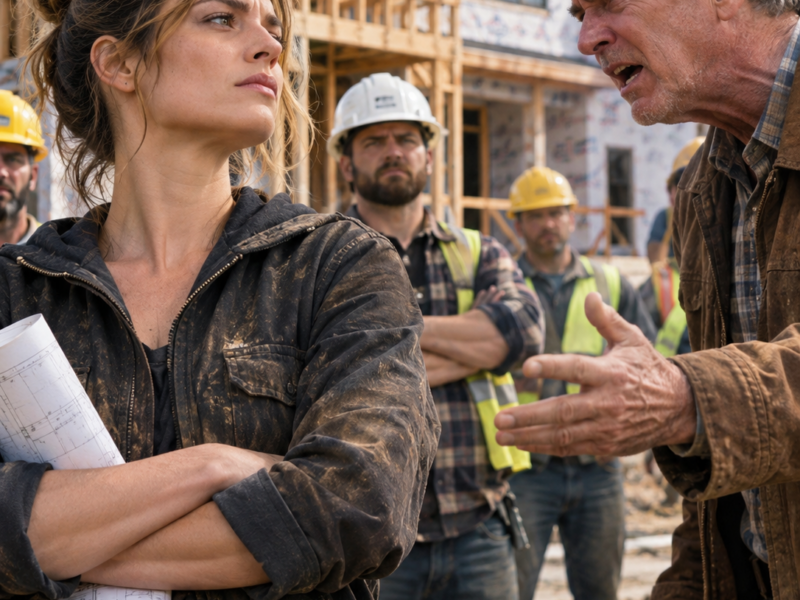
After 19 Years of Building My Father’s Company, He Gave My Brother-in-Law 50% of the Business and Told Me, “You’ll Still Have a Job, Same Crew, Same Pay.” I Quietly Walked Away and Started My Own Company. One Year Later, Dad Showed Up Before Sunrise, Begging Me to Finish His Biggest Contract—a 7,400-Square-Foot Luxury Home—at Cost Under His Name. I Simply Said, “Ride Up With Me, Dad.” When We Reached the Ridge, He Stepped Out of His Truck and Froze at What Was Waiting for Him…
After 19 Years of Building My Father’s Company, He Gave My Brother-in-Law 50% of the Business and Told Me, “You’ll Still Have a Job, Same Crew, Same Pay.” I Quietly Walked Away and Started My Own Company. One Year Later, Dad Showed Up Before Sunrise, Begging Me to Finish His Biggest Contract—a 7,400-Square-Foot Luxury Home—at Cost Under His Name. I Simply Said, “Ride Up With Me, Dad.” When We Reached the Ridge, He Stepped Out of His Truck and Froze at What Was Waiting for Him…
Part 1
“You’ll still have a job, Garth. Same crew, same pay. Caleb’s going to handle the business end now.”
My father made that announcement at Sunday dinner on October 19, 2025, in Dayton, Washington. He raised his water glass as though he were celebrating something wonderful, completely unaware that he had just destroyed the future I had spent nineteen years building.
Almost exactly one year later, he stood outside my workshop before sunrise, shivering in the October cold.
His Silverado was covered in frost, and my brother-in-law, Caleb, sat in the passenger seat with the engine running.
Dad didn’t bother saying good morning.
“I need you on the ridge house.”
Everyone in the valley knew which house he meant. It was a magnificent, 7,400-square-foot custom home overlooking Mill Creek, east of Walla Walla. Two stories, a stone stair tower, enormous exposed beams, and a porch wrapping around three sides.
It was the biggest contract Rasmussen Framing had ever landed.
“Bring your crew up Monday,” Dad continued. “Finish it at cost under our company name. Simon’s getting nervous. If he sees my son working up there, he’ll keep us on the job.”
I studied his face.
“And I’ll make it right with you on the next one,” he added.
There it was again.
The next job. The next opportunity. The next promise.
I had heard variations of those words since I was seventeen.
“Ride up with me, Dad,” I finally said.
Relief crossed his face. He thought I had agreed.
What he didn’t know was that the blueprints for the ridge house were already sitting on my dashboard.
He also didn’t know what my crew had been doing for the previous two days.
But before I explain what happened when we reached that ridge, you need to understand how my father managed to lose everything he had once promised me.
My name is Garth Rasmussen. I was thirty-four when my father decided that my sister’s husband deserved half the family business.
Dad founded Rasmussen Framing in 1993 with one truck, two compressors, and a determination that could move mountains.
For three decades, he built houses throughout southeastern Washington.
He was an excellent carpenter. I won’t pretend otherwise just because of what happened between us.
On Sunday afternoons, he used to drive us around town. Whenever we passed a house he had framed, he tapped his horn twice.
“That’s a Rasmussen,” he’d announce proudly.
I grew up believing that someday I would inherit more than a company. I would inherit a reputation.
My grandfather, Elof, was a carpenter too. He specialized in porches, and his work could be found throughout Dayton.
When I was nine, I watched my grandmother Augusta sit down on her porch swing with a glass of iced tea.
Without warning, the ceiling joist gave way.
The swing crashed onto the porch, breaking her wrist in two places.
Grandpa never forgot it.
After Grandma recovered, he removed part of the ceiling and installed reinforced blocking between the joists. He bolted everything together, rehung the swing, and sat on it himself before allowing Grandma anywhere near it.
Then he looked at me.
“Anything that holds a person, Garth, you build for two grandmas.”
That became the rule I carried into every house I built.
At fifteen, I started working summers for Dad. At eighteen, I joined his company full-time. By twenty-one, I was running my own crew.
Custom builders began requesting me specifically.
Whenever we framed a porch, I installed extra blocking for a future swing. It cost roughly fourteen dollars and twenty minutes.
Dad complained that nobody was paying us for it.
I did it anyway.
After the porch ceiling was finished, I marked the hidden blocking with two tiny brass tacks. When the homeowners moved in, I gave them a paper bag containing two galvanized eye bolts.
“There’s a swing up there,” I’d tell them. “You just can’t see it yet.”
Over the years, I installed swing blocking in approximately 430 porches.
Fifty-eight families sent me pictures after hanging their swings.
Those pictures meant more to me than any paycheck.
Unfortunately, my father had a habit of treating my dedication as something he owned.
The first time he took advantage of me, I was seventeen.
I’d spent an entire summer saving $640 for a used framing nailer. When I checked my savings account, eleven dollars remained.
My sister Lindsay had damaged a front tooth, and Dad had withdrawn my money to pay for her dental crown.
“A nailer’s a want,” he told me. “A front tooth is a bearing wall.”
I understood that Lindsay needed treatment. What I couldn’t understand was why nobody had asked me.
Dad never repaid the money.
Seven years later, a builder offered our company a $9,000 bonus for completing a fourteen-house subdivision ahead of schedule.
Dad promised the entire bonus to my crew.
We worked weekends, pushed through exhausting days, and finished nineteen days early.
The builder paid.
Three weeks later, Dad bought a used telehandler with our bonus.
“It’s an investment,” he explained. “This whole company will be yours someday. What’s the difference?”
“The difference is that I promised those men their money.”
He shrugged.
I paid each of my five crew members $300 from my own savings.
That was when I started keeping a waterproof yellow notebook containing every job, every payment, and every promise.
I also moved my savings into an account Dad couldn’t access.
In 2021, when lumber prices skyrocketed, Dad came to my house and admitted he couldn’t make payroll.
Fourteen families were depending on him.
My wife, Daniella, and I had saved $14,000 toward a larger vehicle because we wanted to start a family.
We lent him every dollar.
This time, at Daniella’s insistence, Dad signed a written agreement promising repayment within one year.
He repaid $3,000.
The remaining $11,000 never came.
Still, I kept working. I trained new employees, prepared estimates, supervised difficult projects, and maintained relationships with builders.
I believed Dad’s promises.
Then Lindsay married Caleb Durkey.
Caleb sold windows and doors and had a construction management degree. He carried a tablet everywhere and owned a spotless white hard hat that spent most of its life displayed on his dashboard.
He called carpenters “labor.”
Not craftsmen. Not crew members.
Labor.
Dad was fascinated by him.
Caleb could produce lumber estimates on his tablet in twenty minutes. Dad watched him as though he were witnessing a miracle.
I’d been preparing those same estimates with a pencil for ten years.
Nobody had ever applauded.
Then came that Sunday dinner in October.
Mom had prepared pot roast. Daniella sat beside me, helping our three-year-old son, Bram, hide carrots beneath his napkin.
Dad tapped his glass and stood.
“At sixty-two, I’ve got to start thinking about the future.”
I put down my fork.
For one foolish moment, I thought he was finally going to acknowledge everything I had done.
“Starting November first, Caleb will become my fifty-percent partner. He’ll handle estimates, contracts, and relationships with builders. He’s got the education and business sense we need.”
Caleb stood and shook Dad’s hand.
Lindsay clapped.
Mom stared at the table.
Then Dad turned toward me.
“You’ll still have a job, Garth. Same crew, same pay.”
Caleb smiled.
“We’re going to need good labor. You’re the best labor we’ve got.”
Something inside me went completely still.
I thought about the stolen savings, the missing bonus, the unpaid loan, and nineteen years of promises.
I placed my napkin beside my plate.
“I don’t need a job, Dad.”
He frowned.
“I’ve got a trade.”
Daniella stood immediately and picked up Bram.
I kissed Mom goodbye, told Lindsay I hoped she was happy, and walked outside.
Dad followed me onto Grandpa’s porch.
“Where do you think you’re going to go?”
I didn’t answer.
The following morning, I arrived at the company shop and began loading my personal tools into my truck.
Rigo Quiroga, Dad’s longtime foreman, pulled into the yard while I was working.
“He really made Caleb a partner?”
“Yes.”
Rigo took a sip of coffee.
“You starting something?”
“I’ve got a truck and some nailers. That’s about it.”
He nodded thoughtfully.
“I’ve got a truck and some nailers too.”
By Friday, Rigo and another experienced carpenter named Ezekiel had submitted their resignations.
Dad believed he had replaced me with someone better.
He had no idea that the people who actually knew how to build his houses were already walking out the door.
And within a year, he would discover exactly how much his decision had cost him.
Part 2
I started my new company with three men, three trucks, and barely enough money to survive.
Our workshop belonged to an elderly widow named Winifred Fennimore. Years earlier, I had repaired her broken porch swing without charging her.
When she learned what Dad had done, she offered me her late husband’s machine shed for $100 a month.
“That’s charity,” I protested.
“Then it’s charity,” she replied.
We named the company Touchet Framing.
Daniella worked extra hospital shifts. I bought a used trailer and took every reasonable job I could find.
By June, we had seven employees.
Every paycheck cleared.
Every porch received swing blocking.
Then Simon Vandergriff, one of Dad’s most important clients, invited me to bid on the enormous ridge house.
My estimate was $258,000.
Caleb submitted a bid for $196,000.
Simon chose Rasmussen Framing.
“Stay in your lane, bro,” Caleb texted me. “That’s a Rasmussen house.”
I didn’t argue.
But shortly afterward, Lindsay visited my workshop with a confession.
Dad hadn’t made Caleb his partner because of his education or business skills.
He had done it because he owed Caleb’s parents $88,000.
And the disastrous investment behind that debt was about to explain everything.
Part 3
Lindsay arrived at the workshop on a Sunday afternoon with her fourteen-year-old son, Jonas.
He immediately wandered toward Ezekiel, who was cutting lumber near the entrance.
Lindsay sat on a stack of studs.
“Mom told me not to tell you this,” she began.
I set down my pencil.
“Tell me what?”
She took a deep breath.
“You remember that house in College Place?”
Of course I remembered.
Caleb had convinced Dad to build a speculative house shortly after marrying Lindsay. He claimed they could make $100,000 selling it.
He called it the Durkey Model.
He had plans for an entire series of houses.
My crew had framed the first one.
Construction dragged on for eleven months because Caleb repeatedly changed the finishes. Then the completed house sat unsold for another fourteen months.
When it finally sold, Rasmussen Framing lost $71,000.
What I hadn’t known was where the investment money came from.
“Caleb’s parents lent Dad eighty-eight thousand dollars,” Lindsay explained. “He couldn’t repay them.”
I stared at her.
“So they made an arrangement. Caleb would get half the company instead.”
For a moment, the sounds of the workshop seemed to disappear.
“The partnership was repayment?”
She nodded.
“Dad also borrowed against the shop to cover some of the remaining expenses.”
I sat down on an overturned bucket.
All those years, Dad had told me the company would eventually be mine.
He had used that promise to justify keeping my money, withholding bonuses, and asking me to sacrifice my family’s savings.
Then he had surrendered half of it because Caleb convinced him to gamble on a house they couldn’t afford.
“Why didn’t he tell me?”
Lindsay shook her head.
“He was ashamed.”
“And telling me I wasn’t qualified was easier?”
She didn’t answer.
I looked toward Jonas, who was laughing while Ezekiel showed him how to measure a board.
“Why are you telling me now?”
Lindsay followed my gaze.
“Because Jonas needs somebody to learn from. And it isn’t going to be Caleb.”
Her voice broke.
I had never blamed my sister for the money Dad took when we were teenagers. I wasn’t going to blame her for this either.
“Send him out on Saturdays when school finishes,” I said. “I’ll pay him twelve dollars an hour to start learning.”
She wiped her eyes.
“Thank you.”
After they left, I opened my yellow notebook and recorded everything she had told me.
Then I sat there for a long time.
Somehow, learning the truth hurt more than believing Dad simply preferred Caleb.
He had traded away the future he promised me to settle a debt.
And instead of admitting his mistake, he had stood at Sunday dinner and presented it as a brilliant business decision.
Meanwhile, Rasmussen Framing was preparing to begin its biggest project ever.
I knew the ridge house well. I had spent four evenings studying its plans.
It required engineered beams, complicated roof framing, reinforced shear walls, and careful attention to structural details.
My estimate wasn’t inflated.
It was what the job required.
Caleb’s bid was $62,000 lower.
There were only two possibilities: he had underestimated the work, or he intended to save money somewhere he shouldn’t.
Neither possibility ended well.
Rasmussen Framing began construction on July 6.
I stayed away.
My company had its own commitments, and I wasn’t interested in watching Dad struggle.
But the construction industry in southeastern Washington is small. Lumber drivers, inspectors, electricians, and plumbers all talk.
By late July, I heard Dad’s crew was down to six men, three of whom were inexperienced.
In August, Dad finally contacted me.
Need two of your guys for a week on the ridge. We’ll pay.
I replied that everyone was booked.
It wasn’t an excuse. We had three houses underway.
Then September brought more troubling news.
A county inspector had rejected the ridge house’s shear walls.
Twice.
The engineered plans required nails every three inches along the edges of the structural sheathing. Dad’s crew had installed them six inches apart.
When they attempted to correct the mistake, many of the additional nails were driven too deeply.
From a distance, the wall looked perfectly fine.
Structurally, it wasn’t.
Then a plumber discovered two engineered floor joists with their bottom flanges cut through to accommodate a drainpipe.
Anyone familiar with those joists knew that cutting the flanges could seriously compromise their strength.
I couldn’t believe those mistakes had happened under Dad’s name.
He had taught me better than that.
Whatever resentment I carried, I had never questioned his ability as a carpenter.
But Caleb was running the business now, and the company appeared to be moving faster than its remaining experienced employees could manage.
The worst news arrived at the beginning of October.
Rasmussen Framing’s payroll checks had bounced.
Then they bounced again.
On October 2, the crew walked off the ridge house at noon.
Nobody returned.
When I heard, I didn’t celebrate.
Some of those men had worked beside me. I’d trained several of them myself.
They had mortgages, children, groceries to buy.
They deserved better.
On October 8, Simon Vandergriff terminated Rasmussen Framing’s contract.
Four days later, my phone rang.
“Garth,” Simon said, “is your number still good?”
“What number?”
“Two hundred fifty-eight thousand.”
I leaned back in my chair.
“I heard you were having problems.”
“Problems is a generous word. Can you come look at it?”
The following afternoon, Rigo and I drove to the ridge.
The property was breathtaking. Beyond the unfinished walls, the valley stretched toward the Blue Mountains.
But the house itself was a mess.
The first-floor walls stood beneath an incomplete second-floor deck. There was no roof.
Rigo approached the north shear wall and ran his thumb across the nail heads.
He looked at me without speaking.
We found the damaged joists.
We found a kitchen window header made from ordinary lumber where the plans specified an engineered beam.
We found great-room walls leaning three-quarters of an inch out of plumb over ten feet, inadequately braced against the ridge’s powerful winds.
Simon watched us examine everything.
“Can you fix it?”
“Yes,” I answered. “But we have to undo some of what’s already been done.”
He nodded.
“Tell me what it costs.”
We spent the remainder of the afternoon calculating the repairs.
The next day, October 14, I sat at Simon’s kitchen table and signed a new contract.
Not under Rasmussen Framing.
Under Touchet Framing.
My company. My crew. My responsibility.
We began work Thursday morning.
The first thing we did was remove the defective sheathing.
By Friday evening, we had made considerable progress, but the weather forecast was turning against us.
I asked the crew if they wanted to work Saturday.
Everyone agreed.
At 5:50 that Saturday morning, I was preparing to leave the workshop when Dad’s Silverado appeared through the darkness.
Caleb sat beside him.
Dad climbed out, shoved his hands into his jacket pockets, and approached me.
“I need you on the ridge house.”
I immediately understood.
He didn’t know.
He didn’t know Simon had hired me.
He didn’t know my men had already spent two days repairing his company’s mistakes.
And somehow, despite receiving a termination notice, he still believed he could recover the contract by putting me back to work beneath his name.
“Finish it at cost,” he said. “For the family.”
I looked toward my truck.
The blueprints were sitting on the dashboard.
“Ride up with me, Dad.”
He smiled for the first time that morning.
Forty miles later, that smile would disappear.
Part 4
Dad followed my truck along Highway 12 through Waitsburg and Walla Walla.
The sky gradually brightened as we turned onto Mill Creek Road and climbed toward the ridge.
I watched his headlights in my rearview mirror.
Part of me wondered whether I should pull over and tell him everything before we arrived.
But I remembered all the times he had made decisions affecting my life without offering me the courtesy of a private conversation.
This time, he could see the truth for himself.
We rounded the final switchback.
Five trucks were parked beside the house.
My tandem trailer stood near the porch, with TOUCHET FRAMING painted across its side in lettering Daniella had chosen.
Above us, Rigo carried a sheet of sheathing across the second floor.
Dad pulled in behind me.
For several seconds, he remained inside his truck.
Then he opened the door and stepped onto the gravel.
His eyes moved from the trailer to the workers, then back to me.
Caleb climbed out wearing his spotless white hard hat.
It was the first time I had ever seen him actually put it on.
Simon appeared around the corner carrying two cups of coffee.
“Morning, Garth.”
Then he noticed Dad.
“Morning, Arvin. I wondered when you’d come back for your sawhorses. They’re beside the dumpster.”
Dad stared at him.
Then he turned toward me.
“How long?”
“We started Thursday.”
“You’re already working here?”
“I signed a contract with Simon on Wednesday.”
Caleb marched forward.
“Hold on. This is our contract. Rasmussen Framing has a signed agreement for this house.”
Simon looked at him calmly.
“You had a contract.”
“You can’t just bring another crew in. We’ve got lien rights. We’ll tie this project up so tight you won’t have a roof until spring.”
Simon took a sip of coffee.
“Your termination letter arrived by certified mail on October eighth. You signed for it, Caleb. I have the receipt.”
Caleb’s expression changed.
“And while we’re discussing liens,” Simon continued, “I paid thirty-one thousand dollars directly to the lumberyard because your account was overdue and they were threatening to place a lien on this property.”
Nobody moved.
“If you’d like to discuss who owes whom, my lawyer would be happy to arrange a meeting.”
Caleb opened his mouth, reconsidered, and looked away.
Dad didn’t challenge Simon.
Instead, he turned on me.
“I taught you everything you know.”
His voice was quiet, which somehow made the accusation heavier.
“Every wall you’ve ever stood, I showed you how. And this is how you repay me? Going behind my back to a builder who’s worked with me for twenty years?”
“I didn’t go behind your back.”
“You took my biggest job.”
“I bid on this house in April, Dad. Simon chose your company. I accepted that decision.”
He shook his head.
“You could’ve called me.”
“And told you what? That someone needed to fix the house?”
I gestured toward the north wall.
“Come look at something.”
We walked over to the remaining section of defective sheathing.
Dad knew immediately what he was looking at.
He placed his palm against the wall and slowly moved his thumb along the nail heads.
It was exactly what Rigo had done four days earlier.
He examined the spacing.
Six inches between the original nails.
Additional nails installed between them, many driven too deeply.
He didn’t need an explanation.
For thirty years, he had inspected work like this.
“Who did this?” he asked.
“Your crew. After the first inspection failed.”
He looked at Caleb.
Caleb was suddenly very interested in his phone.
Dad moved his hand across the wall again.
I could see something changing behind his eyes.
This wasn’t a disagreement about family loyalty anymore.
It was a structural failure bearing his name.
I showed him the damaged joists and explained the incorrect window header.
He listened without interrupting.
Finally, he asked, “What did you bid?”
“Two hundred fifty-eight thousand.”
“Caleb bid one ninety-six.”
“Yes.”
Dad stared toward the unfinished roofline.
“Sixty-two thousand short.”
He said it slowly, as though the difference had only just become real.
Caleb attempted to defend himself.
“We were trying to be competitive. Nobody anticipated all these problems.”
Dad looked at him.
“The plans were right there.”
Caleb said nothing.
Above us, Rigo set down his sheet of sheathing.
The other workers had grown quiet.
Nobody was laughing. Nobody was celebrating.
They were watching a man who had once commanded enormous respect confront the consequences of trusting the wrong person.
Then Henrietta Tibbles, the homeowner, appeared around the porch.
She was seventy, wearing a green raincoat, and had accompanied Simon to inspect the progress.
She looked from Dad to Caleb.
“You’re the other framers?”
Dad nodded.
“Yes, ma’am.”
“I’d like to show you something.”
She pointed upward.
Between the exposed porch joists were two sets of reinforced blocking, positioned five feet apart.
“Garth showed me those on Thursday,” she said. “They’re for my porch swing.”
Dad followed her finger.
“He asked whether I wanted a swing someday. I told him I’d always dreamed of having one overlooking this valley.”
She smiled.
“He’d already installed the blocking. I hadn’t even asked him to.”
Her husband and she had built three homes over forty years, she explained.
No carpenter had ever done that for them.
Dad stared at the reinforced lumber.
I knew exactly what he was remembering.
Grandma’s broken wrist.
Grandpa standing on a stepladder.
Two grandmas.
“That was my dad’s,” he finally whispered.
I looked at him.
“No, sir. It’s mine now. He gave it to me.”
For the first time that morning, Dad didn’t argue.
He looked toward the trailer carrying my company’s name.
Then at the men working above us.
Three of them had once worked for him.
He looked at Simon, who had trusted Rasmussen Framing for twenty years and now trusted Touchet Framing instead.
Finally, Dad tried one more time.
“At cost, Garth. Just this once. For the name.”
I felt the weight of nineteen years settle between us.
“You’ve had me at cost for nineteen years, Dad.”
He looked directly at me.
“I’m not doing it anymore.”
The words weren’t loud.
They didn’t need to be.
Dad nodded almost imperceptibly.
Then he walked toward the dumpster.
Two wooden sawhorses stood beside it, his initials burned into their legs.
He picked up the first and carried it to his truck.
Then he returned for the second.
Caleb didn’t offer to help.
I watched Dad load them into the bed of his Silverado.
For years, he had driven us past houses and proudly announced that they were Rasmussens.
Now he was leaving the largest house he had ever attempted with nothing but two old sawhorses.
Simon handed me my coffee.
“Well,” he said, “that’s a way to start a Saturday.”
I almost smiled.
But watching Dad climb into his truck, I realized I didn’t feel victorious.
I felt relieved.
There was a difference.
Before he drove away, I walked over and knocked on his window.
He rolled it down.
Caleb stared straight ahead.
“Supper’s every other Sunday at our house,” I told Dad. “Starting in November.”
He looked surprised.
“Call first. Just you and Mom.”
For a moment, I thought he might apologize.
He didn’t.
But he nodded.
Then he rolled up the window and drove down the ridge.
I stood there until his truck disappeared around the switchback.
Rigo called down from the second floor.
“You coming up, boss?”
I put my coffee beside the trailer.
“Coming.”
And for the rest of that morning, we did what we had always done best.
We built a house.
Part 5
We finished framing the ridge house and got it under roof on the Tuesday before Thanksgiving.
The final inspection went well.
Every structural problem we had inherited was corrected. The damaged joists were replaced, the appropriate engineered header installed, the walls straightened and properly braced, and the shear walls rebuilt according to the plans.
Rigo stood beneath the completed roof, admiring the complicated intersections.
“Best roof I’ve ever worked on,” he announced.
Coming from Rigo, that was practically a standing ovation.
Simon paid every invoice on schedule.
Before we left the property, I walked around the porch and looked out over the valley.
There would be furniture here someday. Morning coffee. Family conversations. Maybe grandchildren running between the columns.
And there would be a swing.
That mattered to me.
Not because it proved I was better than my father, but because it reminded me why I had chosen this trade in the first place.
We weren’t simply assembling lumber.
We were building the places where people would live their lives.
Rasmussen Framing survived, although it never returned to what it had been.
Dad sold the yellow telehandler in December.
I watched it leave on a flatbed trailer one afternoon.
That was the machine purchased with the $9,000 bonus my crew had earned years earlier.
The following February, he sold the shop on Main Street.
The proceeds covered most of his outstanding bank debt.
I never asked what happened to the arrangement with Caleb’s parents.
Caleb eventually returned to selling windows and doors in Kennewick.
Apparently, he’s quite successful at it.
He has always been good at talking.
Dad now builds decks, garages, and sheds with one helper. He no longer takes on enormous custom houses or maintains a large payroll.
His back seems happier.
And I suspect, although he would never admit it, that he enjoys being a carpenter again instead of trying to become something Caleb convinced him he should be.
Something else changed.
On the first day of every month, an envelope appears in my mailbox.
Inside is a money order for $200.
There is no letter.
No explanation.
Just two words written in Dad’s familiar carpenter-pencil handwriting.
Garth loan.
I record each payment in my yellow notebook.
He still has roughly four years of payments remaining.
I haven’t told him to stop.
He hasn’t asked me to.
For the first time in my life, one of his promises is being fulfilled without me having to remind him.
Our Sunday dinners resumed in November.
Mom always calls ahead, and Dad usually arrives a few minutes early.
She brings a pie or some other dessert.
Dad brings nothing.
That’s fine.
I’m not asking him to buy his way back into my life.
I’m asking him to respect the boundaries that should have existed all along.
We don’t discuss the companies.
We don’t revisit the dinner when he announced Caleb’s partnership.
Sometimes we talk about the weather, or baseball, or whatever Bram has been doing at preschool.
Sometimes Dad tells stories about Grandpa.
Bram listens as though he’s hearing adventures from another century.
One Sunday, after dinner, Dad wandered onto my front porch and sat on the swing.
Bram climbed beside him.
My son was four by then and had decided his grandfather was the funniest man alive.
They rocked gently while the evening sun settled over the wheat fields.
I stood near the doorway, watching them.
For a while, neither spoke.
Then Dad tilted his head back and examined the porch ceiling.
He spotted the two brass tacks.
“What’s this hung from?” he asked.
“Doubled two-by-eights. Bolted.”
He nodded.
Then, so quietly I almost missed it, he said, “Built for two grandmas.”
I stopped moving.
I hadn’t heard him use those words since Grandpa died.
All these years, I had assumed he had forgotten.
Maybe he hadn’t.
Maybe somewhere beneath the financial troubles, wounded pride, and terrible decisions, the carpenter who raised me was still there.
I didn’t say anything.
I simply watched him push the swing gently with his boots while Bram laughed beside him.
There are moments when forgiveness arrives without a dramatic speech.
That was one of them.
I hadn’t forgotten what Dad had done.
I hadn’t excused it.
But I could allow him to be my son’s grandfather without allowing him to control my future.
Those were separate things.
Meanwhile, Touchet Framing continued growing.
Mrs. Fennimore was eighty-four and still refused to increase my rent.
Every Friday at three, she delivered lemon bars to the workshop.
Rigo insisted that any company without a scheduled dessert delivery was fundamentally mismanaged.
I continued driving her to her eye appointments in Walla Walla.
Sometimes, afterward, we stopped for lunch.
She always asked about Bram and the crew.
She never asked how much money the company was making.
One afternoon, I told her I could afford a proper commercial workshop now.
She looked offended.
“What’s wrong with Fred’s shed?”
“Nothing.”
“Then quit talking nonsense.”
So we stayed.
Jonas began working Saturdays, just as Lindsay and I had arranged.
At first, he swept floors, carried lumber, and learned to measure accurately.
Ezekiel supervised him carefully around the tools.
Jonas was fifteen when I finally allowed him to install his first set of porch swing blocking.
He measured the distance three times.
Then he called me over to inspect it.
“Is that right, Uncle Garth?”
I examined his work.
The blocking was properly positioned and securely installed.
“Looks good.”
He grinned.
“Built for two grandmas?”
“Exactly.”
When the homeowners moved in, I gave Jonas a brown paper bag containing the galvanized eye bolts.
“You do it this time.”
He walked across the yard and handed the bag to the couple.
“There’s a swing up there,” he explained, pointing toward the porch ceiling. “You just can’t see it yet.”
I stood beside my truck and listened.
For the first time, those words belonged to somebody else.
And I understood what Grandpa had actually given me all those years ago.
It wasn’t a clever carpentry technique.
It was a responsibility.
Dad had spent years convincing me that inheritance meant owning his company, his equipment, his shop, and the name painted on his trucks.
But Grandpa’s inheritance had never required a contract.
It was something I carried into every house.
Something nobody could sell, borrow against, or trade away to settle a debt.
And now Jonas carried it too.
A few weeks later, Henrietta Tibbles sent me a photograph.
She and her husband were sitting on a beautiful cedar swing beneath the porch of their finished ridge house.
Behind them, the Walla Walla Valley stretched green and endless beneath a clear sky.
Her message was simple.
Garth, we finally hung it. Thank you for thinking of us.
I saved the picture in the same folder as the others.
That made fifty-nine.
Fifty-nine swings I knew about.
Fifty-nine families who had found something waiting for them that they hadn’t necessarily requested.
And somewhere among those houses, perhaps another child would grow up watching their grandparents sit together on a porch.
Perhaps they would remember it decades later.
Perhaps that was how a legacy really worked.
The Sunday Dad announced Caleb’s partnership, he believed he was telling me where I belonged.
He thought I would continue working beneath his name, accepting the same pay and waiting for another promise.
He was wrong about that.
But he was right about one thing.
I still have a job.
I have a workshop, seven hardworking men, a wife who stood beside me when I had almost nothing, and a son who thinks every porch should have a swing.
My nephew is learning a trade.
My father is slowly repaying his debt.
My mother no longer needs to set an extra plate whenever an argument threatens to break out.
And every Friday, seven paychecks clear.
Sometimes I drive Bram around Dayton on Sunday afternoons.
We pass houses Grandpa worked on, houses Dad framed, and houses my own crew built.
Occasionally, Bram points toward one and asks whether I helped make it.
When I tell him yes, he smiles.
I don’t tap the horn anymore.
I don’t need the whole neighborhood to know whose hands stood those walls.
The families living inside them know they have a solid home.
That’s enough.
Because a man’s legacy isn’t measured by how much of a company he owns, how impressive his title sounds, or how many people he can order around.
It’s measured by what remains standing after he walks away.
My father once promised me an entire business.
In the end, I built my own.
And the most valuable thing I inherited from my family wasn’t the Rasmussen name.
It was a lesson from an old carpenter who loved his wife enough to rebuild a broken porch.
Anything that holds a person, you build for two grandmas.
I’ve spent my life following that rule.
And I intend to keep following it, long after the last debt is repaid, the last house is framed, and my own grandson asks me why there are two little brass tacks in the porch ceiling.
THE END