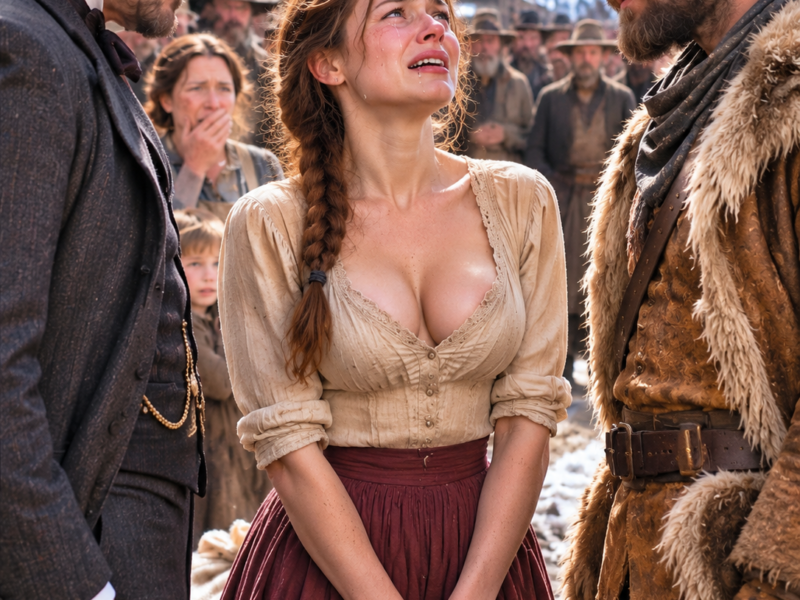
A POOR WOMAN WAS FORCED TO MARRY A CRUEL MERCHANT—UNTIL A MOUNTAIN MAN STEPPED IN
A POOR WOMAN WAS FORCED TO MARRY A CRUEL MERCHANT—UNTIL A MOUNTAIN MAN STEPPED IN
Part 1
The second strike of the leather strap landed across Willa Prather’s back, and her mother still did not move.
Willa knelt in the muddy street of Ransom Gulch, her auburn hair coming loose from its braid, her dress stained with dirt and blood. The November wind swept through the little mining settlement, carrying the smell of wood smoke, wet horses, and frozen earth. Forty people stood along the wooden boardwalks, watching. Some looked uncomfortable. Others stared at their boots. Not one stepped forward.
Across from her stood Barlow Quint, the wealthiest merchant in the settlement. His gray waistcoat was perfectly buttoned, his silver watch chain gleamed in the pale afternoon light, and his rimless spectacles rested neatly on his nose. He held a folded document in one hand and spoke in the calm, pleasant voice of a man discussing an ordinary business transaction.
He was reading the terms of Willa’s marriage.
Behind him, Rufus Lasker, a thick-shouldered teamster with a sandy beard, held a leather strap. He had already struck her twice. Now he was preparing to do it again.
In the doorway of the laundry, Willa’s little brother, West, pressed a fist against his mouth. His thin shoulders trembled with the effort of holding back a cough.
Willa lifted her head.
“No.”
Her voice was weak from pain, but it carried across the street.
The strap rose again.
Then a large hand reached from behind and caught it in midair.
The stranger wearing an old elk-hide coat had two missing fingers on his left hand. He did not shout or threaten anyone. He simply held Rufus Lasker’s arm so firmly that the teamster could not move.
The stranger’s name was Amos Teague.
And eleven days earlier, Willa Prather had believed that her greatest problem in life was a merchant who cheated people out of flour.
She had no idea that the truth would take her to a mountain cabin, force her to confront the difference between love and obligation, and eventually change the fate of an entire town.
It had begun on October 24.
The laundry kitchen was the warmest room in the Prather household, although the warmth came mostly from the enormous boiler that Dorcas Prather used to wash miners’ clothes. Steam clouded the small window, and the smell of soap, wet wool, and wood smoke clung to everything.
In the adjoining room, West coughed.
He had been coughing for weeks. At first, Dorcas had called it a seasonal cold. Then she began saying the mountain air was bad for him. Eventually, she stopped giving the illness a name at all.
Willa knew what that silence meant.
Her father, Elam, had been a miller. Before his death, he had taught her to recognize dishonest measurements, understand the movement of a balance beam, and keep accounts so carefully that even a man looking for an error would struggle to find one.
That morning, she had taken a fifty-pound sack of flour purchased from Quint Company and hung it from her father’s old brass steelyard.
The beam settled.
She moved the weight.
Then she checked again.
Forty-three and a half pounds.
She lowered the sack and stared at the scale.
Perhaps the beam had shifted. Perhaps the old weights had become inaccurate. She cleaned the metal, checked the balance, and tried once more.
Forty-three and a half.
The missing six and a half pounds represented more than five dollars at the prevailing price of flour.
For a prosperous merchant, that might have been a small amount. For a miner’s family, it could mean several days without bread.
Willa opened her father’s cloth-bound day book and wrote down the figures.
She did not immediately accuse anyone. Her father had always told her that a good measurement was worth more than an angry argument.
That afternoon, she walked to Quint Company.
Barlow Quint received her behind the counter. He was a courteous man, always careful to wipe his boots before entering someone’s home and always ready with a pleasant word.
He examined her calculations through his spectacles.
“You have your father’s eye, Miss Prather,” he said.
Willa waited for him to explain the shortage.
He merely handed the paper back.
“Thank you for bringing this to my attention.”
She had expected denial, perhaps even anger. Instead, his calm response left her feeling as though she had handed a thief her purse and politely asked him to watch it.
She returned home unsettled.
Two days later, Barlow Quint visited the Prather laundry.
Dorcas received him in the front room, her sleeves still wet to the elbows. The family was struggling financially. Their laundry business survived almost entirely on credit, and the note secured against the building stood at $214, plus interest, due on March 1.
If they failed to pay, they would lose their home and the business that provided their only income.
Quint knew this.
He also knew West was sick.
He sat comfortably in the chair opposite Dorcas and explained that he had come with a proposal.
He wanted to marry Willa.
Willa stood near the stove, holding a wooden spoon.
She was twenty-four. Quint was old enough to have been her father, and his interest in her had never been particularly difficult to recognize.
He offered Dorcas a comfortable house, a doctor for West, and an agreement to postpone the family’s debt.
He also offered fifty pounds of flour as an advance gift.
The sack had already been delivered. It stood beside the front door, still sealed.
Dorcas looked at it more than once.
Quint spoke about stability, security, and the advantages of joining two respectable households. He even mentioned that Willa’s talent for bookkeeping would be useful in his business.
“A man in trade needs someone who understands figures,” he said. “Someone he can trust to keep them quietly.”
Willa understood the final word.
Quietly.
He wanted her to work beside him, but he also wanted her to forget what she had discovered about his scales.
The wedding agreement would be signed publicly on Saturday, November 4, at noon.
After Quint left, Willa told her mother everything.
She explained the missing flour, the repeated measurements, and the figures in her father’s book.
Dorcas listened with her hands twisted tightly in her apron.
For a long time, she said nothing.
Then she looked toward the sealed sack by the door.
“I can’t eat your principles, Willa.”
Her voice cracked.
Willa stared at her.
“He’s stealing from every family in town.”
“And we are one of those families who cannot afford to lose what little we have.”
“He wants me because I know how to keep accounts.”
“Perhaps he wants you because he can give us a future.”
“He wants me to keep his theft quiet.”
Dorcas closed her eyes.
The arithmetic was cruelly simple. One daughter might have to sacrifice her happiness so that her mother and younger brother could survive.
But nobody had asked Willa whether she was willing to make that sacrifice.
The morning of November 4 arrived cold and gray.
Amos Teague came down from Cutter Creek with two mules and six hundred pounds of elk meat, as he had every autumn for six years.
He was a little over six feet tall, broad-shouldered, and weathered by years in the mountains. His sandy-gray beard covered much of his face, and his nose had been broken long ago and set badly.
His two mules had very different personalities.
Deacon judged everyone.
Pearl wanted oats.
Amos had planned to buy flour, salt, powder, and coffee from Quint Company. Instead, he noticed something unusual as he approached the settlement.
The chimneys were cold.
The streets were quiet.
Men stood outside their cabins with their hands in their pockets, watching the center of town.
Hungry settlements were usually noisy. People complained, bargained, argued, and searched desperately for supplies.
Ransom Gulch seemed to be holding its breath.
Amos tied the mules outside the store but remained on the street.
At noon, Barlow Quint stepped onto the boardwalk.
He unfolded a document and began reading.
The agreement stated that Dorcas Prather had accepted his marriage proposal on behalf of her daughter. It mentioned the fifty pounds of flour, the promise of medical assistance for West, and the postponement of the family debt.
Everything sounded proper.
Everything was carefully written.
And everything treated Willa as though she were another item in a business ledger.
Dorcas signed first.
Her hand shook so badly that the signature slanted upward.
Then she passed the pen to her daughter.
Willa looked at her mother’s name.
She looked at the document.
Then she tore it in half.
She tore it again and let the pieces fall into the mud.
“I will not marry a man who needs me to remain silent.”
Dorcas slapped her.
The sound was small, but everyone heard it.
For a moment, mother and daughter stared at each other. Dorcas’s face crumpled with regret almost immediately, but the damage had already been done.
Quint adjusted his spectacles.
“Mr. Lasker.”
Rufus Lasker stepped forward.
He slowly uncoiled the leather strap from his belt. He looked at Quint, then at Willa. Perhaps he hoped someone would stop him.
Nobody did.
The first strike landed across her back.
The second brought her to her knees.
She refused to cry.
When he raised the strap for a third time, a stranger’s hand caught his arm.
Amos Teague stood behind him.
“You don’t want to carry this for the rest of your life,” Amos said quietly.
Something changed in Rufus’s expression.
His fingers opened.
He stepped backward, his face pale beneath his beard.
Quint approached with his usual polite expression.
“This is a lawful matter, sir. Her mother has signed.”
Amos did not argue about the law.
Instead, he looked at Willa.
“Ma’am, do you want to be here?”
Nobody had asked her that question before.
Willa looked at his weathered face and pale blue eyes.
“No.”
She pushed herself upright.
Then she explained the situation without asking for sympathy.
“He holds my mother’s deed. If I leave, my brother may starve. My mother will lose the laundry. We have nowhere else to go.”
Amos listened.
He looked at the hungry faces along the boardwalk. Then he glanced toward his mules and the six hundred pounds of elk meat.
“I came here to sell my meat to Mr. Quint,” he announced.
He raised his voice so the entire street could hear.
“I’ve changed my mind. Two pounds to anyone who can pay. And a hindquarter goes to Widow Prowther’s door for free.”
For several seconds, nobody moved.
Then a miner near the back raised his hand.
“I’ll take ten pounds.”
The street erupted.
Men pushed toward the mules. Women hurried from their cabins carrying coins. People who had barely spoken to one another in days suddenly began discussing prices and dividing meat.
Quint watched his carefully controlled market disappear before his eyes.
“Mr. Teague,” he said softly, “not one man in this territory will sell you so much as a cup of salt.”
“Then I’ll learn to make coffee from acorns.”
Amos looked at him.
“Though I’m told it’s an acquired taste.”
Quint’s smile disappeared.
“The note against the Prather property remains valid. It will be collected in full on March first.”
Before Amos could respond, Willa spoke.
“I’ll go up the mountain with Mr. Teague as a hired hand. I’ll work for my board and lodging. He’ll bring meat to my family every month. Those are my terms.”
Amos turned toward her.
“That suits me.”
He did not offer marriage. He did not promise to rescue her. He did not tell her what she ought to do.
For the first time in days, Willa felt that her decision belonged to her.
West came running from the laundry doorway and wrapped his arms around her skirts.
“Are you the elk man?” he asked Amos.
“That’s what some people call me.”
“Does your mule bite?”
“Pearl does. Deacon mostly judges.”
West managed a small laugh before another cough interrupted him.
Willa knelt and kissed his forehead.
“I’ll be back at first thaw. That’s a promise. Eat the meat, and mind Ma.”
Then she turned toward the sled.
At the edge of town, she noticed the sealed flour sack that Quint had sent as an advance payment. A small piece of paper had been pinned to it.
The handwriting was her mother’s.
I’d sooner you eat.
Willa read the sentence twice.
She folded the paper and put it in her pocket.
She was not ready to forgive her mother.
She was not ready to accept the flour.
And she certainly was not ready to forget what had happened.
As the first snowflakes began falling, she followed Amos toward the mountain, carrying her father’s sourdough crock against her chest.
Neither of them knew what awaited them beyond the ridge.
But for the first time in her life, Willa was walking away from a place where everyone else had decided what she was worth.
And she intended to make certain that nobody ever did that again.
Part 2
The climb took two days. Snow covered the trail, and Willa walked beside Pearl while Amos led the other mule. They camped beneath a split boulder, sharing roasted elk and the warmth of a small fire.
Amos never asked about her bruises. When she slipped, he offered Pearl’s lead rope instead of grabbing her arm.
His cabin stood beneath a mountain ridge. It had one room, a cast-iron stove, a small loft, and two chairs. One was worn from years of use. The other stood untouched against the wall.
He gave Willa the loft and slept downstairs.
The following morning, she opened her father’s day book.
“Firewood, cooking, and labor against meat, shelter, and supplies,” she announced.
Amos studied her columns.
“I don’t keep accounts.”
“I do.”
“Then write whatever makes you comfortable, Miss Prather.”
And that was how their unusual arrangement began.
Neither understood yet that the little ledger would eventually become the greatest test of their growing affection.
Part 3
The first weeks in the mountain cabin were not easy.
Willa had spent most of her life in a settlement where every task was measured against something else. Every dollar mattered. Every pound of flour had a price, every hour of labor had a value, and every favor came with the possibility of becoming another debt.
She had expected Amos Teague to be difficult.
He was certainly an unusual man. He spoke very little, drank coffee that tasted as though it had been boiled in a leather saddle, and seemed to believe that most household problems could be solved by cutting more firewood.
But he did not behave like the men Willa had known.
He never entered the loft without permission. He never questioned how she spent her time. He did not complain when she corrected his cooking or pointed out that his woodpile was stacked in a manner that invited the entire mountain to collapse upon it.
Most importantly, he never reminded her that she owed him anything.
That made her suspicious.
On her third morning in the cabin, Willa discovered that Amos owned only nine pounds of flour, a little salt, and a considerable quantity of coffee.
She measured the flour carefully, set aside a portion to feed her sourdough starter, and prepared four small loaves.
The first came out too dark on one side.
The second was better.
The third had a golden crust that crackled when she tapped it.
Amos watched from the table.
“Your fire is too hot at the top and sulking at the bottom,” she told him.
“We’ve had our differences.”
“And your coffee isn’t brewed. It’s been punished.”
“It knew what it did.”
She laughed.
It was a small sound, almost unfamiliar to her. She had not laughed freely in months.
Amos cut a slice of bread with his two remaining fingers and ate slowly.
“Good crust,” he finally said.
He did not elaborate, but Willa noticed that he ate three slices.
That evening, while the stove ticked quietly, Amos asked about the merchant.
Willa explained everything again, this time in greater detail.
She told him about the fifty-pound sack that weighed only forty-three and a half pounds. She explained how the missing flour represented money stolen from every family in Ransom Gulch.
“My father was a miller,” she said. “I know what a sack should weigh.”
Amos listened.
“What do you need to prove it?”
Willa had expected him to ask whether she was certain. Instead, he asked what evidence she needed.
“A certified scale. Several sacks weighed at the source. And witnesses who cannot be bought.”
He nodded.
“Then that’s what you need.”
Something inside her loosened.
For years, men had treated her knowledge as an inconvenience. They praised her intelligence when it served them, then ignored it when it became uncomfortable.
Amos had simply believed her.
She did not know what to do with that kind of trust.
Winter settled over the mountain.
The days became shorter, and snow buried the lower trails. Willa learned how to prepare elk meat, repair clothing, and keep the cabin warm without wasting precious wood.
Amos learned that bread could be improved by patience and that a person did not need to burn coffee merely because the beans had become expensive.
Their conversations grew longer.
Sometimes they argued about the stove.
Sometimes they discussed the weather.
Sometimes Amos told stories about the wilderness, including a mule named Judge that had once carried him out of a flooded river.
Willa discovered that he had traveled through territories she had only seen on maps. He knew where elk crossed the ridges, which trees could survive the deepest winter, and how to recognize an approaching storm by the smell of the wind.
He also had an unexpected weakness.
He could not spell.
When Willa discovered this, she nearly dropped her pencil.
“You can’t read?”
“I can read enough.”
“Enough for what?”
“Enough to know when a man is offering me something I don’t want.”
She smiled.
“That isn’t reading.”
“It’s served me well.”
She eventually persuaded him to learn.
They began with the letters written on the back of an empty flour sack. Amos learned slowly, forming each letter with the concentration of a man setting a trap.
He insisted that the letter E was unnecessary in the word axe.
Willa told him that English was not organized for his convenience.
“I’m beginning to see that.”
In return, he taught her to use snowshoes.
Her first attempts were disastrous. She walked awkwardly, fell sideways into a drift, and emerged with snow covering her braid.
Amos stood above her.
“Do you want a hand?”
Willa looked up.
She understood that he was asking something larger than whether she needed help standing.
“Yes.”
He offered his good hand.
She took it.
By December, the shortage of salt had become serious. Without enough salt, Amos could not properly preserve the elk meat that would carry them through the remaining winter.
The embargo imposed by Quint had made it difficult for anyone nearby to trade with Amos.
Willa suggested traveling to Virginia City.
There was a merchant named Alonzo Pettibone who owned a certified platform scale and could provide salt. He was known to be honest, even when honesty cost him money.
They decided to make the journey together.
The trip became dangerous on the second day.
They crossed the bald bench, a wide, exposed stretch of mountain where the wind swept away the snow and left the ground shining beneath the sun.
Amos had given Willa his only pair of smoke goggles.
She noticed that he was squinting.
When she asked whether he was all right, he dismissed her concern.
Then Pearl stopped.
Amos had wandered away from the trail.
His eyes were red and streaming, and he could barely keep them open.
“You can’t see,” Willa said.
“I can see well enough.”
“No, you can’t.”
He stood silently.
The nearest shelter was six miles away. Turning back would mean losing the supplies they desperately needed, and the afternoon light was already fading.
“Take the mules and go,” Amos said. “I’ll wait here.”
Willa looked at him.
“You’re going to freeze.”
“I’ve been alone in worse.”
“I’m not asking whether you’ve been alone.”
Her voice was sharper than she intended.
“I’m not leaving you.”
Amos gave her directions to several landmarks. She wrapped Pearl’s lead rope around her wrist and took Amos by the sleeve.
For hours, she guided him across the mountain.
She found the notched pine, the dead-topped fir, and finally the stone cairn that marked the trail.
When darkness arrived, they had not yet reached the shelter.
Willa dug a hollow beneath a snowdrift, gathered their blankets, and prepared tea. She soaked strips of cloth and placed them over Amos’s eyes.
To keep him awake and distracted, she made him talk.
He told her about the first coffee he had ever burned and a trapper who had cried after drinking it.
Then, after a long silence, he spoke about a time when he might have accepted help from someone.
The sentence stopped there.
Willa did not ask him to finish.
The following morning, his sight began returning. By the third day, he could distinguish the trail and the shapes of the trees.
They reached Virginia City safely.
Alonzo Pettibone greeted Amos with a mixture of amusement and concern.
“You look like something the cat refused.”
“Good to see you too, Alonzo.”
Amos introduced Willa.
“She’s a miller’s daughter. She’ll want to inspect your scale.”
Pettibone allowed her to examine every weight and every notch on the beam.
Then they placed the sealed sack of flour that Quint had sent to the Prather household onto the platform.
It weighed forty-three pounds and six ounces.
Willa stared at the number.
Her suspicion was now supported by an independent measurement.
The following afternoon, they appeared before Judge Orrin Tull.
Quint had filed a complaint accusing Amos of carrying off his intended bride.
The judge listened to Willa’s testimony.
“I went of my own free will,” she explained. “I never agreed to marry Mr. Quint. I tore the agreement myself.”
The judge dismissed the complaint.
However, the flour fraud was more difficult to prove.
One sack was not enough. The court needed several samples weighed at the source, and the winter roads made an investigation impossible.
Worse still, the debt against Dorcas’s property remained valid.
The $214 note would come due on March 1.
Willa left the courtroom with a certificate proving that Quint’s flour was short, but no way to save her family’s home.
They returned to the mountain with salt, powder, and twenty-five pounds of flour purchased from Pettibone.
Christmas arrived quietly.
There were no decorations, no visitors, and no presents beneath a tree.
Willa made a small loaf from the remaining flour and shared it with Amos.
He regarded it with extraordinary seriousness.
“Miss Prather, that’s the largest loaf I’ve ever eaten on Christmas.”
“It’s the only one you’ve eaten on Christmas that hasn’t diminished it.”
She smiled.
Then she noticed something leaning against the table.
It was a bread peel, carved from chokecherry wood. Its handle was smooth, and its blade had been carefully sanded.
She realized Amos had spent many evenings making it.
“Your old boards burn through,” he explained.
“Your hands deserve a better one.”
Willa looked at the beautiful object.
It was the first gift anyone had made for her without expecting something in return.
Yet she could not accept it easily.
“That’s a great deal of work, Mr. Teague. I’ll pay you for the carving.”
“All right.”
He did not argue.
That night, she entered the bread peel in her ledger. Then she crossed out the entry.
In the morning, she found it hanging beside the stove.
She did not remove it.
The days continued.
Amos learned to read short sentences. Willa learned to recognize animal tracks in the snow. They began sharing meals at the table rather than eating separately.
One evening, Willa noticed the second chair.
It had been sitting against the wall since her arrival. She had never seen Amos use it.
She asked why.
After a long silence, he told her about Hannah.
He had been married once, many years earlier. He and his wife had owned a small place in the Willamette Valley. They had a baby girl, only nine months old.
In the autumn of 1850, Amos had left on a trapping expedition to clear a debt against the land.
He promised Hannah he would return before the first snow.
He arrived in the second week of November.
The door was shut.
It had never been shut during the day before.
His wife and daughter had died of fever. Their neighbors had buried them a week earlier.
Amos had stood outside the house with his hand on the latch, unable to understand how the world could continue when the two people who mattered most to him were gone.
Afterward, he stopped staying anywhere long enough for someone to depend on him.
The second chair had been built that first winter.
He had made one every winter since.
“For company that was never coming,” he explained.
Willa did not tell him it was not his fault.
She did not offer empty comfort.
Instead, she crossed the room, pulled the chair away from the wall, and placed it beside the stove.
Then she sat down.
Amos watched her.
For the first time in sixteen years, the second chair was occupied.
By January, Willa had begun looking forward to mornings in the cabin.
She enjoyed the quiet, the bread, the lessons, and the strange humor of a man who could survive alone in the wilderness but needed help spelling the word flower.
When Amos asked whether she would ride down to Ransom Gulch for West’s birthday, she agreed immediately.
The town looked different.
The chimneys were smoking again, and people had begun buying supplies from merchants who were not afraid of Quint.
Rufus Lasker stood unloading a wagon.
When he saw Willa, his eyes met hers briefly before dropping to the ground.
Amos nodded to him.
Rufus did not return the greeting, but he did not turn away.
At the laundry, West looked healthier.
His cough was lighter, and some color had returned to his cheeks.
He handed Amos a drawing of an elk.
The antlers looked more like a tree than an animal, and its legs were all different lengths.
Amos accepted it as though it were an important government document.
“Finest elk I’ve ever seen.”
Later, while the men were outside, Willa spoke privately with her mother.
She told Dorcas that the sealed flour sack had been weighed in Virginia City.
It had contained only forty-three pounds and six ounces.
Dorcas admitted that she had known the flour was a price.
She had understood that Quint was offering security in exchange for her daughter.
“Would you have said yes?” Dorcas asked.
Willa looked at her mother’s exhausted face.
“Yes. For you and West, I would have.”
Dorcas began crying.
“But you never asked me,” Willa continued. “You put the pen in my hand like I was something being delivered.”
She told her mother she intended to remain with Amos, but that she would return at first thaw.
When they left the next morning, Amos heard the date.
March first.
The day the debt came due.
For several days, he said nothing about it.
Then he traveled to Virginia City.
He sold his prized Hawken rifle, some of his pelts, and almost everything he had saved over the years.
The total came to $250.
Enough to pay the note and its interest.
He obtained a receipt from Judge Tull and arranged for the document to be delivered on Willa’s birthday.
He did not tell her.
He wanted to give her something she did not have to earn.
But he had forgotten one important lesson.
Willa had spent her entire life fighting against people who made decisions about her future without asking.
And Amos, despite all his kindness, was about to make the same mistake.
Part 4
On March 2, Willa traveled down the mountain with a sled of elk meat.
She intended to visit her mother and see whether the laundry was still standing.
When she reached Ransom Gulch, Barlow Quint was waiting outside his store.
He greeted her politely.
Then he informed her that the $214 note against her mother’s property had been paid in full on February 25.
The payment had come from Amos Teague.
He had sold his rifle to make it.
Quint watched her face.
“A man doesn’t do that for a hired hand, Miss Prather. He does it for property.”
Willa did not answer.
She went inside and checked the merchant’s records.
The figures were correct.
Then she unloaded the elk outside her mother’s door and walked back toward the mountain.
She did not return until the following morning.
When Amos opened the cabin door, she placed her father’s day book on the table.
“I read Quint’s book.”
Amos took the receipt from his coat.
“I paid your mother’s debt.”
“Without asking me.”
“I thought it would help.”
“You decided what my life was worth, and you didn’t ask.”
He tried to explain that he could not stand by while someone he loved lost her home.
Willa understood his fear.
But understanding did not make the decision right.
“If I say no to you, what happens? Am I still free to leave? Or does the money become another reason I must stay?”
Amos had no answer.
Willa wrote a new entry in her ledger.
Owed to A. Teague: $250.
She hated the number.
She hated even more that she could not leave it unwritten.
That night, she slept in the loft.
At dawn, she packed her father’s day book, his brass steelyard, and old Sherman, the sourdough crock.
She left the bread peel hanging beside the stove.
Amos stood in the doorway.
He could have stopped her.
Instead, he said, “I should have asked.”
Willa did not turn around.
She walked down the mountain alone.
The next two weeks were difficult.
Dorcas was relieved that the debt had been paid, but Willa could see the shame behind her mother’s gratitude.
Willa also struggled with her own feelings.
She missed the cabin.
She missed the sound of Amos reading from the almanac and the smell of his terrible coffee.
But she could not return simply because she missed him.
She needed to know that the next decision would be hers.
In the second half of March, a local blacksmith named Ezra Waller asked her to help with the relief committee’s accounts.
Willa accepted.
She was good with numbers, and the work gave her something useful to do.
While reviewing the committee’s records, she noticed something strange.
Quint had advertised that one hundred and forty sacks of flour had arrived in October.
But his sales records showed that only a fraction of those sacks had been distributed.
She checked the figures again.
Then she checked them a third time.
Eighty sacks had apparently disappeared.
She could not prove where they had gone.
Suspicion was not evidence.
One night, someone knocked at the laundry door.
Willa opened it holding a fireplace poker.
Rufus Lasker stood outside.
His hat was crushed between his hands.
“I couldn’t sleep,” he said.
He explained that Quint had paid him double on October 9 to move eighty sacks of flour into the warehouse cellar.
He had helped construct a false wall to hide them behind barrels and sawdust.
He had also struck Willa in November because Quint had ordered him to.
“I can’t carry it anymore,” Rufus said.
Willa listened without interrupting.
She did not forgive him.
But she understood that his confession could change everything.
On April 1, Quint posted a new announcement.
The missing freight had supposedly arrived, and sales would begin at noon on Saturday, April 7.
Willa knew what he intended.
He planned to sell the hidden flour at enormous prices, knowing that hungry families would pay almost anything to survive.
The relief committee discussed breaking into the warehouse.
Willa stopped them.
“If you break the door, you’ll destroy the evidence. Flour will spill into the mud, someone will get hurt, and Quint will claim you attacked him.”
“What do you propose?” Waller asked.
“A certified scale and a judge.”
She had neither.
But she knew where both could be found.
On April 2, she climbed the mountain.
The trail was difficult, and the snow had begun melting beneath her feet. She carried a letter addressed to Judge Tull and Alonzo Pettibone.
When she reached Amos’s cabin, the door was unlocked.
He opened it before she knocked.
“I need to ask you something,” she said.
He did not immediately answer.
Then he stepped aside.
“Tell me what you need.”
Willa explained everything.
The eighty sacks. Quint’s announcement. Rufus’s confession. The desperate families and the approaching deadline.
She needed a judge and a certified scale brought to Ransom Gulch before noon on Saturday.
The main road was flooded.
Only an old trapper’s trail through the canyon could get them there in time.
Amos was the only person who knew it.
“I’ll carry the letter tonight,” he said.
She looked at the rifle pegs above the door.
His Hawken was gone.
An old shotgun with a wired stock hung in its place.
She understood what he had sacrificed.
But she did not mention it.
“One job,” she said. “A partnership. Nothing owed either way.”
“Nothing owed.”
They shook hands.
It was not a reconciliation.
It was something better: two people agreeing to work together without taking away the other’s freedom.
The morning of April 7 arrived cold and gray.
Ransom Creek roared through the canyon, carrying chunks of melting ice.
On one bank stood Willa, Amos, and the two mules.
On the other stood Pettibone’s wagon, Judge Tull, and the certified platform scale.
Amos examined the water.
“We have until ten, perhaps. After that, the creek rises.”
He threw a weighted rope across the gap.
Pettibone caught it and secured a heavier line.
Using a pulley system, they began transporting the scale components across the rushing water.
Willa checked every weight against the certificate.
There were thirty-four pieces.
If even one was missing, the entire measurement could be challenged.
Her hands were numb, but she counted carefully.
“Thirty-three.”
She looked at the list.
Then a final bundle came across.
“Thirty-four.”
Everything was accounted for.
Judge Tull crossed next, sitting in a makeshift rope sling.
Halfway across, he remarked that he had attended worse court hearings.
He had never, however, been delivered to one by a pulley.
By ten o’clock, the water was rising.
The equipment was secured to Waller’s sled, and the group hurried toward town.
They arrived at 11:50.
The whole settlement was waiting.
Quint stood outside his store, dressed in his usual gray waistcoat.
He watched the certified scale being unloaded.
For the first time, his expression seemed uncertain.
Pettibone assembled the platform in front of the store.
Judge Tull took a chair on the boardwalk.
Willa stood beside the scale with her father’s day book.
West held the book’s worn cover against his chest.
Dorcas stood at the edge of the crowd.
Amos stood beside Willa.
He had asked whether she wanted him to speak.
She had told him no.
“Just stand here.”
And he did.
Quint approached the judge.
He welcomed the inspection but insisted that his own store scale be used first.
Then he questioned Willa’s credibility.
He reminded everyone that she had spent the winter living in a trapper’s cabin.
He suggested that her accusations were motivated by bitterness.
Willa felt the familiar heat rising in her face.
She did not respond to the insult.
Instead, she addressed the judge.
“I ask that both scales be used on the same sacks. Every family who purchased flour from Quint Company since October should be allowed to bring their own.”
“Why?” Judge Tull asked.
“So nobody has to take my word or his.”
The judge nodded.
“Granted.”
The first sack was placed on the certified scale.
Then the second.
Then the third.
Every measurement was short.
The crowd began whispering.
One miner’s wife realized she had paid for fifty pounds of flour twenty times, yet had received barely enough to feed her children.
A man calculated how much money he had lost over the winter.
Another looked toward Quint’s store with growing anger.
Then Pettibone asked for the merchant’s fifty-pound counterweight.
Two men carried it out.
The iron block was placed on the certified platform.
The beam moved.
Pettibone checked it twice.
“Forty-three and a half pounds.”
Someone had hollowed out the weight and sealed the opening.
The crowd went silent.
Quint adjusted his cuff.
“A fault of the supplier,” he said calmly. “I had no knowledge of it.”
Then he turned toward Rufus Lasker.
“Mr. Lasker, I believe this is the moment for you to do your duty.”
Rufus stood near the water trough.
His leather strap hung from his belt.
He looked at Quint.
Then at Willa.
He slowly removed the strap and let it fall into the mud.
He stepped forward.
“Your Honor, I have something to say.”
And the truth about the eighty missing sacks was finally about to come out.
Part 5
Rufus Lasker removed his hat.
His hands trembled.
He admitted that Quint had paid him double to move eighty sacks of flour into the warehouse cellar on October 9.
He explained how he had built a false wall and hidden the sacks behind barrels and sawdust.
Then he admitted that he had struck Willa in November because Quint had ordered him to.
“I’m not asking anyone to forgive me,” he said. “I’m just telling what’s true.”
Judge Tull recorded the statement.
Then he ordered the warehouse opened.
Waller’s men entered with crowbars.
A moment later, someone shouted from inside.
They had found the flour.
One sack came out.
Then another.
Then ten more.
Eighty sacks, all bearing the official mark of Salt Lake Mills.
The crowd surged forward.
People shouted, and someone raised an axe.
They had spent months hungry while the food they needed sat hidden behind a false wall.
Willa saw what was about to happen.
If the crowd rushed the warehouse, the sacks would split. Flour would spill into the mud. Someone would be trampled, and Quint would have an opportunity to claim that he was the victim.
Before she could move, Amos stepped onto the boardwalk.
He stood in front of the warehouse entrance.
He carried no rifle.
He raised no hand.
He simply faced the angry crowd.
“Wait for the scale.”
A man shouted that they had waited all winter.
“I know it,” Amos replied. “I’ve sold some of you elk. It’s one more hour. Then everyone gets what they’re owed.”
The crowd hesitated.
They remembered the meat Amos had sold when they were starving. They remembered that he had stood up for Willa when forty people had watched her suffer.
Slowly, the shouting subsided.
Willa stepped forward.
“Every family will receive its share according to what they purchased. Every sack will be weighed on Mr. Pettibone’s scale and recorded in the committee’s book.”
She looked around the street.
“Nobody takes more than their count, and nobody goes without.”
A miner asked why they should trust the same system that had failed them.
Willa answered quietly.
“Because a woman who was traded for flour should be the last person to want it handed out crooked.”
The words silenced the crowd.
Then she turned toward her mother.
Dorcas stood near the edge of the boardwalk, looking smaller than Willa remembered.
“Ma, will you stand with me?”
For a moment, Dorcas seemed unable to understand.
Then she stepped forward.
She stood in the very place where she had signed the marriage agreement months earlier.
Her hands trembled.
“I stood here in November,” she said, “and I sold my daughter for fifty pounds of flour.”
She stopped.
“It weighed forty-three.”
Nobody spoke.
“That is what I did.”
Willa looked at her mother.
“I tore it up.”
“I should have.”
A man near the back removed his hat.
Another followed.
Then another.
One by one, the people along the boardwalk lowered their heads.
They were not offering Willa forgiveness on behalf of her mother.
They were acknowledging their own failure.
They had watched a young woman being punished for refusing an unjust arrangement.
They had stood silently because they were afraid of losing what little they had.
Now they understood what that silence had cost.
Willa reached for her mother’s hand.
Dorcas began crying.
Willa embraced her.
West pressed himself against both of them, still clutching his father’s day book.
For a moment, the three of them stood together while the spring water ran through the muddy street.
Judge Tull ordered Quint taken into custody.
The merchant remained polite until the end. His silver watch chain still gleamed, and his spectacles remained perfectly straight.
But his influence had disappeared.
He was eventually fined, ordered to compensate the families he had cheated, and forced to leave the territory.
Ransom Gulch never saw him again.
By evening, the recovered flour was being distributed.
Willa sat beside Pettibone with her father’s day book open across a barrel.
Every family received the amount recorded in the committee’s accounts.
Every pound was weighed.
Every transaction was entered.
For the first time in six months, the town had flour it could trust.
When the final sack was distributed, Judge Tull handed Willa an envelope.
“The informant’s share of the fine,” he explained. “Two hundred dollars. It belongs to you by law.”
Willa counted out part of the money for her mother.
Dorcas tried to refuse it.
Then she accepted.
She understood that accepting help did not always mean surrendering her independence.
Next, Willa went to Pettibone.
She placed ninety dollars on his counter.
He looked at the money and understood immediately.
He disappeared into the back room.
When he returned, he was carrying something wrapped in worn buckskin.
Inside was Amos’s Hawken rifle.
Willa had bought it back.
She found Amos at the end of the boardwalk, watching the last wagon leave.
She held out the bundle.
He opened it.
The rifle lay across his arms, polished by years of use.
His two remaining fingers moved slowly over the stock.
He said nothing.
Willa understood that some sacrifices could not be measured in dollars.
She opened her father’s day book.
For months, it had recorded every favor, every meal, every pound of flour, and every obligation between them.
She turned to the pages carrying Amos’s name.
Then she began tearing them out.
One page.
Then another.
And another.
The paper fell at her feet in ragged pieces.
On a clean page, she wrote one final entry.
Received one rifle sold for my family’s sake. Owed nothing.
Given one rifle returned. Paid in full by love.
She closed the book.
Amos watched her.
“May I ask you something?”
“Ask.”
He looked uncomfortable.
He had spent weeks learning to read and write, but speaking about his feelings was still more difficult than crossing a flooded canyon.
“I’ve been told by a reliable authority that my coffee is a punishment.”
Willa smiled.
“I’ve also got a mountain, a shotgun with a wired stock, and a mule who judges me.”
He paused.
Then he looked directly at her.
“Will you marry me, Willa?”
She did not reach for her ledger.
She did not calculate the value of his cabin, his land, or the work she might have to do.
She did not wonder what she would owe him.
For the first time in her life, she answered without measuring anything.
“Yes.”
Amos looked at her as though he needed to hear it again.
“Yes, Amos. I’d be a fool not to.”
They were married on June 16, 1866, beside Ransom Creek.
Judge Tull performed the ceremony.
Dorcas wore her best gray dress, and West stood beside her, taller and healthier than he had been the previous autumn.
Pettibone attended.
Waller attended.
Half the town came to watch.
The ceremony was simple.
There were no expensive decorations, no grand feast, and no promises about wealth.
But there was something neither Willa nor Amos had expected to find again.
A future they had chosen together.
The town gradually began rebuilding itself.
The relief committee used part of its remaining money to establish a proper mill beside the creek.
Willa insisted that it bear her father’s name.
Elam’s Mill opened that summer.
Amos helped construct the mill race, digging through the hard earth with his own hands.
Rufus Lasker hauled grain to the mill every morning.
He no longer wore a leather strap at his belt.
He never asked Willa to forget what he had done, and she never pretended that the memory had disappeared.
But he spent the rest of his life doing honest work.
Dorcas and West moved into a house in the valley.
West’s health improved steadily. The coughing that had once frightened everyone in the household gradually disappeared.
Amos built another cabin near the mill and kept the mountain cabin for the warmer months.
The second chair came with them.
It no longer stood against a wall.
On November 4, exactly one year after the day Willa had torn up the marriage agreement, Elam’s Mill ground its first flour.
The room filled with the sound of turning stones and moving grain.
Willa stood beside the scale.
A fresh sack was placed on the platform.
She adjusted the beam, moved the weight, and waited until everything settled.
Then she read the measurement aloud.
“Fifty pounds exactly.”
People laughed and applauded.
It was a small moment, but to Willa it meant more than any fortune could have meant.
The first flour produced by the mill was honest.
Every family could buy it without wondering whether someone had secretly taken a portion from the sack.
That evening, the family gathered in the valley cabin.
There were four chairs around the table.
A round loaf cooled on Elam’s old wooden board.
The chokecherry bread peel hung beside the stove.
Amos poured coffee.
Willa tasted it and raised an eyebrow.
“Better,” she admitted.
“High praise.”
“Don’t become proud. It still needs work.”
He smiled.
West was telling a story about Deacon, who had apparently judged the entire morning’s activities and found them unsatisfactory.
Dorcas was laughing.
The fire burned steadily.
And on the table, beside the bread, lay Willa’s father’s cloth-bound day book.
It was open to a clean page.
There were no columns.
No calculations.
No debts.
No names beside amounts of money.
Willa looked at it for a long moment.
For most of her life, she had believed that keeping careful accounts was the only way to protect herself. She had learned to measure every pound, count every coin, and record every favor because the world had taught her that anything unmeasured could eventually be used against her.
But she had discovered something during that long winter.
There were things worth recording because they mattered.
And there were things that became smaller the moment someone tried to assign them a price.
The bread peel had been made without a demand for repayment.
The second chair had waited sixteen years for someone to sit in it.
The rifle had been sold because Amos wanted to protect the people he loved, even though he had not yet learned how to ask for permission.
And the love between them had survived only after both learned that caring for someone did not mean deciding their future for them.
Willa reached across the table and took Amos’s hand.
His two missing fingers rested against her palm.
She had once believed that a person’s worth could be discovered through careful measurement.
Now she understood that the most important things in life could never be weighed.
Outside, the creek moved through the valley beneath the November stars.
Inside, the bread was warm, the chairs were occupied, and nobody was waiting for someone else to sign away their future.
For the first time, the ledger remained open without a single debt written on its pages.
And Willa Prather, the woman who had once been forced to stand in the mud while strangers decided what she was worth, finally had a home where every decision began with one simple question:
“What do you want?”
And where the answer was always allowed to be her own.