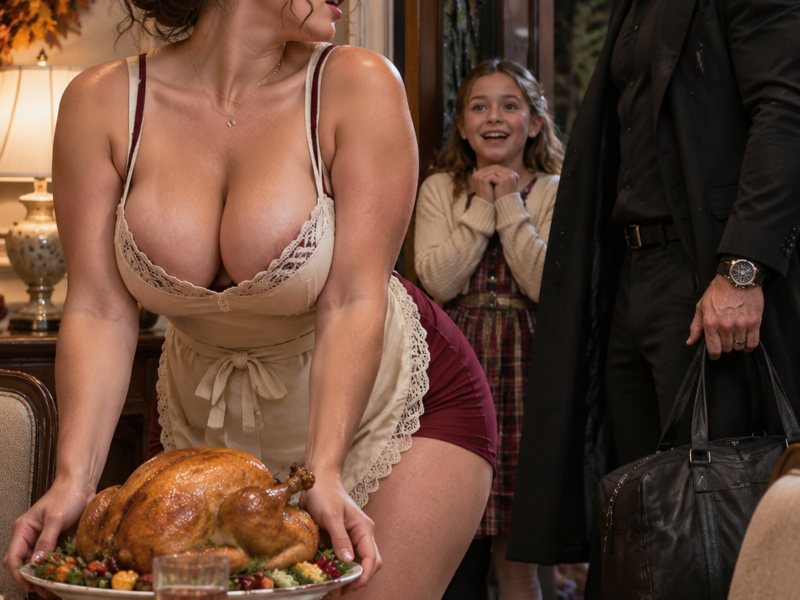
A Mafia Boss’s Daughter Ordered a “Mom for Thanksgiving” Online — Dad Came Home to a Curvy Stranger
A Mafia Boss’s Daughter Ordered a “Mom for Thanksgiving” Online — Dad Came Home to a Curvy Stranger
PART 1
The order arrived on a quiet Sunday evening, four days before Thanksgiving, through the website of a small catering business called Penny’s Kitchen.
At first glance, it looked like an ordinary holiday booking. The customer had selected the traditional Thanksgiving menu, requested delivery at ten o’clock Thursday morning, and entered the number of guests as three.
The name on the order was Massimo Conti.
But it was the final box, the one marked Special Requests, that made Penny Marsh stop breathing for a moment.
Someone had typed a message in careful, slightly uneven letters.
“Please send a mom. Ours lives in Paris and forgot about us. Dad doesn’t know how to make Thanksgiving. Please make her nice. And please bring pie. Thank you. From Daisy, age nine.”
Penny read the message once.
Then she read it again.
She was sitting alone in her rented commercial kitchen, her shoes kicked beneath a metal table and a cup of tea growing cold beside her. Outside, rain tapped against the windows. Inside, the refrigerators hummed, and the faint smell of cinnamon lingered from the apple pies she had baked that afternoon.
She had received strange catering requests before. Once, a customer had requested a birthday cake shaped like a submarine. Another had asked her to prepare an entire Christmas dinner without using anything red or green.
But nobody had ever ordered a mother.
Penny looked at the name on the booking.
Massimo Conti.
She didn’t recognize it, and she didn’t know that the man behind that name was one of the most feared figures in the city.
She only knew that somewhere in a large house, a nine-year-old girl was hoping a stranger could make Thanksgiving feel like a family holiday.
And Penny understood that feeling better than most people.
Four days later, at exactly four o’clock on Thanksgiving afternoon, Massimo Conti walked through the front door of his enormous stone mansion and stopped as though someone had pointed a gun at his chest.
The first thing he noticed was the smell.
Butter.
Roasted turkey.
Sage, onions, cinnamon, and something sweet baking in the oven.
It was the unmistakable smell of Thanksgiving.
He had lived in that house for years, but he had never once smelled anything like it.
For the last two Thanksgivings, the kitchen had been practically abandoned. Dinner usually consisted of expensive restaurant food delivered in cardboard containers, eaten between phone calls and business meetings.
But today, someone had transformed the place.
Massimo followed the smell down the hallway.
Then he reached the kitchen doorway.
And froze.
A young woman stood beside an enormous golden turkey, holding a basting spoon. She wore a cobalt-blue dress beneath a white chef’s apron. Her thick copper-red hair had begun escaping from its loose tie, and a small streak of flour crossed one freckled cheek.
She was curvy, soft-looking, and completely absorbed in her cooking.
Beside her stood Massimo’s daughter, Daisy, balancing on a little wooden step stool. She wore a raspberry-pink sweater and a matching apron decorated with tiny white polka dots.
Behind Massimo, his enormous bodyguard, Gus, had stopped walking with a piece of stuffing halfway to his mouth.
The woman looked up.
Her eyes widened.
Daisy turned around, saw her father, and immediately stretched both arms toward the woman as if presenting the greatest discovery in the world.
“Dad!” she announced proudly. “This is Penny. I ordered her. She’s our mom for Thanksgiving!”
Massimo Conti opened his mouth.
Nothing came out.
He had negotiated with dangerous men, survived betrayals, and ended conflicts between powerful families without raising his voice.
Yet somehow, standing in his own kitchen, he couldn’t find a single appropriate sentence.
The woman slowly lowered her spoon.
“Hi,” she said.
Then, after a brief pause, she added, “I’m the caterer. Apparently, I’m also the mom. Gravy should be ready in about ten minutes.”
To understand how a young caterer ended up cooking Thanksgiving dinner for a mafia boss’s family, we need to go back four days.
Daisy Conti was nine years old, and she was a planner.
She had long dark hair, usually divided into two neat braids, and serious brown eyes that seemed to notice everything adults hoped children would overlook.
Daisy loved notebooks.
She kept one for her favorite books, another for interesting words, and a third for things she planned to accomplish when she grew up.
She once had Paris written near the top of that list.
Later, she crossed it out.
Her mother lived there.
Vivienne Conti had left when Daisy was three years old. She had been beautiful, sophisticated, and apparently unhappy with the life she had married into.
One spring, she announced that she was going to Paris for a long weekend.
She never came home.
Eventually, she married a wealthy banker and began living in a beautiful apartment overlooking the city.
She sent Daisy birthday cards most years. Occasionally, she called on Christmas or when she happened to remember.
The last call had been in July.
Daisy kept the birthday cards in a shoebox underneath her bed, but she rarely opened it.
Her father, however, had never left.
Daisy knew that Massimo loved her more than anything in the world. She never doubted that.
He remembered her favorite ice cream, knew which stories she liked before bedtime, and had once canceled an important meeting because she had a fever.
But her father was also Massimo Conti.
He controlled one of the oldest and most influential criminal families on the city’s north side. His days were filled with meetings, negotiations, security briefings, and problems that ordinary people could barely imagine.
For men like him, holidays were rarely peaceful.
They were opportunities for rival families to meet, settle disagreements, exchange information, and negotiate arrangements.
For the previous two Thanksgivings, Daisy had spent the afternoon in the back room of her father’s office.
She would sit with a coloring book while men in expensive suits moved in and out of the room.
Sometimes someone remembered to bring her pizza.
Sometimes Massimo would stop beside her chair, kiss her forehead, and say, “Just one more hour, sweetheart.”
On the drive home, he always made the same promise.
“Next year, Daisy. Next year we’ll do it properly.”
And both times, Daisy had nodded.
She had learned that promises from busy adults sometimes became things that disappeared.
This year, however, her teacher made everything worse.
On Friday morning, Mrs. Bell announced a special classroom assignment.
“After Thanksgiving, I want everyone to bring in a photograph of their family’s holiday table. We’ll put all the pictures together on our Thanksgiving wall.”
The other children immediately began talking.
One girl said her grandmother was making three pies.
A boy announced that his cousins were flying in from another state.
Someone else complained that his mother always made too much stuffing.
Daisy sat quietly.
She imagined twenty-four photographs hanging on the classroom wall.
Grandparents smiling.
Mothers carrying dishes.
Fathers carving turkeys.
Children sitting beside cousins and siblings.
And then she imagined her own picture.
An empty dining table.
Or perhaps a pizza box on her father’s office desk.
She didn’t want another photograph of herself eating alone while adults discussed things she wasn’t allowed to understand.
That Sunday evening, she took the family iPad from the kitchen counter and went upstairs.
She typed a question into the search bar.
“How do you get a real Thanksgiving if you don’t have a mom?”
The internet offered countless articles about single-parent families, holiday loneliness, and ways to celebrate without relatives.
Most of them made her feel worse.
Then she discovered a website called Penny’s Kitchen.
The homepage displayed a beautiful golden turkey surrounded by candles, mashed potatoes, vegetables, and homemade pies.
Across the top were the words:
Home-cooked holidays. We cook in your home so your house smells like the holidays, just like Mom used to make.
Daisy read the sentence several times.
The company sent cooks into people’s homes. They prepared the food, decorated the table, and made everything feel special.
It wasn’t exactly what she wanted.
But it was closer than anything else she had found.
She opened the booking page.
The form was surprisingly simple.
She entered her father’s name, selected Thanksgiving Thursday, and chose the traditional menu because it included the most pies.
When the payment page appeared, the iPad automatically filled in her father’s saved credit card information.
Daisy had seen that card used dozens of times for pizza orders.
She knew it was probably expensive.
But she also knew her father would never buy himself a Thanksgiving turkey.
At the bottom of the page was a box marked Special Requests.
Daisy stared at it for several minutes.
Then she typed exactly what she wanted.
She pressed the order button before she could change her mind.
The following Monday night, Penny Marsh discovered the request.
She was twenty-six years old and had built her entire life around cooking.
A year earlier, she had worked as a sous chef at Lumiere, one of the most fashionable restaurants downtown.
She had been talented, hardworking, and ambitious.
But one afternoon, the restaurant’s owner called her into his office.
“Penny, you’re a very good chef,” he began.
Then his eyes moved over her body.
“But customers walk past the open kitchen, and they expect to see a certain image. They don’t necessarily want to see a chef who looks like she eats the profits.”
He offered her a position in the back kitchen, where customers wouldn’t see her.
Penny had stared at him for a moment.
Then she removed her apron, folded it carefully, placed it on his desk, and walked away.
She refused to spend her life hiding because someone thought her body was bad for business.
She started Penny’s Kitchen with a secondhand delivery van, a small rented commercial kitchen, and a collection of recipes inherited from her mother.
Business had been difficult.
She was three months behind on rent, and some weeks she barely made enough to cover ingredients.
But she kept going.
Her mother had died when Penny was twelve.
That first Thanksgiving afterward, her father had stood in the kitchen staring helplessly at a frozen turkey.
He had loved his wife desperately, and without her, even ordinary household tasks seemed impossible.
Penny remembered climbing onto a chair, reaching for her mother’s old recipe box, and deciding that someone had to make dinner.
She had cooked the entire meal herself.
She had been making Thanksgiving dinner every year since.
So when she read Daisy’s request, she felt something inside her shift.
She put her phone down and stared at the wall.
Then she thought about the $600 booking.
Three months of unpaid rent.
And a little girl who had written, Please make her nice.
The next afternoon, Penny called the number on the order.
A small, serious voice answered.
“Hello, Conti residence.”
“Hi, sweetheart. This is Penny from Penny’s Kitchen. Am I speaking to Daisy?”
There was a sharp intake of breath.
“Yes. Are you the mom?”
“I’m the cook, sweetheart. And I’m very happy to help you with Thanksgiving. But I need to speak to an adult before I can confirm everything. Is your father home?”
“No. He’s at work.”
“Is there another grown-up there?”
A pause followed.
Then Penny heard a muffled whisper.
“Gus. Gus, you have to be my uncle. Please. You owe me for the cannoli.”
There was another pause.
Finally, a deep, gravelly voice came onto the line.
“Hello. This is the uncle.”
Penny closed her eyes.
She had a feeling this was going to be an unusual Thanksgiving.
PART 2
“You’re aware your niece has ordered a mother?” Penny asked.
“Yes, ma’am. I’m aware.”
The man sighed heavily.
“Look, the kid needs a turkey. Ten o’clock Thursday is fine. Tell the guard at the gate your name, and he’ll let you in.”
“Will her father be there?”
Silence.
“He’ll be home for dinner,” Gus finally answered. “And could you avoid mentioning the mother part?”
Penny promised she would.
On Thanksgiving morning, her white van arrived at the enormous iron gates of the Conti estate.
After checking her identification, the guards allowed her inside.
Daisy opened the front door before Penny could knock.
Behind her stood Gus, a mountain of a man wearing a black suit.
Daisy held out a notebook.
“I made a list of what moms do on Thanksgiving.”
Penny opened it.
One: Make the house smell good.
Two: Let me lick the spoon.
Three: Tell me I did a good job.
Four: Make Dad sit down and eat.
Five: Hug, optional.
Penny crouched beside her.
“You’re right about something, Daisy. You already have a mother. I’m not here to replace her. But until dinner, I can help you with every single thing on that list.”
Daisy considered this carefully.
Then she smiled.
“Deal.”
Neither of them knew that by four o’clock, Massimo Conti would walk through that kitchen door and discover that his daughter had ordered something far more important than Thanksgiving dinner.
PART 3
The Conti mansion was even more intimidating from the inside than it had appeared from the driveway.
Penny had expected an expensive home, perhaps a little too much marble and a few paintings that cost more than her entire business.
What she hadn’t expected was a kitchen that looked as though it had been built for a magazine photograph and then completely forgotten.
White marble countertops stretched beneath enormous windows. Copper pans hung above a professional stove. A refrigerator stood against one wall, large enough to hold food for an entire restaurant.
There were rows of beautiful spice jars, each labeled in perfect handwriting.
But most of them had never been opened.
The knives were so clean that Penny suspected nobody had ever used them.
She opened a cabinet and found a collection of expensive serving dishes still wrapped in their original protective paper.
“This is a beautiful kitchen,” she said.
Gus shrugged.
“Mrs. Hadley uses the microwave.”
“Mrs. Hadley?”
“Housekeeper. She’s visiting her daughter for Thanksgiving. Won’t be back until Monday.”
Penny slowly looked around again.
It was a kitchen designed for cooking, but nobody had ever really cooked in it.
She tied her apron, washed her hands, and began unpacking.
“All right, Daisy. We’re going to need some music.”
Daisy immediately ran to a small speaker on the counter.
“What kind?”
“Something cheerful.”
Daisy selected a playlist of Christmas songs.
“It’s Thanksgiving,” Penny reminded her.
“I know. But Christmas music makes everything happier.”
Penny laughed.
“Fair enough.”
Within minutes, the kitchen was alive.
Onions softened in butter. Celery and carrots filled the air with their sweet aroma. Sage, thyme, and rosemary mingled with the smell of the roasting turkey.
Penny moved confidently between the stove and the countertops, checking temperatures, adjusting seasoning, and giving Daisy small jobs she could manage.
Gus stood nearby.
He had been assigned to security.
Unfortunately, he appeared to believe that food required the same level of inspection as suspicious packages.
Every time Penny removed something from the oven, he stepped forward.
“I’ll need to check that.”
“Check what?”
“Security.”
He inspected the stuffing.
Then the sweet potatoes.
Then the cranberry sauce.
At one point, he reached for the roasted carrots.
Penny gently slapped his hand with a wooden spoon.
“Stop stealing my ingredients.”
Gus looked genuinely offended.
“I’m doing my job.”
“Your job is keeping dangerous people out of the house, not eating the dinner before it’s ready.”
Daisy burst into laughter.
It was a wonderful sound, and Penny noticed that Gus looked almost surprised to hear it.
He glanced at the little girl, then quickly returned to his serious expression.
But the corners of his mouth had moved.
A little after noon, Penny decided it was time to make the pumpkin pie.
She brought Daisy beside her and placed a large mixing bowl on the counter.
“First lesson,” she announced. “A good pie crust needs cold butter.”
Daisy listened carefully as Penny explained how to cut the butter into small pieces and work it into the flour.
“Don’t press too hard. Use your fingertips.”
Daisy tried.
Her first attempt was sticky.
Her second attempt produced a crust that tore apart when she lifted it.
The third was lopsided but surprisingly good.
Penny smiled.
“Now you’re getting it.”
Daisy looked at the dough.
“Does it have to be perfect?”
“No. It has to be delicious.”
“What if it looks ugly?”
“Then we call it homemade.”
Daisy laughed.
Penny showed her how to roll the dough from the center outward and how to gently press it into the pie dish.
When the crust was ready, they prepared the filling.
Pumpkin puree, cream, eggs, brown sugar, cinnamon, and a generous amount of nutmeg went into the bowl.
Daisy watched as Penny mixed everything together.
Finally, Penny held out the wooden spoon.
“Number two.”
Daisy stared at it.
Then she looked up.
“Really?”
“That’s what your list says.”
Daisy accepted the spoon with both hands and licked the pumpkin mixture from it.
Her eyes closed.
For a moment, she looked completely happy.
Then she asked a question so quietly that Penny almost missed it.
“Did my mom ever let me do this?”
Penny stopped stirring.
Daisy looked down at the spoon.
“I don’t think so,” she answered herself. “I think I’d remember.”
Penny felt something tighten in her chest.
She wanted to say something comforting, but she knew there were some things children didn’t need adults to explain away.
So she simply handed Daisy another spoon.
“Then you can have two.”
Daisy smiled again.
As the afternoon continued, she asked more questions.
“Do moms get tired?”
“All the time.”
“Do moms get angry?”
“Sometimes. Usually at ovens that don’t cooperate.”
“Do moms cry?”
Penny paused.
“Sometimes. Mostly in the car, when nobody can see.”
Daisy was quiet for a moment.
Then she pressed the edge of her pie crust with a fork.
“My dad cries in the car.”
Penny turned toward her.
“He does?”
“Sometimes, when he thinks I’m asleep in the back seat.”
Daisy continued pressing the crust.
“I don’t tell him I know.”
Penny didn’t ask what made Massimo cry.
She had already begun to understand that the little girl knew much more about loneliness than anyone her age should.
At two o’clock, Daisy insisted on setting the dining table herself.
She selected the finest white plates, polished silverware, and several candles from a cabinet.
Then she arranged little decorative pumpkins along the center.
Penny watched her fold the napkins.
“You’ve done this before?”
“No. But I watched a video.”
Daisy disappeared upstairs and returned with four handmade name cards.
One said Daisy.
One said Dad.
One said Penny.
And the last said Gus, with a drawing of a sword underneath it.
“Why a sword?” Penny asked.
“Because he’s a guard.”
Gus, who had been standing nearby, suddenly found something extremely interesting outside the window.
A few minutes later, he disappeared into the garden.
When he returned, his eyes were slightly red.
“Allergies,” he explained.
Penny wisely said nothing.
At three o’clock, the pumpkin pie came out of the oven.
Its golden surface trembled gently as Penny placed it on the counter.
Daisy stood on her stool, staring at it.
Her little hands were covered in flour.
She looked at the crust she had made, then at Penny.
“I did it.”
“You certainly did.”
“By myself?”
“Almost entirely by yourself.”
Daisy smiled.
Penny glanced at the notebook lying beside the pie.
Number three.
Tell me I did a good job.
She put down the dish towel.
“Daisy, you did a wonderful job. A really wonderful job.”
The little girl’s expression changed.
Her smile disappeared, and her lower lip began to tremble.
Before Penny could say anything else, Daisy stepped forward and wrapped both arms around her waist.
She buried her face against Penny’s apron.
Then she began to cry.
Not the quiet crying of a child who had fallen and hurt her knee.
These were deep, desperate sobs, the kind that came from somewhere much farther inside.
Penny put her arms around her.
Daisy held on tightly.
“Nobody says that,” she whispered.
Penny stroked her dark braids.
“What, sweetheart?”
“That I did a good job. Nobody ever says it like that.”
Penny felt tears gathering behind her own eyes.
She looked down at the notebook.
Number five.
Hug, optional.
There was nothing optional about it anymore.
She held Daisy until the crying gradually stopped.
Then she wiped the little girl’s cheeks and kissed the top of her head.
“Listen to me. You are a very brave, very clever little girl. And you made a beautiful pie.”
Daisy nodded.
“Can we make another one sometime?”
“Anytime you want.”
At that moment, Penny had no idea whether she would ever see Daisy again after Thanksgiving.
But she already knew she would remember her.
Meanwhile, across the river, Massimo Conti was sitting at a long restaurant table surrounded by men who wanted something from him.
Thanksgiving had become a business obligation.
The Ruggeri brothers were seated opposite him. They had been trying to take control of the docks for two years, and their leader, Leo Ruggeri, had made it clear that he wasn’t interested in compromise.
Leo was handsome, charming, and dangerous in a way that made people uncomfortable.
He smiled often.
He spoke politely.
And he never forgot an insult.
At the head of the table sat Don Cesare, an eighty-six-year-old patriarch respected by every major family in the city.
He had listened to arguments for four hours.
Finally, he raised one hand.
“Enough. We will settle this properly. Christmas Eve. One dinner. All the families. One table.”
He looked at Massimo.
“You will host.”
Massimo agreed.
But his attention kept returning to his phone.
At ten past one, he had received a message from Daisy.
“Dad, come home at 4:00. It’s important. Wear a nice shirt.”
He had tried calling her.
No answer.
He had called Gus.
No answer either.
That was unusual.
Gus had been his closest security man for eleven years and had never ignored a call.
By three-thirty, Massimo had stopped listening to the conversation.
At twenty minutes to four, he stood up.
“I have to go.”
Nobody questioned him.
He drove home faster than usual, thinking about the previous two Thanksgivings.
He remembered his daughter sitting alone with her coloring book.
He remembered promising her that next year would be different.
He remembered how she had nodded without looking at him.
And for the first time, he wondered whether she had stopped believing him.
Then he entered his house.
The smell of turkey reached him immediately.
And he found the stranger in his kitchen.
Now, standing in the doorway, Massimo studied Penny carefully.
She was clearly surprised to see him, but she wasn’t frightened.
That was unusual.
Most people became nervous around him. Men who had spent decades in business meetings lowered their eyes when he entered a room.
Penny simply looked at him.
Then she glanced at Daisy.
Then back at him.
Her expression seemed to say that if he upset the child, she would have no hesitation about using the wooden spoon in her hand.
Massimo almost smiled.
“Who are you?”
“Penny Marsh. Penny’s Kitchen.”
“Why are you here?”
“Your daughter booked a Thanksgiving dinner.”
“My daughter?”
“Yes. Using your credit card.”
Behind him, Gus made a small noise.
Penny continued.
“Your bodyguard confirmed the appointment. Your security team checked my documents. I’ve been here since ten o’clock. And dinner is almost ready.”
Massimo looked at Daisy.
She had slowly lowered her arms.
Her face was beginning to fall.
He understood something then.
His daughter was waiting for him to decide whether this was acceptable.
He could have dismissed Penny immediately.
He could have shouted at Gus.
He could have demanded an explanation.
Instead, he looked at the dining room.
The good plates were out.
Candles were burning.
There were handmade name cards on the table.
One had Dad written across it, with a turkey drawn underneath.
Massimo stared at the little drawing.
Then he removed his coat, placed it over a chair, and rolled up his sleeves.
“Where do you want me?”
Daisy made a small sound.
Then she ran into his arms.
And for the first time that afternoon, Massimo saw his daughter smile without holding anything back.
Dinner was served at a quarter to five.
The dining table was built to accommodate twenty people, but only four places were occupied.
Massimo carved the turkey with the grim concentration of a man attempting to disarm an explosive device.
Penny stood beside him.
“Along the bone.”
He moved the knife.
“No, the other bone.”
He tried again.
“That’s a wing, Mr. Conti.”
Daisy laughed so hard she nearly slipped from her chair.
Gus sat very straight, studying the food with the seriousness of a security professional.
When everyone had been served, Daisy announced that they had to do something.
“What?” Massimo asked.
“Say what we’re thankful for. That’s what real families do.”
Gus went first.
“I’m thankful for the stuffing.”
Penny smiled.
“I’m thankful for good ovens and brave children.”
Massimo looked at his daughter.
“I’m thankful that my daughter didn’t give up on having a proper Thanksgiving.”
Daisy blushed.
Then it was her turn.
She sat up straight.
“I’m thankful I ordered Penny.”
Everyone laughed.
Halfway through dinner, Massimo’s phone buzzed.
He glanced at the screen.
Then he began to stand.
“I need to take this.”
Penny reached across the table and held out her hand.
She said nothing.
Instead, she tapped Daisy’s notebook.
Number four.
Make Dad sit down and eat.
Massimo looked at the notebook.
Then at his daughter.
Then at Penny.
For several seconds, the most powerful man on the north side of the city appeared to be considering whether he should argue with a caterer.
Finally, he took out his phone, switched it off, and placed it in her hand.
Penny put it inside the bread basket and covered it with a napkin.
Daisy looked at her father as though he had just performed a miracle.
And Massimo realized that perhaps he had.
PART 4
After dinner, Daisy brought the iPad into the dining room.
She set the camera timer and insisted that everyone gather together for a photograph.
Massimo stood beside her.
Penny joined them, still wearing her flour-stained apron.
Gus tried to stay outside the frame.
Daisy immediately ordered him to move closer.
“You’re part of the family picture.”
“I’m security.”
“You’re Uncle Gus.”
Gus sighed and stepped into the frame.
At the last second, he held up a turkey leg.
The camera flashed.
The photograph was terrible.
Massimo’s eyes were half closed. Penny was laughing. Gus’s turkey leg covered part of the image, and Daisy’s braids had become uneven.
But Daisy stared at it for a long time.
“It’s perfect,” she whispered.
She saved the photograph.
Then, at six o’clock, the iPad rang.
The screen displayed one word.
Maman.
Daisy’s smile disappeared.
Her mother was in Paris, where it was midnight.
Vivienne hadn’t called in four months.
Daisy hesitated before answering.
Then a beautiful woman appeared on the screen, wearing a silk robe in a bright apartment overlooking the city.
“Hello, Daisy. Happy Thanksgiving.”
“Happy Thanksgiving, Maman!”
Vivienne looked confused.
“Isn’t that today? I can never remember American holidays.”
Daisy immediately turned the camera around.
“Look! We had a real Thanksgiving. I made the pie crust myself. And this is Penny.”
She pointed the camera toward the young caterer.
“I ordered her. She’s our mom for Thanksgiving.”
There was a pause.
Vivienne’s expression changed.
“Massimo,” she said, “you hired the help to play mother? How very like you.”
Her eyes moved over Penny.
“Well, at least she looks like she can cook.”
Penny felt her cheeks grow hot.
Daisy slowly lowered the iPad.
Her little face changed in a way that Massimo would never forget.
He stood immediately.
He walked around the table and gently took the device from her hands.
“Vivienne,” he said quietly.
His voice was calm, but there was something in it that made even Penny stop moving.
“You can call Daisy any day of the year. She will always be happy to hear from you.”
Vivienne began to speak.
“But you don’t get to call after four months and insult the woman who prepared your daughter’s Thanksgiving dinner.”
He paused.
“Not in my house. Not in front of my daughter.”
Then he ended the call.
He placed the iPad on the table and crouched beside Daisy.
She looked at him.
“You stood up for Penny,” she whispered.
“I stood up for you.”
Massimo gently brushed a strand of hair away from her forehead.
“I should have been doing that a long time ago.”
That evening, after Daisy fell asleep on the couch with her notebook resting against her chest, Massimo found Penny washing dishes.
“You don’t have to do that,” he said.
Penny glanced at the mountain of roasting pans.
“Somebody does. Mrs. Hadley isn’t coming back until Monday.”
He picked up a towel.
“Then I’ll help.”
For a while, they washed dishes without speaking.
Finally, Penny broke the silence.
“I’m guessing you’re not an accountant.”
“No.”
“The guards, the gate, the security equipment, and the man who pretended to be an uncle when I called…”
Massimo looked at her.
“I’m not stupid, Mr. Conti.”
“No,” he said. “I can see that.”
He dried a plate.
“My name is Massimo Conti. If you read the newspapers, you probably know what I do.”
“I don’t read newspapers.”
“What do you read?”
“Recipes.”
He almost smiled.
Penny told him about her former restaurant, the owner who had asked her to hide in the back kitchen, and the decision she had made to start her own business.
She told him about her mother and the first Thanksgiving she had cooked alone.
Massimo listened without interrupting.
When she finished, he looked toward the hallway.
“Daisy’s mother left when she was three. I told myself she was too young to remember. I thought if I kept her safe, gave her everything she needed, and made sure she had a good education, that would be enough.”
He lowered his eyes.
“I’m very good at keeping people alive, Ms. Marsh. I’m terrible at making them happy.”
Penny dried her hands.
“She didn’t order happiness, Mr. Conti.”
He looked at her.
“She ordered a turkey. You were the happy part.”
Massimo was quiet.
At the front door, he offered her a thick envelope.
Penny refused it.
“Your daughter already paid me six hundred dollars. That’s the price.”
“You did more than prepare dinner.”
“I know. But I don’t want you paying me for something I chose to do.”
She put on her coat.
Massimo watched her for a moment.
“Would you teach me to cook?”
Penny raised an eyebrow.
“Excuse me?”
“Not everything. Just enough to make a proper dinner.”
He glanced toward the stairs.
“So next year, Daisy doesn’t have to order anyone.”
Penny studied him.
Then she smiled.
“Sunday nights. Seven o’clock. Bring an apron.”
On Monday afternoon, Massimo picked Daisy up from school himself.
It was the first time in four months that he had done so.
Mrs. Bell greeted him at the classroom door.
“Mr. Conti, I think you should see something.”
She led him toward the Thanksgiving wall.
Twenty-four photographs were pinned across a long sheet of orange paper.
There were families around enormous tables, children holding pies, grandparents smiling, and several photographs of dogs wearing Thanksgiving costumes.
Near the middle was Daisy’s picture.
It was slightly crooked.
Massimo stood in front of it for a long time.
Underneath, Daisy had written:
“Me, my dad, Penny, our mom for Thanksgiving, and Uncle Gus, not really our uncle.”
Mrs. Bell smiled.
“She talked about that dinner for twenty minutes. I’ve never heard her talk for twenty minutes about anything.”
Massimo looked at the photograph again.
Then he thanked the teacher.
Across the city, Penny’s phone was ringing constantly.
On Thanksgiving night, Daisy had left a review on the Penny’s Kitchen website.
It read:
“Five stars. Best mom I ever ordered. She made the house smell good and let me lick the spoon and told me I did a good job. Also, the pie was excellent. Daisy, age 9.”
Someone shared the review on social media.
Then another person shared it.
By Monday morning, more than a hundred thousand people had read it.
By Tuesday, Penny’s Kitchen was booked for almost every weekend in December.
By Wednesday, Penny had paid three months of overdue rent.
She sat on an upturned crate in her rented kitchen, holding her phone and laughing until she cried.
For the first time in a long time, she wasn’t wondering whether her business would survive another month.
She was wondering how she would manage all the orders.
But something else had changed, too.
Every Sunday evening at seven, a white van drove through the iron gates of the Conti estate.
And every Sunday, Massimo Conti waited in the kitchen wearing an apron.
He was, without question, Penny’s worst cooking student.
He held knives as though they were weapons.
He measured flour with the seriousness of a man collecting evidence.
His first attempt at pancakes produced so much smoke that the alarm went off.
Three armed security men came running into the kitchen.
They found their boss standing in a cloud of smoke, wearing a pink polka-dot apron Daisy had made him.
Gus was eating one of the blackened pancakes.
“For security,” he explained.
Daisy laughed until she developed hiccups.
Massimo didn’t complain.
He kept practicing.
By the third Sunday, he could prepare a respectable tomato sauce.
Penny tasted it, considered the result, and finally nodded.
“Not bad.”
Massimo looked genuinely pleased.
“High praise.”
“Don’t let it go to your head.”
But on the second Sunday, Penny arrived late.
She was quieter than usual, and when she started preparing dinner, she accidentally burned the garlic.
Massimo noticed immediately.
“Something wrong?”
Penny hesitated.
Then she told him that the owner of Lumiere had called.
He had seen the Thanksgiving review.
He had also seen the attention Penny’s business was receiving.
Suddenly, he wanted her back.
Not in the back kitchen this time.
He wanted her standing in the open kitchen, visible to every customer, representing the restaurant.
He even offered to make her the public face of the business.
Massimo listened carefully.
“What did you tell him?”
“I told him I was booked through March.”
“And?”
Penny scraped the burned garlic into the trash.
“I told him I don’t work for men who only want to look at me when it’s profitable.”
She gave a small laugh.
“Then I sat in my van and cried for twenty minutes because apparently I’m an idiot.”
“You’re not an idiot.”
Penny looked at him.
Massimo’s expression was completely serious.
“You were right to leave.”
She felt her throat tighten.
“Thank you.”
He returned to chopping vegetables.
“Now make the garlic again, Chef.”
Penny laughed.
And for the first time, she noticed something about the way he looked at her.
He wasn’t watching the pan.
He was watching her.
She told herself not to think about it.
After all, Massimo Conti was a complicated man, and she had a business to run.
But sometimes, while they stood side by side in the kitchen, with Daisy doing homework behind them, she caught him looking at her with an expression she couldn’t quite understand.
Then came the third Sunday.
Daisy had gone upstairs to bed, and Massimo sat across from Penny at the kitchen table with two cups of coffee.
“Christmas Eve,” he began.
Penny looked up.
“I’m hosting a dinner.”
“Another catering job?”
“Something like that.”
He explained the situation.
Six powerful families had agreed to gather at the Conti estate. Don Cesare would sit at the head of the table and attempt to settle the dispute that had threatened to destroy the fragile balance between them.
Twenty-two guests.
One dinner.
One chance to prevent a conflict from becoming something much worse.
But there was a problem.
Nobody trusted anyone else’s kitchen.
Every family had its own cooks, and serving food prepared by a rival family would be considered a serious risk.
Massimo needed someone independent.
Someone who belonged to nobody.
He looked directly at Penny.
“I want you to prepare the Feast of the Seven Fishes.”
Penny stared at him.
“For twenty-two people?”
“Yes.”
“On Christmas Eve?”
“Yes.”
“With six families of gangsters sitting around one table?”
“That’s correct.”
She leaned back.
“You’re asking me to cook seven seafood courses for twenty-two people who probably consider a dinner invitation a security threat.”
Massimo nodded.
Penny looked at her coffee.
Then she smiled.
“Fine. But I’m charging full price this time.”
Massimo nodded.
“Of course.”
Neither of them knew that the most dangerous part of that dinner would arrive in twelve white boxes.
PART 5
The seafood delivery arrived at two o’clock on Christmas Eve.
Penny had ordered everything ten days earlier from Bay Street Seafood, a respected wholesaler near the harbor.
The menu was carefully planned.
Clams, mussels, shrimp, scallops, calamari, and a beautiful whole sea bass would form the centerpiece of the meal.
The salt cod had already been soaking in Penny’s own kitchen since Sunday.
Everything was supposed to be fresh.
But that morning, Bay Street had called to explain that its refrigerated truck had broken down.
They apologized and promised that another supplier would deliver the order.
The replacement company was called Harbor Fresh.
Same products.
Same quantities.
Same price.
Penny had accepted the arrangement because she had no reason to suspect anything was wrong.
The truck arrived exactly on time.
The driver unloaded twelve white boxes into the kitchen, handed Penny the delivery paperwork, and left quickly.
She opened the first box.
Then she stopped.
Something about the shellfish didn’t look right.
Penny picked up a mussel and tapped it against the edge of the counter.
A live mussel should close when tapped.
This one remained open.
She tested another.
Then another.
None of them moved.
Her expression changed.
She examined the clams.
Several were gaping open.
The shrimp smelled faintly sour beneath the ice.
Penny went through every box, one by one.
Then she noticed the labels.
Each box had a neat white sticker stating that the seafood had been packed on December 22.
She frowned.
It was Christmas Eve.
That seemed reasonable.
But something about the paperwork bothered her.
She took a small paring knife and carefully lifted the corner of one label.
Beneath it was another sticker.
Packed December 9.
Penny stared at it.
She peeled back the label on the second box.
The same date.
The third.
The same.
All twelve boxes had been relabeled.
Then she discovered the temperature log attached to the final container.
Every refrigerated delivery was supposed to have an hourly temperature record.
The sheet showed perfect readings throughout the journey.
But every entry from midnight until two o’clock that afternoon had been written in the same blue pen, in the same handwriting.
There wasn’t a single smudge.
The document looked as though someone had filled it out at a desk, not inside a moving refrigerated truck.
Penny felt cold.
This wasn’t a mistake.
Someone had deliberately sent old seafood to the Conti estate.
She immediately went to find Massimo.
He was in his study with Gus, reviewing the seating arrangements.
Penny entered without knocking.
She placed the labels and temperature log on his desk.
“Your seafood is two weeks old.”
Massimo looked up.
“What?”
“Someone changed the labels and falsified the temperature records. If I had served this tonight, your guests could have become seriously ill.”
She pointed toward the papers.
“Don Cesare is eighty-six. I won’t risk serving him this.”
Massimo studied the documents.
His expression became very still.
“Harbor Fresh,” he said.
Gus was already reaching for his phone.
Within minutes, he had the company registration.
The owner was a man named Pauly Sacco.
Leo Ruggeri’s brother-in-law.
Massimo closed his eyes.
Now he understood.
The Christmas Eve dinner was supposed to establish peace between six families.
If twenty-two guests became violently ill after eating at his house, every family would suspect that Massimo had deliberately poisoned them.
The peace agreement would collapse.
The Ruggeri family would have the perfect opportunity to blame him.
And Leo would stand aside, pretending to be shocked by the disaster.
“Cancel the dinner,” Massimo said quietly.
Penny shook her head.
“No.”
He looked at her.
“If we cancel, Leo wins anyway. Everyone will know you couldn’t host the peace dinner.”
“Then what do you suggest?”
Penny pulled out her phone.
“I have five hours, a city full of seafood suppliers, and a few people who owe me favors.”
She turned toward Gus.
“Get me a van.”
What followed was one of the most chaotic afternoons the Conti mansion had ever experienced.
Penny called Manny Esposito, an old fishmonger who had operated a small stall at Water Street Market for forty years.
He had sold her first piece of fish when she was twelve.
He had also been one of the few adults who had helped her after her mother died.
Manny had already closed his stall for Christmas Eve.
But when he heard Penny’s voice, he listened quietly.
“Kid, what’s wrong?”
“I need seafood. A lot of it. And I need it now.”
There was a short pause.
“Give me twenty minutes.”
Gus drove across the city.
He collected fresh clams from Manny, scallops from a Korean fishmonger on Ninth Street, calamari from a small seafood shop, and a beautiful sea bass from an old Portuguese grocer who opened his closed store specifically for Penny.
Nobody charged her extra.
Some refused to take payment at all.
By three-thirty, however, Penny was standing alone in the enormous Conti kitchen, staring at the clock.
Nine pots were heating on the stove.
There were ingredients everywhere.
But the replacement seafood was still arriving.
Twenty-two guests.
Seven courses.
Less than four hours.
For the first time that afternoon, she felt panic rising through her chest.
She gripped the edge of the counter.
She had built her business with her own hands. She had survived being humiliated, losing her job, and nearly losing her kitchen.
But this was different.
The success of an important peace dinner now depended on her.
Massimo found her standing motionless.
He didn’t tell her everything would be fine.
He didn’t tell her to calm down.
He simply walked over and placed one large hand gently between her shoulder blades.
“Tell me what to do, Chef.”
Penny took a breath.
Then another.
She straightened.
“Peel the shrimp. Chop the garlic. And don’t touch anything without asking me.”
Massimo immediately obeyed.
For the next several hours, the mafia boss worked beside the caterer.
He peeled shrimp, chopped vegetables, washed pans, and carried heavy trays.
He wore the same pink polka-dot apron Daisy had given him.
Daisy had been sent upstairs, but she had returned almost immediately.
She was wearing a green velvet Christmas dress and had brought her notebook.
Since she couldn’t help with the cooking, she sat at the end of the counter and prepared all twenty-two place cards.
Each card had a tiny fish drawn in the corner.
Gus stood beside her, occasionally checking the front windows.
“Are we safe?” Daisy asked.
Gus looked toward the kitchen.
“Your father is here.”
“That’s not what I asked.”
Gus smiled.
“Yes, sweetheart. We’re safe.”
At seven o’clock, the guests began arriving.
Expensive cars passed through the iron gates.
Men in dark suits entered the mansion with their security teams.
Women wearing elegant evening dresses followed them into the dining room.
By eight-fifteen, twenty-two people were seated beneath the enormous chandelier.
Don Cesare sat at the head of the table.
He looked tired but alert.
Leo Ruggeri sat halfway down the table, wearing a dark suit and his usual confident smile.
He glanced toward the kitchen door several times.
He seemed to be waiting for something.
Massimo stood.
“Before we begin,” he announced pleasantly, “I have a small Christmas gift for Mr. Ruggeri.”
Leo raised an eyebrow.
Massimo walked down the length of the table and placed a white envelope beside his plate.
Then he returned to his seat.
Leo opened it.
Inside were two labels.
One read December 22.
The other read December 9.
There was also a copy of the falsified temperature log and the company registration papers for Harbor Fresh.
Leo’s smile slowly disappeared.
“My caterer discovered these this afternoon,” Massimo explained to the entire table.
“Inside twelve boxes of shellfish that were supposed to be served to all of you tonight. The seafood had been stored for fourteen days, relabeled, and delivered by a company owned by Mr. Ruggeri’s family.”
The room became completely silent.
Massimo looked toward Don Cesare.
“I’ll leave the judgment to you. I’m only the host.”
Nobody moved.
Every eye turned toward Leo.
Don Cesare picked up the documents with his thin, spotted hands.
He examined them carefully.
Then he looked at Leo.
“Go.”
It was only one word.
But it was enough.
Leo stood.
For the first time that evening, he had nothing to say.
He left the mansion without another word.
Nobody followed him.
Nobody needed to.
By the new year, the Ruggeri family had lost its influence over the docks, its place at the negotiating table, and the trust of nearly every family that had once done business with it.
The attempted poisoning had destroyed the peace they had hoped to manipulate.
And nobody had been hurt.
That was what mattered most to Massimo.
Then the kitchen doors opened.
Penny appeared carrying the first course.
The Feast of the Seven Fishes began.
The dinner turned out to be extraordinary.
The clams were perfectly seasoned.
The shrimp were tender.
The scallops were golden on the outside and delicate in the center.
The calamari was light, crisp, and served with a sauce that had taken Penny years to perfect.
Then came the salt cod.
Don Cesare tasted one bite and stopped speaking.
He took another.
Then he placed his fork down.
“In sixty years,” he announced, “I have not eaten salt cod like this.”
He looked toward the kitchen.
“Who is this woman?”
Massimo smiled.
“Penny Marsh. She’s the chef.”
Don Cesare nodded approvingly.
“Why is she not married?”
Massimo answered before he could stop himself.
“I’m working on it.”
The entire table burst into laughter.
Penny, who had just entered with another platter, turned scarlet.
She quickly disappeared into the kitchen.
The dinner continued for hours.
People who had arrived suspicious of one another began speaking.
Old disagreements were discussed.
New arrangements were considered.
The evening that had been designed to destroy a peace agreement became the beginning of a different one.
And it was all because a young caterer had refused to serve spoiled seafood.
At midnight, the last guest finally left.
Penny was exhausted.
She sat on the kitchen floor with her back against the oven, her shoes kicked off beside her.
Her feet hurt.
Her arms ached.
Her hair had completely escaped its tie.
She closed her eyes.
A few moments later, someone sat down beside her.
It was Massimo.
He was still wearing his expensive suit, although his tie had been loosened.
For a while, neither of them spoke.
Then he said, “I don’t need a caterer.”
Penny opened one eye.
“That’s unfortunate. I have several bills.”
Massimo smiled.
“Half the city wants to book you now. I’ll have to fight them for a reservation.”
He looked down at his hands.
“And I don’t need a mother for one day.”
Penny turned toward him.
He continued.
“My daughter ordered one of those for Thanksgiving. She got more than she paid for.”
His voice became quieter.
“I’m not ordering anything, Penny. I’m asking.”
He looked directly into her eyes.
“Stay. Not because of Daisy. Not because of me. Not because of money. Stay only if you want to.”
He paused.
“You can say no.”
Penny looked at him for a long time.
Then she smiled.
“Your daughter wrote a list on Thanksgiving.”
“I remember.”
“Number five was hug, optional.”
Massimo nodded.
“I remember that, too.”
Penny moved closer.
“I’m choosing the optional.”
She wrapped her arms around him.
Massimo held her gently, as though he had spent so many years protecting everything around him that he had forgotten what it felt like to be allowed to hold something simply because he wanted to.
After a moment, he kissed her.
It wasn’t dramatic.
There were no fireworks.
Just two exhausted people sitting on a kitchen floor in a house that finally smelled like the holidays.
But to Massimo, it felt like the beginning of something he had never known how to ask for.
On the staircase, a nine-year-old girl stood in her pajamas.
She was supposed to be asleep.
Instead, she had been watching.
She quietly opened her notebook and took out a pencil.
One by one, she placed check marks beside every item.
Make the house smell good.
Let me lick the spoon.
Tell me I did a good job.
Make Dad sit down and eat.
Hug, optional.
Then she smiled and went back upstairs.
Christmas morning arrived with sunlight pouring through the tall windows.
At nine o’clock, the iPad rang.
The screen displayed Maman.
Daisy looked toward her father.
Massimo nodded.
She picked up the device and carried it into the living room, where she sat beneath the Christmas tree.
Vivienne appeared on the screen.
This time, she looked more awake.
“Good morning, Daisy.”
“Good morning!”
They talked for twenty-two minutes.
Daisy told her about the seafood dinner, the twenty-two guests, the old man who loved the salt cod, and the tiny fish she had drawn on all the place cards.
She also talked about Penny.
She explained how Penny had taught her to make pie crust, how Massimo had burned pancakes, and how Gus still insisted on tasting everything for security.
Massimo stood in the kitchen doorway with a cup of coffee.
He didn’t interrupt.
He didn’t listen closely.
He simply let his daughter have the conversation.
When Daisy finally returned, her eyes were slightly red, but she was smiling.
“Maman says to tell the cook that the pie looked very nice.”
She delivered the sentence carefully.
Penny laughed so hard that she had to sit down.
Massimo understood what that small comment meant.
It wasn’t a perfect apology.
It didn’t undo the years Vivienne had been absent.
But perhaps it was the first small step toward something better.
And for Daisy, that was enough for Christmas morning.
The following months changed the Conti household in ways nobody had expected.
Penny’s Kitchen grew rapidly.
The small rented kitchen eventually became too small to handle the orders.
Penny hired two assistants, then three.
She bought better equipment and moved into a larger commercial space.
She still refused to change the name of her business.
People suggested that she rebrand it.
They told her she could charge more if she created a luxury image.
But Penny preferred the little logo she had designed herself.
A wooden spoon.
A handwritten name.
And the words Home-cooked holidays.
Massimo continued his Sunday cooking lessons.
He became surprisingly good.
He learned how to roast chicken, prepare sauces, make fresh pasta, and bake bread.
He still measured flour too carefully, but Penny no longer complained.
Daisy became his official cooking assistant.
She wore her pink apron and graded every meal.
Gus remained responsible for security.
He also remained responsible for tasting everything.
One evening, Penny found Massimo preparing dinner without her help.
He had made roasted chicken, potatoes, and a simple salad.
Daisy was sitting at the table, looking impressed.
“How is it?” Massimo asked.
Daisy considered the food.
“Four stars.”
“Why not five?”
“The potatoes need more salt.”
Massimo looked toward Penny.
She shrugged.
“She’s right.”
He smiled.
A year earlier, he would have considered cooking an unnecessary task.
Now he understood that preparing dinner was one of the simplest ways to tell someone they mattered.
And Penny had become part of their lives in a way none of them had planned.
She didn’t try to replace Daisy’s mother.
She didn’t demand that Daisy call her anything special.
She simply showed up.
She remembered school projects.
She attended parent meetings when Massimo couldn’t make them.
She taught Daisy recipes and listened to her stories.
She also taught Massimo that being a father wasn’t just about providing a safe house and expensive clothes.
It was about sitting down.
Listening.
Keeping promises.
And sometimes putting the phone away because a little girl wanted to show you a drawing.
Eventually, Massimo asked Penny to marry him.
He didn’t arrange a grand public event.
He didn’t invite the entire city.
He simply prepared dinner himself, set the table with candles, and placed a small ring box beside Penny’s plate.
The food was slightly overcooked.
The potatoes were too salty.
The sauce was excellent.
Penny noticed the ring.
Then she looked at him.
“Did you cook all this?”
“Yes.”
“Without help?”
“Mostly.”
“Did Gus inspect it?”
“Twice.”
She laughed.
Massimo took her hand.
“I don’t know how to promise you a perfect life,” he said. “But I can promise that you’ll never have to wonder whether you’re welcome in my home.”
Penny looked around the kitchen.
At the copper pans.
At the photographs on the refrigerator.
At Daisy’s drawings.
At the little pink apron hanging beside Massimo’s black one.
Then she looked back at him.
“Yes,” she whispered.
And for the first time, the house that had once felt like a fortress began to feel like a home.
The following Thanksgiving, the order arrived on Sunday night.
It came through the same little website, although Penny’s Kitchen was no longer a little company.
The booking was under Massimo Conti.
Number of guests: Everybody.
Delivery: Thursday.
Menu: Traditional Thanksgiving, with extra pie.
And in the special requests box, someone had written:
“Please send Mom forever. From Daisy, age ten.”
Penny read the message while standing in the Conti kitchen.
There was a ring on her left hand.
There was flour on her cheek.
Massimo stood beside the stove, flipping pancakes that were finally golden instead of black.
Daisy sat on her little stool wearing a pink apron, carefully grading each pancake out of five.
Gus waited beside the plate with a fork.
“Security,” he explained.
Penny laughed.
Then she typed two words into the reply box.
“Order confirmed.”
She looked around the kitchen.
The house was filled with the smell of butter, warm bread, and coffee.
There were family photographs on the walls.
There were handwritten recipes in the drawers.
There were people who loved one another sitting around the table.
And there was a little girl who no longer needed to order happiness from the internet.
Penny had arrived to cook one Thanksgiving dinner.
She had stayed for every holiday afterward.
And perhaps that was the most beautiful thing about the entire story.
Sometimes, the family we need doesn’t arrive exactly as we imagined.
Sometimes it arrives in a white van, carrying a turkey, three homemade pies, and a wooden spoon.
Sometimes it comes with flour on its cheek and a stubborn refusal to let a child feel forgotten.
And sometimes, all it takes to change an entire household is one nine-year-old girl brave enough to write what she really wants in a little box marked Special Requests.