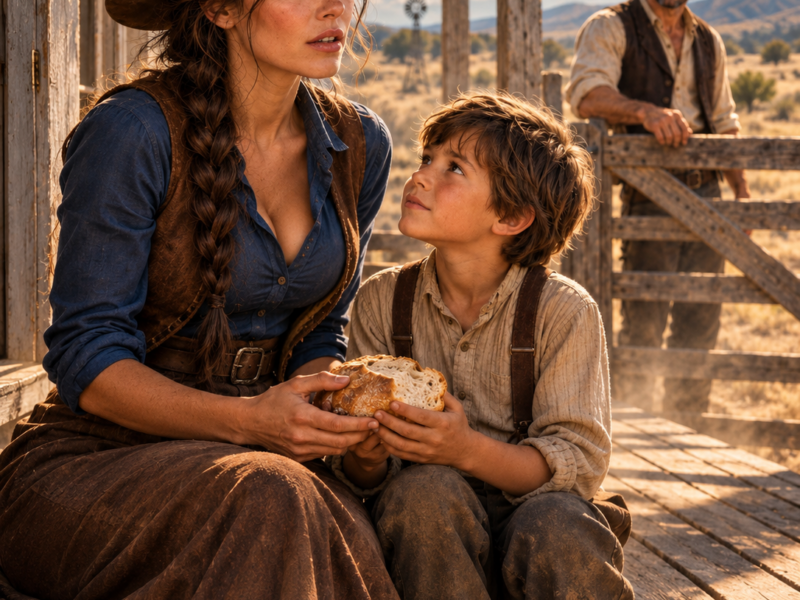
A Hungry 9-Year-Old Boy Knocked on My Ranch Door Asking to Work for Breakfast, While His Exhausted Father Waited at My Gate, Too Proud to Accept a Meal. I Fed Them Both, Then Let Them Use My Private Road—Until I Spent Three Days Improving It, and the Whole Town Started Laughing, “She Built Her Cowboy a Road!” His Face Changed When He Heard Those Words, and He Said, “You Never Asked Me.” Then He Took the Dangerous Seven-Mile Road Home, and What Happened Three Weeks Later Changed Everything…
A Hungry 9-Year-Old Boy Knocked on My Ranch Door Asking to Work for Breakfast, While His Exhausted Father Waited at My Gate, Too Proud to Accept a Meal. I Fed Them Both, Then Let Them Use My Private Road—Until I Spent Three Days Improving It, and the Whole Town Started Laughing, “She Built Her Cowboy a Road!” His Face Changed When He Heard Those Words, and He Said, “You Never Asked Me.” Then He Took the Dangerous Seven-Mile Road Home, and What Happened Three Weeks Later Changed Everything…
Part 1
The first thing Lydia Hail noticed about the boy was not his empty sack or the dust covering his boots. It was the way he held himself when she opened her front door, standing perfectly straight despite looking as though he might collapse from hunger.
“Good morning, ma’am,” he said, removing his battered little hat. “I was wondering if you had any work I could do for breakfast.”
Lydia had spent thirty-two years learning to recognize trouble before it reached her doorstep. She had managed four hundred head of cattle, survived droughts, buried her parents, and kept Hail Crossing running through winters that had driven stronger men into bankruptcy.
But nothing in those years had prepared her for the quiet dignity of a nine-year-old boy trying to earn a piece of bread.
“What’s your name?” she asked.
“Benjamin Mercer, ma’am. Folks call me Ben.”
“And what sort of work can you do, Benjamin?”
He considered the question seriously.
“I can carry wood. Fetch water. Sweep a floor. I’m learning to mend harness, but Pa says I still make the stitches crooked.”
Lydia glanced at the sack hanging from his shoulder. It was almost completely flat.
“When did you last eat?”
The boy’s expression changed.
“Yesterday, ma’am.”
“Yesterday morning or yesterday evening?”
He hesitated.
“Morning, I reckon.”
Lydia stepped aside.
“Come inside.”
“But the work—”
“We’ll discuss that after breakfast.”
She led him into her kitchen, where fresh bread cooled beside the stove. She cut two thick slices, spread them with butter, and added a generous spoonful of plum preserves.
Ben stared at the plate as though someone had placed a fortune before him.
“Go ahead,” Lydia said.
He tried to eat slowly.
For approximately three seconds, he succeeded.
Then hunger overcame manners, and the bread disappeared so quickly that Lydia quietly turned back toward the stove, allowing him the privacy of not being watched.
She poured buttermilk into a cup and set another slice beside his plate.
That was when she noticed something strange.
Every few moments, Ben glanced toward the window.
Not toward the road or the pasture.
Toward the wooden gate at the far end of her yard.
Lydia followed his gaze.
A man stood beside the gate.
He was tall, broad-shouldered, and covered in the pale dust of the Texas plains. One hand rested on the top rail. His hat shaded his face, but even from a distance, Lydia could recognize the exhaustion in his posture.
He was not approaching.
He was not calling for the boy.
He was simply waiting.
Lydia looked back at Ben.
“Is that your father?”
The boy lowered his eyes.
“Yes, ma’am.”
“Does he know you’re here?”
“He knows now.”
There was something in the way Ben said it that made Lydia understand the entire situation without another question.
The father had given his son whatever food remained.
The boy had seen smoke rising from a stranger’s chimney.
And the man at the gate was standing there, too proud to follow his hungry child inside.
Lydia took another plate from the cupboard.
She filled it with eggs, potatoes, bacon, and two slices of bread.
Then she walked outside.
September sunlight stretched across the yard, and the morning air still carried a trace of coolness.
The man straightened as she approached.
“Ma’am,” he said. “That’s my boy you’ve got in there. I apologize if he bothered you.”
“He hasn’t bothered me.”
“He knows better than to knock on strangers’ doors.”
“Well,” Lydia replied, “I’d say he’s nine years old, hungry, and considerably braver than most grown men.”
Something moved briefly across the stranger’s face.
He removed his hat.
“Elias Mercer.”
“Lydia Hail.”
“I’ll pay for whatever he ate, Miss Hail. Cash if you’ve a mind to wait until I get to town. Work if you’d rather settle it now.”
Lydia held out the plate.
“There’s breakfast for you, too.”
His eyes dropped toward the food.
For one moment, she saw the hunger he had been hiding.
Then his expression hardened.
“I’ve already eaten.”
“When?”
“That isn’t your concern, ma’am.”
“No,” Lydia agreed. “It isn’t.”
She placed the plate on the gatepost.
“But the food’s already cooked, and I have no intention of standing here arguing with a hungry man about whether he’s hungry.”
He almost smiled.
Almost.
“I won’t be carried into your house,” he said.
“That’s fortunate. I’ve got a bad shoulder, and you look considerably heavier than a feed sack.”
This time, a reluctant breath of laughter escaped him.
Lydia nodded toward the plate.
“Eat it here if you prefer. The post is clean.”
She turned and walked back toward the house.
Behind her came the soft scrape of a plate being lifted.
Inside, Ben had finished his second helping and was studying Lydia’s elderly dog, Trouble, who lay asleep in a patch of sunlight.
“Is your pa angry?” Lydia asked.
Ben swallowed.
“I think so.”
“Why?”
“He told me not to come up the lane.”
“Did he?”
“Yes, ma’am. But I saw your chimney smoking, and I thought maybe you needed something done.”
Lydia sat opposite him.
“And what happened to your food?”
The boy hesitated before answering.
“We were crossing a creek yesterday. The wagon slipped where the bank gave way. Our flour got wet, and the meat spoiled.”
“That’s unfortunate.”
“Pa said it was his fault.”
“Was it?”
“No, ma’am. The ground just broke.”
“Then your father ought to stop blaming himself for things the ground does.”
Ben seemed to consider this valuable advice.
“We’ve got our own place now,” he volunteered. “Mercer Ridge. Pa bought it.”
Lydia recognized the name immediately.
The property lay several miles northeast of Hail Crossing. It had stood abandoned for years while relatives argued over ownership.
It was a decent piece of land, provided someone was willing to repair the house, clear the well, and rebuild half the barn.
“Your father’s bought Mercer Ridge?”
“Yes, ma’am. It’s got a house and everything. Pa says it’ll be a fine place once we’ve fixed it.”
The pride in his voice warmed her more than the morning fire.
“And where’s your mother?”
Ben looked down at his cup.
“She died.”
Lydia said nothing for a moment.
“I’m sorry, Benjamin.”
“It’s been a long time.”
He said it with the seriousness of a child repeating something adults had told him.
When Lydia returned outside, Elias had finished his breakfast.
The plate was empty.
He handed it back carefully.
“That,” he said, meeting her eyes, “was the best meal I’ve eaten in a month.”
She studied him.
His belt was pulled tight through its last hole. His boots had been repaired more than once. His hands were rough, but his manner was steady.
There was no laziness in him.
Only fatigue.
“I’m glad you enjoyed it.”
“I mean to pay you.”
“You don’t owe me anything.”
“Everything’s owed, Miss Hail.”
“That’s a miserable way to go through life.”
“It’s arithmetic.”
Lydia considered him.
“All right. I’ll name my price.”
He straightened immediately.
“Name it.”
“One day, you’ll meet someone who needs something you can give. It won’t be convenient. It might cost you time or money or trouble. Give it anyway, and don’t ask them to repay you.”
Elias frowned.
“That’s not a price.”
“It’s the only one I’m asking.”
“Sounds more like a sermon.”
“Then be grateful it’s short.”
For the first time, he smiled.
It changed his face so unexpectedly that Lydia found herself looking away.
“Agreed,” he said.
Ben appeared on the porch.
“Pa?”
“Come along, son.”
The boy approached Lydia and made a little bow.
“Thank you for breakfast, ma’am.”
“You’re welcome. Next time, knock loudly.”
Elias placed a hand on his son’s shoulder.
They walked down the dusty lane together.
Lydia watched until they disappeared beyond the ridge.
Then she returned to work.
She moved cattle, checked fences, reviewed accounts, and gave instructions to her crew.
And she thought about Elias Mercer only eleven or twelve times before supper.
Three days later, Lydia rode into Little Bend for supplies.
Cora Vance, who ran the mercantile with her husband and considered every neighbor’s business a matter of public interest, greeted her with a knowing expression.
“You’ve heard about the new folks at Mercer Ridge?”
“I’ve met them.”
“Have you?”
Cora’s eyebrows rose.
“Widower and a boy. Paid cash for the property. Bought flour, beans, coffee, lamp oil, and a writing slate. Seems determined to make a proper home.”
“He’s got a polite son,” Lydia replied.
“And a handsome face.”
“I hadn’t noticed.”
Cora smiled.
“Of course you hadn’t.”
Lydia paid for her supplies and left before the conversation became unbearable.
But during the following week, she noticed something that increasingly irritated her.
Elias Mercer traveled to Little Bend along the old northern road.
It was seven miles of loose shale, washed-out crossings, and broken ground that punished wagon wheels and exhausted horses.
There was a shorter route.
It passed directly through Lydia’s eastern pasture and joined the main road near her house.
Using it would save Elias nearly an hour each way.
Twice she watched him lead his tired gray mule along the difficult route while Ben walked beside the wagon.
The third time, her ranch forewoman, Nan Cruz, watched with her.
“That’s a hard road for a mule,” Nan observed.
“It is.”
“He could use your east gate.”
“He could.”
“You’d let him.”
“Of course.”
Nan studied Lydia.
“Then what’s stopping him?”
“His own stubborn head.”
Nan laughed.
Lydia did not.
Because she understood precisely what Elias was doing.
He had accepted breakfast once, and now he refused to accept anything else.
He had decided that asking for another kindness would make him a burden.
And what irritated Lydia most was that he had made that decision without giving her a voice in it.
On Sunday afternoon, she saddled her horse and rode to Mercer Ridge.
She expected to find a struggling household.
Instead, she found a neatly swept yard, a repaired porch, a stacked woodpile, and clean laundry hanging between two posts.
Someone was hammering inside the barn.
Ben came running around the corner carrying a squawking chicken.
“Miss Hail!”
“Good afternoon, Benjamin.”
“We’ve got six hens now!”
“So I see.”
“This one’s the troublesome one.”
“There’s always one.”
He grinned.
“Pa! The bread lady’s here!”
Lydia closed her eyes briefly.
“The bread lady,” she muttered.
Elias emerged from the barn carrying a hammer.
He stopped when he saw her.
For half a second, his face brightened.
Then he composed himself.
“Miss Hail.”
“Mr. Mercer.”
“Something wrong?”
“No.”
“Then what brings you all this way?”
Lydia glanced toward the house.
“I wanted to see what you’d done with the place.”
His gaze followed hers.
“Still needs a great deal.”
“Most good things do.”
He offered her coffee.
It was, to Lydia’s considerable annoyance, excellent coffee.
They sat on the porch while Ben described the well, the chickens, and a dozen important discoveries about country life.
Eventually, the boy wandered off.
Lydia set down her cup.
“I’ve seen you taking the north road.”
Elias looked at her.
“It’s the road to town.”
“It’s a road to town. Not the best one.”
“It’s public.”
“And my eastern lane is four miles shorter.”
“Your land, Miss Hail.”
“Yes. My land.”
He waited.
Lydia leaned forward.
“Elias, why haven’t you asked to use it?”
His eyes lowered.
“Because you’ve already been kind enough.”
“And who decided that?”
“I did.”
“Exactly.”
He looked up.
“You decided what my answer would be without asking me. You assumed that letting you cross my pasture would be charity.”
“I don’t want to make a habit of needing favors.”
“Then stop treating every neighborly gesture as a debt.”
He was silent.
Lydia continued.
“Respect isn’t refusing every offer someone makes. Respect is asking a question and believing the answer.”
Elias stared at the yard for a long moment.
Finally, he nodded.
“That’s fair.”
“I’m generally fair.”
“Are you always this difficult?”
“Only when I’m right.”
He laughed.
And Lydia discovered that she liked the sound considerably more than she should have.
“All right,” he said. “Miss Hail, may Ben and I use your east lane when we travel into town?”
Lydia smiled.
“Yes. Under certain conditions.”
She explained them carefully.
Only the east gate and hayground lane. Gates must always be closed. No shortcuts through the calving pasture. If her crew was moving cattle, he would wait.
Elias listened closely.
“And what do you get from the arrangement?”
“A properly closed gate and a neighbor who isn’t wearing his mule down to the bones.”
He considered this.
“Two weeks,” Lydia added. “We’ll try it. If either of us dislikes the arrangement, we say so.”
Elias nodded.
“On one condition of my own.”
Lydia raised an eyebrow.
“I’d like us to walk the route together. Every gate, every fence, every crossing. And I want Ben to understand exactly where he’s allowed to go.”
She looked at him.
For the first time since meeting Elias Mercer, she realized something.
His pride could be infuriating.
His stubbornness could test the patience of a saint.
But beneath both was a man who took responsibility seriously.
A man who wanted to get things right.
And that realization was considerably more dangerous than a handsome face.
“Thursday afternoon,” she said.
“Thursday,” he agreed.
Neither understood that they had just arranged something far more important than a walk through a pasture.
They had opened the first gate between two lives that had been closed for years.
Part 2
On Thursday afternoon, Elias arrived carrying a roll of tools, while Ben followed with enough excitement for three children.
They walked the eastern lane together, inspecting fences and crossings beneath the autumn sun.
At the middle gate, Elias discovered a broken latch Lydia had been securing with wire for two years.
“You manage four hundred cattle with this contraption?” he asked.
“I manage four hundred cattle and approximately eleven hundred problems. This one’s number seven hundred.”
He smiled, knelt, and repaired it.
When the new latch clicked perfectly into place, Elias opened and closed the gate four times, looking absurdly pleased with himself.
Lydia watched him, quietly fascinated.
Then Ben pointed out that several nearby gates looked identical.
Together, they devised a solution.
Elias carved three deep notches into the correct gatepost. Lydia filled them with red paint. Ben placed a broad white stone at its base.
“Three marks means we’re allowed,” the boy announced.
That evening, as they reached her yard, Elias lingered beside the water pump.
“You could’ve sent a ranch hand today,” he said. “Why come yourself?”
Lydia looked directly at him.
“Because I wanted to see you again.”
Elias went completely still.
And for once, he had no careful answer.
Part 3
For a man who could repair a broken gate in thirty minutes, Elias Mercer was remarkably slow at understanding what to do when a woman told him she wanted to see him.
Or perhaps, Lydia suspected, he understood perfectly well and was simply afraid to believe it.
They stood beside her water pump while the September sun disappeared behind the hills.
Elias stared at her for so long that she nearly regretted speaking.
Then he removed his hat.
“Miss Hail,” he said quietly, “I’ve spent six years being wanted mostly for what my hands could build or my back could carry. I’m not certain I remember how to be wanted for anything else.”
Lydia felt the words settle somewhere deep inside her.
“Then you’ll have to relearn.”
“I might be slow.”
“I’ve noticed.”
“Will you be patient?”
“I’ll make an effort.”
He smiled.
That evening, after Elias and Ben departed through the eastern gate, Lydia stood in her yard long after the wagon disappeared.
She told herself she was watching the sunset.
Nan Cruz, riding past the barn, did not appear convinced.
By October, the two-week trial had quietly become a permanent arrangement.
Elias used the lane regularly, observing every condition Lydia had established.
He closed every gate, avoided the grazing pastures, and waited patiently whenever cattle blocked the road.
Once, Lydia watched him sit beside his wagon for nearly an hour while Nan moved two hundred steers through the crossing.
He could easily have turned through another field.
He did not.
Somehow, the simple sight of him keeping his word made Lydia happier than a bouquet of flowers could have.
Ben began appearing on his own, riding a shaggy pony Elias had acquired in exchange for repairing a harness.
The boy loved delivering letters, collecting eggs, and reporting the condition of the white stone beneath the marked gate.
“It’s sinking a little, Miss Hail,” he announced one morning.
“Then we’d better fix it.”
“Shall I do it?”
“You certainly shall.”
Ben spent twenty delighted minutes packing earth around the stone.
Lydia rewarded him with a biscuit.
He declared it excellent payment.
The boy had gradually become a familiar part of Hail Crossing, and Lydia discovered that she enjoyed his presence.
He asked questions about horses, cattle, weather, and the peculiarities of Trouble, her elderly dog.
He never asked her to replace his mother.
He simply accepted her as Lydia.
And she accepted him as Ben.
One Sunday afternoon, Lydia rode to Mercer Ridge and discovered Elias building a small wooden desk.
It stood inside the barn beneath a hanging lantern.
The pine boards had been smoothed carefully. A sloping lid opened to reveal a compartment for pencils and schoolbooks.
“It’s for Ben,” Elias explained.
“I gathered that.”
“The left leg’s crooked.”
Lydia examined it.
“By how much?”
“About a sixteenth of an inch.”
“No human being will notice.”
“I’ll notice.”
He began planing the leg.
Lydia sat on an overturned crate and watched.
“You could buy a desk in Amarillo.”
“I could.”
“It would save you three days’ work.”
He continued smoothing the wood.
“When his mother died, Ben slept in a room with nothing but a bed for eight months.”
His voice remained steady.
“I was working wherever I could. Some weeks I barely saw him awake. I kept thinking I’d make things right when I had enough money.”
Lydia said nothing.
“He never complained,” Elias continued. “Not once. But I remember that room. I remember how empty it was.”
He stopped working.
“I want him to own something that was made just for him. Something he can look at years from now and know somebody thought he was worth the trouble.”
Lydia looked at the unfinished desk.
For the first time, she understood that Elias’s insistence on paying his own way had roots deeper than pride.
He was trying to rebuild a life that grief had nearly destroyed.
“What was her name?” Lydia asked.
“Marin.”
He said it gently.
“She died six years ago this December.”
“She must have been special.”
“She was funny. Much funnier than I am.”
“That wouldn’t be difficult.”
He laughed.
“She would’ve liked you.”
Lydia raised her eyes.
“You think so?”
“I know so. You two would’ve become friends, and I would’ve spent my life being outnumbered.”
His smile faded into something softer.
For several seconds, neither spoke.
Then Ben burst into the barn.
“Pa! Can horses get hiccups?”
The moment disappeared.
Elias answered the question with the seriousness of a university professor, and Lydia found herself loving him a little for it.
She did not call the feeling love yet.
That would have required admitting how deeply she had begun to care.
Instead, she called it interest.
An inconvenient amount of interest.
The following week, Elias surprised her by coming to her door after sunset.
He had left his horse at the eastern gate.
“I need to ask a favor,” he said.
Lydia folded her arms.
“Somebody mark the calendar.”
He ignored her teasing.
“A freight wagon’s bringing window glass from Amarillo Thursday morning. I need to reach Little Bend before daylight. Would you mind if I crossed your lane around three?”
“Of course.”
“That’s outside our arrangement.”
“Then consider this an amendment.”
He nodded.
“And,” she added, “you’ll stop here for breakfast afterward.”
“That isn’t necessary.”
“Neither is standing outside arguing about it.”
Elias looked at her for a long moment.
“Lydia, are we still discussing the gate?”
She smiled.
“You’ve asked about that gate eleven different ways since September. One of these days, you’re going to have to ask me about something else.”
His hat stopped moving in his hands.
“I’m working toward it.”
“I know.”
He left looking thoroughly unsettled.
Lydia closed the door and leaned against it, smiling like a schoolgirl.
Thursday morning, Elias returned at seven with four panes of glass packed in straw and a face gray from the cold.
She served eggs, fried potatoes, and coffee.
He stayed until nine.
They discussed cattle, horses, broken machinery, and Ben’s developing inability to whistle correctly.
The conversation mattered less than the fact that neither wanted it to end.
As Elias prepared to leave, he mentioned the autumn social in Little Bend.
“First Saturday in November,” he said.
“I know.”
“Are you going?”
“Every year. Cora Vance spends the evening trying to arrange my marriage.”
“Does she?”
“She considers it a public responsibility.”
Elias looked down at his hat.
“Sounds exhausting.”
Then he left.
Without asking her to accompany him.
Lydia stared after him in disbelief.
For three days, she waited.
By Wednesday, she realized that if she waited for Elias Mercer to gather sufficient courage, they would both be elderly.
So she rode to Mercer Ridge.
He was splitting firewood when she arrived.
“Elias!”
He set down his axe.
“Lydia?”
“Come to the social with me.”
He blinked.
“As what?”
She stared.
“What do you mean, as what?”
“As your neighbor? As the man whose son you fed? Or as someone you’d actually like to dance with?”
Lydia dismounted.
She walked toward him until they stood an arm’s length apart.
“I want you to accompany me as the man I intend to dance with in front of Cora Vance and every gossip in the county. I want there to be absolutely no confusion about why we’re together.”
Elias looked at the woodpile.
Then at her.
“I haven’t got a proper coat.”
“Wear your old one.”
“It hasn’t been out of the trunk since 1884.”
“Then we’ll hang it in the wind.”
He smiled slowly.
“Yes,” he said.
The social was held inside the Little Bend schoolhouse.
Lanterns hung from the rafters. Desks had been stacked against the walls. A fiddler from Channing played lively tunes while townspeople danced and children chased each other outside.
Elias arrived wearing a dark coat that smelled faintly of cedar.
Lydia thought he looked magnificent.
She did not tell him immediately.
Cora Vance approached within four minutes.
“Well,” she said.
“Cora,” Lydia replied.
“Well, well.”
“Don’t start.”
“I haven’t said anything.”
“Your face has.”
Cora smiled and hurried away to tell everyone.
Elias and Lydia danced twice.
Badly.
He had not danced in six years and apologized each time he stepped on her foot.
Then the fiddler began a slow waltz.
Elias placed one hand against her back.
Lydia rested hers on his shoulder.
Something changed.
The noisy schoolhouse seemed to drift away.
He stopped counting steps.
She stopped worrying about who might be watching.
For those few minutes, there was only the warmth of his hand and the quiet certainty growing between them.
Afterward, they stepped outside.
Ben was asleep in the wagon beneath a heavy blanket.
Elias tucked the blanket around his son’s shoulders, then turned toward Lydia.
“I need to tell you something.”
“I’m listening.”
“I think about you when there’s no reason to.”
Her heart began beating faster.
“I think about you when I’m repairing fences, when I’m shoeing horses, when I’m drinking coffee alone. I see something interesting and immediately wonder what you’d say about it.”
He paused.
“I’ve been doing that since early October, and it isn’t stopping.”
Lydia could barely breathe.
“Elias Mercer.”
“Yes?”
“If you don’t kiss me soon, I’m going to lose every scrap of dignity I’ve spent thirty-two years acquiring.”
He laughed softly.
Then his expression grew serious.
“May I?”
That simple question nearly undid her.
“Yes,” she whispered.
He kissed her beneath the cold November stars.
And for the first time in years, two people who had learned to survive alone began imagining what life might feel like together.
But neither knew that the greatest test of their love was still waiting.
And when it arrived, it would begin with another gate.
Part 4
Their courtship unfolded slowly, at least according to the townspeople of Little Bend.
According to Lydia, who had spent most of her life making decisions without consulting anyone, it was proceeding at a positively reckless speed.
Elias visited Hail Crossing on Sundays.
Lydia rode to Mercer Ridge on Wednesdays.
Sometimes they shared supper. Sometimes they worked together. Sometimes they sat on her porch drinking coffee until the stars appeared.
They learned each other’s habits.
Elias approached every problem thoughtfully, examining every angle before making a decision.
Lydia preferred to make decisions immediately and correct them later if necessary.
He argued that a young colt should be trained over eight weeks.
She insisted three would be sufficient.
Their disagreement lasted twenty minutes.
Nan Cruz eventually rode past and observed that the colt had fallen asleep while they debated its future.
They laughed until their sides hurt.
To Lydia’s surprise, she discovered that disagreements did not have to become battles.
Elias could challenge her without trying to diminish her.
And she could disagree with him without fearing he would abandon her.
At least, that was what she believed.
By early December, the weather turned bitter.
One afternoon, Lydia inspected the narrow stretch of road between her hayground and the eastern lane.
The crossing had deteriorated badly.
Deep wagon ruts filled with water. A sharp turn threatened to overturn a loaded cart. The old fence squeezed the passage into a dangerous bottleneck.
Elias traveled that road twice a week.
Ben sometimes rode it alone.
Lydia imagined the boy navigating the crossing after sunset with a nervous pony beneath him.
The thought made her stomach tighten.
She had four available ranch hands, a scraper, several wagonloads of rock, and three days of clear weather.
So she gave the order.
“Widen the road by twelve feet,” she told Nan. “Raise the center. Fill the low ground with shale.”
“And the fence?”
“Move it back.”
Nan studied the crossing.
“That’s a substantial undertaking.”
“Then we’d better start.”
The men worked for three days.
They widened the lane, improved the drainage, and covered the dangerous ruts with stone.
Then Lydia noticed that the road would benefit from a new entrance gate.
She ordered one installed.
Strong oak posts.
A reliable iron latch.
And three red notches cut into the wood.
Exactly like the markings Ben recognized.
When everything was finished, Lydia surveyed the work with enormous satisfaction.
The road was smooth.
The entrance was safe.
Ben would never have to wonder which passage to take.
She imagined Elias seeing it.
Perhaps he would smile.
Perhaps he would understand that she had built it because she cared about him.
What Lydia failed to imagine was how it might look to everyone else.
By Saturday, half the county had seen the improvements.
By Sunday, the story had spread.
And by Monday, Cora Vance was telling customers at the mercantile that Lydia Hail had built her handsome cowboy a private road.
People laughed.
Some admired her generosity.
Others wondered aloud how a penniless widower had managed to convince a successful ranch owner to improve his access to town.
A few suggested that Elias Mercer had discovered an extraordinarily profitable method of courting women.
There was no real malice in most of the remarks.
That almost made them worse.
When Lydia heard what people were saying, she immediately saddled her horse.
She reached Mercer Ridge that afternoon.
Elias was standing beside his wagon, coiling a rope.
He looked up.
“Miss Hail.”
The formal greeting struck her like a slap.
“Don’t call me that.”
He continued winding the rope.
“I saw the new road.”
“Then you know why I came.”
“It’s excellent work. Tell Nan I said so.”
“Elias.”
“And the new gate. Three red marks on the post.”
“For Ben.”
“Yes,” he replied quietly. “For Ben.”
Lydia approached.
“What’s wrong?”
He finally faced her.
“You didn’t ask me.”
The words were simple.
Their meaning was not.
“Would you have agreed?” she demanded.
He looked away.
“No.”
“Exactly.”
“That doesn’t make it right.”
“I made the road safer.”
“You did.”
“I wanted Ben protected.”
“I know.”
“Then why are you angry?”
Elias slowly removed his hat.
“Three men stopped me in town Saturday. One asked whether he ought to court a wealthy widow himself, considering how well it had worked for me.”
Lydia felt her face grow cold.
“Who said that?”
“Doesn’t matter.”
“It matters to me.”
“Two of them were trying to be kind.”
His voice cracked slightly.
“That was worse.”
He leaned against the wagon.
“I stood there with my hat in my hands, and I didn’t know what to say. Because from the outside, Lydia, it looks like I came here with a hungry boy and found a woman willing to give me everything.”
“That’s not what happened.”
“I know.”
“Then why does it matter what people think?”
“Because I’ve spent six years trying to prove to myself that I can provide for my son.”
Lydia stepped closer.
“You have provided for him.”
“And now everyone sees me as the man whose woman built him a road.”
She stared at him.
“Do you think I care about you because you needed breakfast?”
“No.”
“Do you believe I’m with you out of pity?”
“No,” Elias whispered. “That’s the worst part. I don’t believe that. But I don’t know how to make other people understand it.”
Lydia’s eyes burned.
“You don’t owe strangers an explanation.”
“Maybe not. But I need to feel like I’m standing beside you, not behind you.”
He climbed onto the wagon.
“I’m taking the northern road for a while.”
“Don’t.”
“I need time.”
“Then take time. Be angry. Argue with me. But don’t disappear behind seven miles of rock.”
He looked down at her.
“You’re right.”
For one brief moment, Lydia thought he would climb down.
Then he said, “And I’m going anyway.”
The wagon rolled away.
Lydia stood in the yard until the sound of its wheels disappeared.
The next three weeks were the loneliest she could remember.
Christmas came and went.
She worked constantly.
She checked fences, hauled hay, and supervised winter repairs.
At night, she sat alone at her kitchen table, staring at the empty chair Elias usually occupied.
She missed his voice.
She missed his terrible jokes.
She missed having someone who challenged her decisions.
Most painfully, she missed Ben.
On January third, Lydia ordered the new entrance gate removed.
Nan watched as she lifted the heavy gate from its hinges.
“That cost eleven dollars,” Nan said.
“I know.”
“And it’s a perfectly good gate.”
“Yes.”
“Then why take it down?”
Lydia rested her hands on the wood.
“Because I put it there without asking the man who would have to live with what it meant.”
Nan considered this.
“Are you removing it so he’ll come back?”
“No.”
Lydia swallowed.
“I’m removing it because I was wrong. Whether Elias comes back or not.”
The improved road remained.
The unnecessary gate came down.
And for the first time in her life, Lydia began to understand that generosity could become another form of control when the person receiving it had no choice.
Meanwhile, at Mercer Ridge, Elias was learning a lesson of his own.
He traveled the rocky northern road eleven times.
On the ninth trip, his wagon axle broke.
He spent a day and a half repairing it in freezing weather.
Every miserable mile reminded him of Lydia.
And every time he imagined her sitting alone, his shame grew heavier.
One evening, Ben found him working on a harness.
“Pa?”
“Yes, son?”
“Are we not friends with Miss Hail anymore?”
Elias put down his tools.
“Come sit.”
Ben climbed onto the little stool beside his desk.
“Did she do something wrong?”
“Yes.”
“Then why are you sad?”
Elias stared at his hands.
“Because I did something wrong, too.”
“What?”
“When somebody hurts you, even if they didn’t mean to, you have to tell them. Then you have to stay long enough to hear their answer.”
Ben frowned.
“Didn’t you tell her?”
“I told her. Then I left.”
“Why?”
“Because leaving was easier than being hurt again.”
The boy considered this.
“Ma used to say easy things aren’t always good things.”
Elias closed his eyes.
“She did.”
Ben looked toward the window.
“I miss Miss Hail.”
“So do I.”
“And Trouble.”
“I suspect Trouble misses you, too.”
“Then why don’t we go back?”
Elias looked at his son.
At last, he understood something that had taken him six years of grief and three weeks of stubbornness to learn.
Pride could protect a man’s dignity.
But it could also destroy the very things that gave his life meaning.
“Tomorrow,” he said.
The following morning, Elias rode directly through the eastern lane.
He passed the marked middle gate.
He saw the missing entrance gate.
But he did not turn around.
At ten o’clock, Lydia heard a knock.
Not a timid knock.
Three firm taps.
She opened the door.
Elias stood on her porch, holding his hat.
“I’d like to come inside,” he said, “and I’d like to stop being the fool who stands outside your gate.”
Lydia stepped aside.
“Then come in. It’s freezing.”
He entered and stood beside the stove.
“I owe you an apology.”
“So do I.”
“Let me finish first.”
She nodded.
“I let other people’s words make me ashamed of something good. Then I punished you by going away instead of staying and working through it.”
His voice grew rough.
“My father spent thirty years punishing my mother with silence. I swore I’d never become that kind of man.”
He looked directly into Lydia’s eyes.
“And I nearly did.”
A tear slipped down her cheek.
“I’m sorry,” he whispered.
Lydia took a shaky breath.
“My turn.”
She explained why she had removed the gate.
She admitted that she had made decisions for him because she believed she knew best.
“I kept saying the road cost me almost nothing,” she said. “But that wasn’t the question. I never asked what accepting it might cost you.”
Elias lowered his head.
“We both made mistakes.”
“Yes.”
“Half and half?”
She smiled through her tears.
“Half and half.”
He set down his hat.
Then he asked the question that had frightened him most.
“Lydia, if Ben had never been hungry, and if I had never needed that road, would you still want me?”
She crossed the kitchen.
“I want the man who repaired my gate latch and opened it four times because he loved the sound.”
Elias stared at her.
“I want the man who makes ridiculous coffee, takes too long over hinges, argues with me about horses, and never pretends to agree when he doesn’t.”
Her voice trembled.
“I want you, Elias. Not because you need me.”
He reached for her hands.
“Then hear my answer, too.”
He told her about the long rides north.
About every sunset, every hawk, every strange little occurrence he had stored away because his first thought had been that Lydia would enjoy hearing about it.
“There’s nothing in my day that feels finished,” he said, “until I’ve told you about it.”
She began crying in earnest.
Elias drew her close.
And there, beside the kitchen stove where a hungry boy had once eaten breakfast, they kissed as though they had finally found their way home.
Part 5
They did not become engaged that morning.
Years later, Lydia would say that this was the wisest decision either of them had made during their entire courtship.
Because loving someone was one thing.
Learning how to share a life without losing yourself was another.
During February, they began doing something neither had previously found easy.
They asked.
When Lydia wanted to send hay to Mercer Ridge during a cold spell, she rode over and asked Elias how much he needed.
“A ton and a half,” he admitted after inspecting his supplies.
“I could send four.”
“I know.”
“Then why not take four?”
“Because a ton and a half is what I need.”
Lydia sighed.
“Very well.”
Elias smiled.
“And I’ll shoe your saddle horses in March.”
“You don’t have to repay me.”
“I’m not repaying you. I’m helping my neighbor.”
She considered that.
Then smiled.
“Fair enough.”
When Elias thought Lydia was working a young colt too hard, he told her directly.
She listened.
They disagreed.
They discussed it.
Eventually, she extended the training schedule by one week instead of the two he recommended.
He accepted the compromise.
Neither left in anger.
Neither punished the other with silence.
The smallest decisions became the foundation of something neither had known how to build before.
A partnership.
One evening, Elias arrived carrying a bundle of property papers.
The ownership documents for Mercer Ridge had become tangled among several counties, and he could not make sense of the conflicting records.
“Would you help me?” he asked.
Lydia nearly dropped her coffee.
“You’re asking?”
“Yes.”
“Out loud?”
“Don’t make me regret it.”
She laughed.
They spent two evenings sorting documents, checking signatures, and preparing letters.
Whenever Lydia reached to take complete control, she stopped herself.
“This one needs your decision,” she would say.
Elias eventually smiled.
“You’re working very hard at this.”
“I am.”
“I’m proud of you.”
She looked up.
“Don’t tell anyone. It’ll ruin my reputation.”
By the end of February, the relationship between Hail Crossing and Mercer Ridge had become something comfortable and strong.
Ben moved freely between the properties, always observing the rules of the marked gates.
He helped Lydia collect eggs, fed Trouble scraps under the table, and practiced his handwriting at the desk his father had built.
Sometimes he spoke about Marin.
Lydia listened.
She never tried to become the woman Ben had lost.
She understood that his mother’s place in his heart did not need to be emptied for someone else to enter.
One afternoon, Ben brought Lydia a drawing.
It showed three buildings, two horses, a crooked fence, and three people standing together.
“What’s this?” she asked.
“Our places.”
“Both of them?”
“Yes, ma’am.”
“And who are these people?”
“Pa. Me. You.”
Lydia studied the picture.
“Why am I taller than your father?”
Ben looked offended.
“Because you’re in charge of the cows.”
She laughed so hard that Trouble woke from his nap.
Later, when Ben ran outside, Lydia placed the picture inside her desk drawer.
She looked at it again that evening.
And the evening after.
On the first day of March, Elias came to Hail Crossing just before sunset.
The air smelled of damp earth, and the cottonwood trees along the creek showed the first pale green of spring.
“Would you walk with me?” he asked.
“Where?”
“To the middle gate.”
Lydia studied his expression.
There was something different about him.
He looked nervous.
That alone was enough to make her heart race.
They walked past the barn and along the familiar lane.
The three red notches remained on the gatepost.
Ben’s white stone stood beneath them, carefully packed into the earth.
Elias stopped beside the gate.
He rested his hand on the wooden rail.
Exactly as he had done on the September morning when Lydia first carried him a plate of food.
For a moment, neither spoke.
Then Elias cleared his throat.
“I had a speech prepared.”
Lydia smiled.
“Did you?”
“A very good one.”
“What happened to it?”
“Seems to have abandoned me.”
“Perhaps it wasn’t as good as you thought.”
He laughed nervously.
Then he took both her hands.
“Lydia, I need to say something about Ben first.”
She nodded.
“He had a mother. Marin was a wonderful woman, and he’ll always love her. I’m not asking you to replace her.”
“I know.”
“What you and Ben have is something different. Something that’s grown on its own.”
Lydia squeezed his hands.
“I love that boy.”
“I know you do.”
Elias took a breath.
“And I love you.”
The words settled between them with extraordinary simplicity.
No grand declaration.
No audience.
Just the truth.
“I’m thirty-eight years old,” Elias continued. “Six years ago, I thought the part of my life that could surprise me was finished.”
His voice thickened.
“Then one September morning, my boy knocked on a stranger’s door, and a woman came walking toward me carrying a plate.”
Lydia’s eyes filled.
“I was hungry, proud, frightened, and too stubborn to admit any of it. And you argued with me until I ate.”
“You were being unreasonable.”
“I was.”
“And rude.”
“A little.”
“And impossible.”
“Lydia.”
She smiled through her tears.
“Go on.”
Elias stepped closer.
“I want to spend the rest of my life hearing you tell me when I’m being unreasonable.”
“That could be a very long list.”
“I’m counting on it.”
He held her hands tighter.
“Lydia Hail, will you marry me?”
For perhaps the first time in her life, Lydia had no immediate answer.
Not because she was uncertain.
Because the happiness rising inside her was almost too much to bear.
Finally, she laughed through her tears.
“Yes.”
Elias exhaled as though he had been holding his breath for six months.
“Yes?”
“Yes, Elias Mercer.”
He pulled her into his arms.
She kissed him.
Then she leaned back.
“But the ranch stays under my management.”
“I wouldn’t dare suggest otherwise.”
“And Mercer Ridge remains yours.”
“Agreed.”
“And if we’ve got a disagreement, we discuss it.”
“No running away.”
“No making decisions for each other.”
“No silent punishments.”
She smiled.
“You realize we’re going to argue constantly.”
Elias kissed her forehead.
“I certainly hope so.”
They stood beneath the fading sky until the evening grew cold.
Then Lydia remembered something.
“Elias?”
“Yes?”
“Ask me again.”
He looked startled.
“Why?”
“Because the first time I was crying, and I want to hear it properly.”
He laughed.
Then, with complete seriousness, he asked again.
And she said yes again.
Their wedding took place on the second Saturday of April in the little church at Little Bend.
Approximately sixty people attended.
Cora Vance arranged the flowers and informed anyone willing to listen that she had known the marriage would happen since October.
Nan Cruz stood beside Lydia, wearing a dress she had protested against for three weeks.
When someone noticed Nan wiping her eyes during the ceremony, she blamed the wind.
Despite being indoors.
Ben carried the wedding ring.
He held it tightly in his fist because he had spent the previous evening considering all the ways a pocket could fail.
Elias wore the same cedar-scented coat he had worn to the November social.
Lydia wore a simple cream-colored dress.
When she reached the front of the church, Elias looked at her as though he had forgotten everyone else existed.
For a moment, she remembered the exhausted stranger standing at her gate with his hat in his hands.
Then she looked at the man before her.
His shoulders were straight.
His eyes were bright.
And he was smiling.
After the ceremony, Ben threw his arms around both of them.
“Does this mean we’re all one family now?”
Elias knelt beside him.
“We’ve been becoming one for quite a while, son.”
Ben considered this.
“Then can I call Miss Hail Lydia?”
She laughed.
“You’ve been allowed to do that for months.”
“I know. But it seemed polite to ask.”
That evening, the three of them sat around Lydia’s kitchen table.
They discussed their future with a pencil, a notebook, and two cups of coffee.
It was not particularly romantic.
But it was entirely theirs.
They decided to live primarily at Hail Crossing.
The ranch required Lydia’s daily attention, and its cattle operation was too important to disrupt.
Mercer Ridge would remain in Elias’s name.
He had dreamed for years of raising and training horses, and now he finally had the chance.
That first year, he acquired eight mares.
He repaired the barn, expanded the paddocks, and began building the horse operation he had imagined since he was twenty.
Ben helped wherever he could.
He spent his afternoons riding, cleaning stalls, and learning the patience required to handle young horses.
Lydia maintained the cattle business.
Elias respected her decisions.
She respected his.
Sometimes they disagreed loudly enough for Nan to hear across the yard.
But the arguments ended with conversation instead of distance.
The northern road was repaired that summer, too.
Elias improved the drainage and reinforced the worst crossings.
Lydia watched him work one afternoon.
“Why bother?” she asked. “We’ve already got a good road.”
Elias looked toward the ridge.
“Because somebody else might need this one someday.”
Lydia remembered the price she had named at the gate the previous September.
Help someone when it isn’t convenient.
Ask for nothing in return.
She smiled.
Elias had remembered.
The middle gate remained exactly as it was.
Three red notches on the post.
A white stone beneath.
Every spring, Ben repacked the dirt around the stone.
Every year, he solemnly announced that the markings remained visible from a considerable distance.
And every year, Elias listened as though hearing the report for the first time.
The gate became more than a passage between two properties.
It marked the place where three people had learned how to trust one another.
Where kindness had first been offered.
Where pride had caused pain.
Where forgiveness had become possible.
And where a man and woman had promised to spend their lives together.
One September evening, almost exactly a year after the first hungry knock, Lydia stood in her kitchen making bread.
Her sleeves were rolled up.
Flour covered her hands.
Outside, the sun was sinking behind the cottonwoods.
Then she heard it.
Three careful knocks.
Low.
Polite.
Familiar.
She smiled before reaching the door.
When she opened it, Ben stood on the porch holding a blue enamel plate in both hands.
On the plate rested a loaf of bread.
It was slightly crooked and a little dark along one edge.
The boy looked up at her with a mischievous grin.
“Good evening, ma’am.”
Lydia folded her arms.
“Good evening, Benjamin.”
“I was wondering whether I might work for my supper.”
She glanced at the bread.
“That depends. Did you make this yourself?”
“Pa helped.”
“Did he?”
“Yes, ma’am. But I did the kneading.”
“And what’s happened to this side?”
Ben looked embarrassed.
“It’s a little burnt.”
Lydia pretended to inspect it seriously.
“Hmm. That’s usually the best side.”
Ben burst into laughter.
Then Lydia looked past him.
Elias stood at the bottom of the porch steps.
His hat was in his hands.
There was dust on his boots and a tired smile on his face.
But this time, he was not waiting at the distant gate.
He was not hiding his hunger.
He was not trying to decide whether he had earned the right to enter.
He stood where he belonged.
At the door of his own home.
“Evening, Mrs. Mercer,” he said.
Lydia felt a warm rush of happiness.
“Evening, Mr. Mercer.”
“Your husband’s been working all day. Any chance there’s room at your table?”
She glanced at Ben.
“Well, I suppose we might find something for two hardworking gentlemen.”
Elias smiled.
Then he asked the question he had learned to ask without fear.
“May we come in?”
Lydia took the plate from Ben’s hands.
She stepped back and opened the door wide.
“Both of you,” she said. “Come inside.”
Ben hurried past her toward the kitchen.
Trouble raised his old gray head, thumped his tail against the floor, and settled back to sleep.
Elias remained on the porch for another second.
Lydia looked at him.
“What?”
He smiled softly.
“I was just remembering the first time I stood at your gate.”
“And?”
“I thought accepting breakfast meant I owed you something.”
She reached for his hand.
“You did owe me something.”
His eyebrows rose.
“Did I?”
“Yes.”
“What?”
She smiled.
“You owed me the chance to know you.”
Elias brought her hand to his lips.
“And you got it.”
“I certainly did.”
He stepped through the doorway.
Behind them, the evening wind moved gently across the pasture, through the old wooden gate with its three red marks and past the white stone that a small boy had placed there with such care.
The gate swung slightly.
Then its repaired latch settled into place with one clean click.
And somewhere inside the warm house, Ben was already asking whether he could have two helpings of supper.
Lydia laughed.
Elias answered him.
And the door closed against the gathering cold.
A year earlier, a hungry boy had knocked on that very door hoping to earn a piece of bread.
Neither he nor his father had known that the woman who opened it would change their lives.
And Lydia had never imagined that the simple act of feeding two strangers would give her something she had spent years convincing herself she did not need.
A family.
A partner.
A home filled with laughter.
In the end, the most important thing she had given Elias Mercer was never the breakfast, the road, or the shelter of her house.
It was the freedom to be loved without having to earn every kindness.
And the greatest thing he had given her was the understanding that love was not something one person built for another.
It was something two people chose, repaired, protected, and built together.
One honest conversation at a time.
One forgiveness at a time.
One open gate at a time.
And for the rest of their days, whenever somebody asked Elias how he had met his wife, he always smiled and told the same story.
“My boy was hungry,” he would say, “and I was too proud to ask for help.”
Then he would glance toward Lydia.
“And she was the only woman in Texas stubborn enough to feed me anyway.”
Lydia would always answer the same way.
“Somebody had to. You would’ve stood at that gate until you starved.”
And Elias would laugh.
Because she was right.
She usually was.
But neither of them ever forgot that on one bright September morning, the road to their happiness had begun with an empty sack, a plate of warm food, and a little boy brave enough to knock on a stranger’s door.