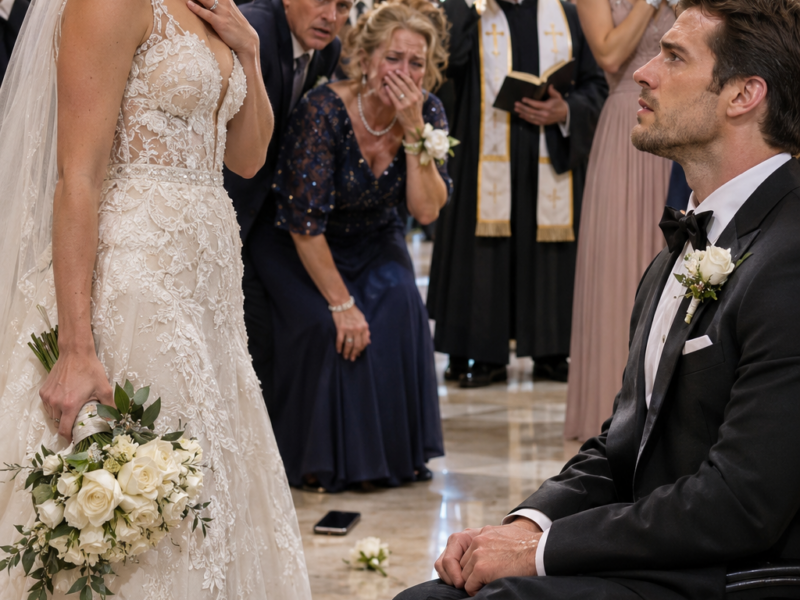
4 Mins To The Ceremony, The Groom Fled To Bali, Making His Disabled Brother Wed Me. I Did, But He…
4 Mins To The Ceremony, The Groom Fled To Bali, Making His Disabled Brother Wed Me. I Did, But He…
Four minutes before the wedding ceremony, Harper O’Connor realized that the man standing beside her in a perfectly tailored black tuxedo was not the man she had agreed to marry.
She did not discover it through some mysterious intuition or an inexplicable feeling in her heart. She discovered it because she knew how to observe people. For most of her adult life, Harper had worked with children whose difficulties communicating had caused the world to underestimate them. She had learned to pay attention to the smallest details: the movement of a hand, the rhythm of someone’s breathing, the direction of their eyes, and the subtle changes in their expressions when they were frightened or trying to hide something.
Those skills had become second nature to her. She had never imagined that one day they would help her recognize a stranger wearing her fiancé’s face.
The historic county courthouse was beautifully decorated for the occasion. White lilies stood in tall glass vases, their fragrance mixing with the faint scent of polished oak. Sunlight streamed through the enormous windows, illuminating the wooden benches and the small podium where the officiant was arranging the marriage documents. Behind Harper, nearly one hundred and twenty guests whispered excitedly. A photographer moved around the room, adjusting his camera and looking for the perfect angle.
Everything appeared exactly as a wedding should.
Except for the man beside her.
Harper glanced at him again.
The first thing she noticed was his eyes. Vance Lockwood, her fiancé of eighteen months, rarely looked directly at anyone for very long. Even during intimate conversations, his attention seemed to wander. He would glance at his phone, examine something outside a restaurant window, or become distracted by the arrival of someone across the room. Harper had grown accustomed to that habit, although she had never particularly liked it.
The man beside her was different.
He looked at her continuously, almost desperately, as though he feared she might disappear if he allowed himself to blink.
Then she noticed the mole.
Vance had a small, dark mole beneath his left ear. Harper knew it intimately. She had kissed that exact spot countless times.
The man standing beside her had the same mole, but it was on the opposite side.
Her stomach tightened.
The third difference was even more revealing. Vance constantly played with his car keys or slipped his hands into his pockets. This man kept both arms straight at his sides. His right fingers trembled slightly, while his left hand remained clenched so tightly that the knuckles had turned white.
Harper slowly inhaled.
She remembered a telephone call from that morning.
At exactly seven o’clock, Vivian Lockwood, Vance’s mother, had contacted her with an unusually cheerful voice.
“Harper, sweetheart, don’t be alarmed. Vance has practically lost his voice after yesterday’s board meeting. The doctor says his vocal cords are badly inflamed. He needs complete rest, so please don’t make him talk more than necessary today. He can manage the ceremony, of course. He only needs to say a few words.”
At the time, Harper had accepted the explanation without suspicion. Now, standing in the courthouse, she understood why Vivian had been so concerned about protecting her son’s voice.
Someone who could not speak would not be asked questions.
Someone who could not speak only needed to repeat two words.
And those two words were about to make Harper legally connected to a man who was not even present.
She turned slightly toward the front row.
Vivian sat there in an elegant pearl-gray dress, her blonde hair arranged in a flawless style. She wasn’t watching the bride or the groom. Her eyes were fixed on the man’s hands, following every small movement with the concentration of someone watching a dangerous tightrope performance.
Harper’s thoughts moved rapidly.
The Lockwood family was well known throughout the Hudson Valley. Their company, Lockwood Timber Homes, had built luxurious wooden estates, mountain lodges, and custom timber-frame houses for wealthy clients for decades. Vance was the public face of the business, the charming son who attended meetings, negotiated contracts, and represented the family at social events.
But there was another son.
Merrick.
Vance’s identical twin brother.
Harper had met him only once, at Vivian’s birthday party. He had been sitting alone in the garden, wearing an old sweater and drawing geometric patterns in the gravel with a small stick. When Harper had expressed an interest in speaking with him, Vance had immediately grabbed her elbow.
“Don’t bother. He’s not right in the head.”
He had explained that Merrick suffered from a severe intellectual disability and had been diagnosed as incompetent since childhood. According to Vance, their mother had sacrificed her entire life caring for him.
Harper had found the explanation uncomfortable. The man she had seen drawing in the garden had been creating remarkably precise geometric patterns. Nothing about his behavior had suggested an inability to think.
Still, she had respected the family’s privacy.
Now, looking at the stranger beside her, she understood.
Identical twins. The same height. The same face. The same voice, perhaps, if the stranger could speak without difficulty.
But the hands were different. The mole was different. And the breathing was unmistakable.
The man was Merrick.
The officiant began the ceremony.
“Dearly beloved, we are gathered here today…”
Harper barely heard her.
She remembered another summer, fifteen years earlier, when she had been fourteen years old.
Her grandmother, Eleanor O’Connor, had been a respected speech-language pathologist with more than forty years of experience. Every summer, Eleanor welcomed a small group of children with serious speech disorders into her large log house beside the river. Some came from families that could barely afford treatment. Others had parents who had exhausted every available medical option.
Eleanor never turned them away.
Harper helped with the children. She handed out workbooks, organized games, took them swimming, and read plays aloud with them.
That particular summer, one boy had arrived in an old Ford Bronco with a quiet father whose hands looked as though they had spent a lifetime working with wood.
The man had spoken privately to Eleanor.
“My wife thinks he’s a half-wit,” he had said. “But I don’t believe her. Please, take a look at him.”
The boy’s name was Merrick.
He struggled terribly with speech. Sometimes he could spend several minutes trying to pronounce a single word. His face would turn red, tears would gather in his eyes, and eventually he would give up.
But he could draw.
He spent hours on Eleanor’s porch, copying the elaborate wooden decorations around the roof. Every carved swirl, every decorative beam, and even the small wooden rooster attached to the gable appeared in his drawings with extraordinary precision.
One afternoon, Harper sat beside him.
“Why are you drawing the house when you can see the real thing right in front of you?” she asked.
Merrick struggled to answer. After several attempts, he picked up his pencil and wrote something at the bottom of the page.
To understand how it’s made.
Harper had smiled.
Her grandmother had taught her a small technique for helping children overcome moments when speech became trapped. She called it the key. Two gentle taps on the wrist, followed by a controlled exhale, helped the speaker release tension and approach the difficult word without forcing it.
Harper demonstrated it to Merrick.
“Two taps. Breathe out. Don’t rush. Let the word come when it’s ready.”
They practiced together every afternoon.
By the end of the summer, Merrick managed to say an entire sentence to her without becoming trapped in his stutter.
“I will draw a house for you.”
It was the most beautiful sentence Harper had ever heard.
A week later, his mother arrived unexpectedly. She was an elegant woman with an expensive handbag and a permanently disapproving expression. When she discovered her son talking comfortably with Harper, she immediately took him away.
Harper never saw him again.
She had not even known his last name.
Now, fifteen years later, that boy was standing beside her in a wedding tuxedo.
Merrick Lockwood.
The officiant turned toward the groom.
“Do you, Vance Sterling Lockwood, take Harper Lynn O’Connor to be your lawfully wedded wife?”
Merrick’s neck muscles tightened.
Vivian leaned forward.
For a moment, silence filled the room.
Then Merrick gently touched his right wrist twice with the fingers of his left hand. He exhaled and spoke.
“I do.”
The words came out clearly.
Harper felt the world shift beneath her feet.
He had used the key.
The same gesture she had taught him fifteen years earlier.
He knew who she was. He remembered her.
And he was terrified.
Harper had a choice. She could expose everything immediately. She could turn toward the guests and announce that the groom was an impostor.
But she understood what would happen next.
Vivian would pretend to be horrified. She would claim that her mentally disabled son had somehow escaped supervision and dressed himself in his brother’s clothes. She would describe Merrick as unstable, confused, and dangerous. Within minutes, someone would probably call the private psychiatric clinic where he had once been confined.
Harper knew what institutions could do to vulnerable people when the people in charge had already decided they were incapable of defending themselves.
And she knew something else.
Her friend Sloan, a family-law attorney, had once explained that a valid marriage required the physical presence and consent of the actual parties. Vance was not there. Merrick could not legally consent on his brother’s behalf.
Whatever happened in this room, the marriage could later be challenged.
For the moment, Harper needed to understand why the Lockwoods had gone to such extraordinary lengths to arrange this deception.
The officiant turned toward her.
“Harper Lynn, do you take Vance Sterling Lockwood to be your husband?”
Harper looked directly into Merrick’s eyes.
He was waiting for her to scream.
Instead, she smiled faintly.
“I do.”
Merrick’s lips trembled.
The officiant instructed them to sign the marriage register. Merrick picked up the pen with his left hand and quickly reproduced his brother’s signature. Harper noticed the difference immediately. Vance was right-handed. Merrick was not.
The photographer captured several close-up pictures of their hands over the marriage documents.
Harper silently hoped he would preserve every photograph.
They exchanged rings.
When the officiant invited them to kiss, Harper stepped forward and gently kissed Merrick’s cheek. He froze, his entire body stiffening as though he had received an electric shock.
A woman behind them giggled.
“He’s so shy. Poor thing. And without his voice, too.”
Harper lowered her eyes to hide her expression.
The ceremony was over.
She was now part of the Lockwood family, at least in the eyes of everyone who had attended.
During the drive to the reception, Merrick sat beside her in the back of the car. He stared out the window, his hands resting motionlessly on his knees.
Harper watched his reflection in the glass.
She thought about her grandmother.
Eleanor had raised her almost entirely alone. Harper’s mother had died when she was three, and she had never known her father. Her grandmother had taught her to be independent, disciplined, and compassionate without allowing compassion to become weakness.
“First, do everything you possibly can,” Eleanor used to say. “Then, if you still feel like crying, you can cry.”
Harper had followed that philosophy throughout her life.
She studied speech-language pathology, graduated with honors, and worked at a state developmental center for children with communication and hearing difficulties.
She left after four years because she discovered something horrifying.
The institution was deliberately misdiagnosing children.
The facility received additional government funding for children classified with severe intellectual disabilities. Its director had developed an arrangement with a psychiatrist who issued diagnoses that were not supported by proper evaluations.
Children who simply stuttered, struggled with reading, or had hearing difficulties were being classified as intellectually disabled.
They were placed in simplified educational programs and denied opportunities to develop their actual abilities.
Harper investigated, collected evidence, and reported the scheme to the district attorney’s office.
The investigation confirmed her findings. The director was dismissed, the psychiatrist lost his medical license, and twelve children eventually had their diagnoses overturned.
Harper was warned that she would never work in the state system again.
She opened a private practice instead.
Within a year, her waiting list had grown to three months.
Two years earlier, Eleanor had died peacefully in her sleep, leaving Harper the family house and ten acres of riverfront property.
That was where Harper had first met Vance.
He had appeared at her grandmother’s funeral, dressed in an expensive overcoat. He helped coordinate transportation, assisted the funeral staff, and behaved with such consideration that Harper had been grateful for his presence.
He mentioned that his father had known Eleanor and respected her work.
Harper was too devastated to ask how he knew her grandmother.
A week later, Vance called.
Then he called again.
Soon, they were going to restaurants, attending performances in the city, and spending weekends together. He was charming, generous, and attentive whenever he wanted to be.
After years of loneliness and exhausting professional battles, Harper believed she had finally found someone who genuinely cared about her.
But five months into their relationship, Vance began asking questions about her inheritance.
The riverfront property was beautiful, with old pine trees, a wooden cabin, and a view of the water. Vance repeatedly commented on its potential.
He mentioned an investor named Harrison Caldwell, who was interested in developing luxury residential communities.
“We could get an incredible price,” he told her one evening.
“I’m not selling.”
Vance smiled.
“Who said anything about selling? I’m just thinking about our future.”
A month later, he proposed.
Harper accepted.
A week before the wedding, he mentioned that they needed to visit an estate attorney on Monday to sign some routine financial documents.
“The company needs a line of credit,” he explained. “The bank wants our paperwork organized. Five minutes, and then we’ll have lunch.”
Harper had not thought much about it.
Now she understood that the wedding was only one part of a much larger plan.
The reception was held at an exclusive country club overlooking the Hudson River. There were white tablecloths, elaborate floral arrangements, and a string quartet playing softly in the background.
Vivian had organized everything.
She seated Harper and Merrick at the head table and remained close to her son throughout the evening. Every time a guest approached with a question, Vivian immediately intervened.
“Vance can’t speak today. His vocal cords are inflamed. The doctor ordered complete silence.”
She repeated the explanation so often that Harper began to recognize it as a rehearsed performance.
Harrison Caldwell delivered the first toast.
He was a short, gray-haired businessman with sharp eyes and an unusually direct manner.
“Sterling Lockwood built a company on keeping his promises,” he said. “I expect his sons to do the same. Here’s to the land this family stands on, and to the paperwork being completed on Monday. Vivian, I’m an old-fashioned man. I’ll wait until Wednesday. After that, I won’t hold anyone responsible for what happens.”
The guests laughed.
Vivian laughed louder than anyone.
Harper did not.
She memorized every word.
Later, Sloan managed to reach the head table.
“Harper, Vance is acting strangely,” she whispered. “I’ve never seen him this quiet.”
“He lost his voice,” Harper replied.
Sloan narrowed her eyes.
She had known Harper for twenty years. She understood when her friend was hiding something.
“If you need anything, call me.”
“I will,” Harper answered. “Sooner than you think.”
During dinner, Vivian’s cousin Beau became increasingly loud after drinking too much wine.
He began telling stories about the Lockwood family.
“Good thing we left Merrick at home,” he announced. “He would have caused a disaster at this wedding. Remember Sterling’s funeral? He was moaning and dropping plates. Vivian, you’re a saint for looking after him. I would have put him in a home years ago.”
Some guests laughed uncomfortably.
Others looked away.
Merrick sat motionless beside Harper, staring at his untouched plate.
Harper noticed a vein pulsing in his neck.
He had heard every word.
And he had endured comments like those for most of his life.
Harper slowly lifted her glass.
“You know,” she said, her voice quiet but clear, “I’ve spent seven years working with children who were written off as intellectually disabled. I’ve learned something interesting. Sometimes, the people who are actually slow aren’t the children. They’re the adults who decide what those children are capable of.”
Beau nearly choked on his drink.
Vivian gave Harper a sharp look before immediately recovering her smile.
“Our Harper is such a protector,” she said sweetly. “It’s simply the nature of her profession.”
Later that evening, Harper stepped onto the veranda.
The temperature had dropped, and the wind coming off the river was cold.
Before she could reach for her coat, someone placed a shawl around her shoulders.
It was Merrick.
He had noticed her leaving and remembered that she had left the shawl on her chair.
Harper looked at him.
Vance had never once noticed something so small.
She thanked Merrick quietly.
Before leaving the country club, she approached the photographer and asked him to preserve every original photograph, especially the close-ups from the courthouse.
“I want to remember every detail of this day,” she explained.
The photographer promised that he would.
That night, the newlyweds were taken to the Lockwood estate.
Vivian escorted Harper upstairs to a spacious guest bedroom.
“Don’t be offended, sweetheart. Vance will sleep in his office tonight. The doctor says his condition might be contagious. We don’t want you getting sick immediately after the wedding.”
“Of course,” Harper replied. “Health comes first.”
Vivian lingered in the doorway, studying her daughter-in-law’s expression.
She seemed satisfied that Harper was not particularly intelligent.
“Good night, dear.”
Harper changed into comfortable clothes and sat on the edge of the bed.
She waited.
The house gradually became quiet. Doors closed. The cleaning staff finished their work. The last vehicle left the property.
At one in the morning, Harper slipped out of her bedroom and walked downstairs.
A thin strip of light appeared beneath the office door.
She knocked once and entered.
Merrick was sitting at the desk, still wearing his dress shirt. A pencil lay beside a sheet of paper.
When he saw Harper, he jumped up so suddenly that his chair struck the wall.
She approached the desk.
The drawing made her stop.
It was Eleanor’s porch.
The carved columns, decorative wooden swirls, the sunburst patterns around the windows, and the little rooster on the roof were all reproduced with astonishing accuracy.
He had remembered every detail after fifteen years.
Harper felt her throat tighten.
“Merrick,” she whispered. “The key.”
His expression changed.
He tried to speak, but the first word became trapped. His face reddened, and his eyes squeezed shut.
“Don’t force it,” Harper said gently. “Write it down.”
She pushed a notepad toward him.
Merrick sat and began writing.
His first words were an apology.
He explained that Vance had flown to Palm Beach that morning on an eleven-forty flight. He was with a wealthy woman named Blair Kensington, an influential entrepreneur who owned a successful interior-design business.
Blair had invested money in the Lockwood company. She had no idea Vance was getting married.
Merrick continued writing.
His mother had told him that if he refused to impersonate his brother, Dr. Julian Harris would have him committed to Tranquil Pines Wellness Center again.
Six years earlier, Merrick had already spent two months there against his will.
His mother had warned him that the same thing would happen if he disobeyed.
The plan was simple. Merrick would marry Harper, remain in Vance’s place for approximately ten days, and then disappear when the real Vance returned.
Vivian believed Harper would never notice the difference.
Harper looked up.
“I noticed in one minute.”
Merrick lowered his eyes.
He wrote another question.
Why did you say yes?
Harper assumed he was asking whether she had agreed to protect him from the clinic.
But Merrick shook his head.
He wrote that he had recognized her long before the wedding.
A year earlier, he had seen Harper’s photograph on Vance’s phone.
He had immediately recognized the girl who once sat beside him on Eleanor’s porch.
He had wanted to see her again.
Just once.
Harper stared at the sentence.
The realization hurt more than she expected.
Vance’s appearance at her grandmother’s funeral had not been accidental. His interest in her had not been spontaneous. He had known exactly who she was and had used their shared history as an opportunity to gain access to her inheritance.
The family had remembered the ten acres of riverfront property.
And they had built an elaborate deception around it.
Harper asked what the Monday appointment was really about.
Merrick explained that Vivian had instructed him to sign anything placed in front of him. It involved Harper’s land.
She had promised Caldwell that the property would eventually belong to the Lockwood family.
Harper took out her phone and searched for Blair Kensington.
Her Instagram account was public.
The newest photograph showed an airport lounge, two glasses of champagne, and an airplane wing visible through the window. The caption read:
Finally alone. Ten days of paradise.
A man’s hand appeared at the edge of the photograph.
On his wrist was a watch with a dark face and a steel bracelet.
Harper recognized it immediately.
She had ordered that watch for Vance’s birthday.
The inscription on the back read, Our time.
She placed the phone on the desk.
For a moment, she felt nothing.
Not heartbreak.
Not anger.
Only a cold emptiness.
Eighteen months of lies had been carefully arranged around ten acres of land.
Merrick watched her anxiously.
He wrote, What are you going to do?
Harper took out her phone and sent Sloan a message.
Tomorrow, ten in the morning. The coffee shop in town. Bring the New York legal code. Don’t ask questions.
The reply came almost immediately.
I’ll be there at quarter to.
Harper turned back to Merrick.
“Listen carefully. From this moment forward, you do not sign anything without me. You don’t go anywhere without telling me. If someone tries to take you away, you contact me immediately. And until we understand exactly what we’re dealing with, you play along.”
He nodded.
“And stop apologizing,” she added. “You’re the only person in this house who hasn’t wronged me.”
Merrick lowered his head.
A tear fell onto the paper, blurring the word forgive.
Harper left him alone.
But when she reached her bedroom, she found a folded piece of heavy cardstock lying outside the door.
Vivian’s handwriting was unmistakable.
Monday, 10:00 a.m. Attorney. Don’t forget your IDs.
Harper looked down the dark hallway.
Behind Vivian’s bedroom door, there was no sound.
For some reason, that silence frightened her more than anything else.
The following morning, Vivian greeted Harper with coffee and a perfectly arranged breakfast.
“Good morning, sweetheart. Did you sleep well?”
“Wonderfully.”
“Excellent. The attorney is expecting us tomorrow at ten. Caldwell will be waiting for the paperwork on Wednesday.”
Harper smiled.
She said she was going into town to meet a friend.
“By yourself?” Vivian asked.
“Of course.”
“Enjoy yourself. Vance needs to rest anyway.”
Merrick glanced at Harper and gave a barely perceptible nod.
Sloan was waiting at a small coffee shop with a battered copy of the New York State Legal Code and a legal pad.
Harper told her everything.
The mole.
The left hand.
The key.
The impersonation.
Palm Beach.
Blair Kensington.
The proposed property transfer.
And the note Vivian had left outside her bedroom.
Sloan listened without interrupting.
When Harper finished, the attorney removed her glasses.
“I’ve known you for twenty years, and you still manage to surprise me.”
“Legally, what happens now?”
Sloan opened the code book.
“First, the marriage. A valid marriage requires the actual parties to be present and to consent. Vance was not there. Merrick could not consent on his behalf. The marriage can be challenged on grounds of fraud and lack of consent.”
“But I knew.”
“I assumed you would say that. It doesn’t change the central fact. Vance wasn’t present. And you can explain that you remained silent because you believed Merrick would be taken back to a place where he had previously been held against his will.”
Sloan leaned forward.
“However, we need evidence. You are going to prepare a detailed timeline today. Every conversation, every suspicious incident, every document, every name. And from now on, you do nothing without discussing it with me.”
Then they discussed Monday’s appointment.
Sloan was certain that the paperwork would include a postnuptial agreement and a power of attorney.
The first could convert Harper’s inherited property into marital property.
The second could authorize Vance to sell it without Harper’s direct participation.
“Do not sign anything,” Sloan said firmly. “Not one page.”
Harper also explained that Vivian controlled Merrick’s forty-percent share in Lockwood Timber Homes through a power of attorney signed six years earlier.
“Has he ever been legally declared incompetent by a court?” Sloan asked.
“Not that I know of.”
“Then he may be able to revoke that power of attorney himself. But we need his identification documents.”
Merrick had told Harper that Vivian kept his identification.
The next day, Vivian drove Harper and Merrick to a glass office building in Poughkeepsie.
The estate attorney, Gary Shaw, greeted them enthusiastically.
“Congratulations to the newlyweds. Everything is ready.”
Two stacks of documents were waiting on his desk.
Harper began reading.
Sloan had been right.
The postnuptial agreement would make her grandmother’s house and ten acres joint marital property.
The power of attorney would authorize Vance to sell Harper’s share at whatever price he considered appropriate. It would remain valid for three years, and he would be entitled to collect the proceeds.
Vivian smiled.
“It’s all standard paperwork, sweetheart. The bank requires it.”
“Which bank?” Harper asked.
Vivian hesitated.
“Our corporate partners.”
Harper placed the documents on the desk.
“Mr. Shaw, please explain exactly what will happen to my property if I sign these documents.”
The attorney shifted uncomfortably.
He glanced at Vivian before explaining that the land would become joint property and that Vance would be able to sell Harper’s share without her direct involvement.
“And he would receive the money?”
“Under the terms of this agreement, yes.”
Harper nodded.
Then she turned toward Merrick.
“Vance, you’re the person I’m trusting with my home. Do you want me to sign this?”
The room became completely silent.
Merrick stared at the papers.
Slowly, he reached for a pen.
Using his left hand, he wrote one word.
NO.
Vivian went pale.
Harper stood up.
“Well, my husband has made his position clear. I need time to think. Thank you, Mr. Shaw.”
In the parking lot, Vivian finally lost her composure.
“What the hell do you think you’re doing? Do you understand what this means for the company?”
“I understand that you want to take my grandmother’s property.”
“It’s for the family’s future.”
“Then the family should find another way to finance it.”
Vivian stared at her for several seconds.
Then her expression changed.
The pleasant mother-in-law disappeared, replaced by a woman calculating her next move.
She eventually smiled again.
“Fine. Think about it. We still have until Wednesday.”
She then announced that Vance needed to travel to Portland, Maine the following day to visit a supplier.
Harper understood immediately.
Vivian intended to send Merrick away and replace him with the real Vance.
But Harper had already prepared her next move.
“What a shame,” she said. “I was planning to move into my grandmother’s cabin with my husband. He promised to repair the porch before the wedding.”
Vivian hesitated.
Harper continued.
“And perhaps Harrison Caldwell would appreciate seeing the young couple living on the very property he’s interested in buying.”
Vivian considered the suggestion.
She eventually agreed.
The following morning, Harper and Merrick arrived at Eleanor’s old cabin.
It stood on a high bluff surrounded by ancient pine trees. The dark wooden walls remained exactly as Harper remembered them. The decorative carvings around the windows had weathered slightly, and the porch sagged on one side.
Merrick stood at the gate for a long time.
Then he walked toward the porch and gently ran his fingers along one of the carved columns.
He was touching a place he had not seen in fifteen years.
Harper unlocked the door, opened the windows, and prepared tea.
When she returned outside, Merrick was sitting on the bottom step.
She handed him a mug.
He touched his wrist twice, exhaled, and spoke quietly.
“Nothing has changed here.”
Harper smiled.
“Some things have. The porch is falling apart.”
He examined the damaged wood.
“You can fix it,” she said.
Merrick hesitated.
“I’ll f…”
The word became trapped.
He used the key again.
“Fix it.”
For the next several days, Harper discovered a side of Merrick that nobody in the Lockwood family had ever allowed her to see.
He found Eleanor’s old carpentry tools in the shed, sharpened them, and began repairing the porch. His hands moved with extraordinary precision. He understood the structure of the wood intuitively and worked without wasting a single motion.
Harper watched him and thought about the years he had spent being treated as though he were incapable of doing anything.
After lunch, she began working with him on communication.
She conducted the same assessments she would have performed with any new student.
The results were unmistakable.
Merrick had no intellectual disability.
His reasoning, memory, and spatial intelligence were exceptionally strong. He had severe dyslexia and a childhood-onset fluency disorder that caused significant stuttering.
His difficulties with reading and speaking had been mistaken for an inability to think.
Worse, years of humiliation and intimidation had made him afraid to communicate at all.
Harper never forced him.
They practiced breathing. They sang old folk songs because singing often reduced the difficulty of producing words. They read short passages slowly, tracing each line with their fingers.
Merrick was embarrassed at first, but gradually he became more comfortable.
His singing voice was unexpectedly beautiful.
In the evenings, he told Harper stories.
Sometimes he spoke.
Sometimes he wrote.
She learned that his father, Sterling, had taken him to construction sites from the age of twelve. Merrick had designed many of the company’s most successful architectural models, including the North Star, Birchwood Estate, and Grand Lodge.
Vance had presented the designs to clients and collected the bonuses.
Merrick had done the actual work.
A month before Sterling died, he had announced during a company meeting that Merrick would become the chief architect.
Vance, he suggested, could handle sales because he had a natural gift for talking.
Vivian had remained silent.
Three months after the funeral, she took Merrick to Dr. Julian Harris at Tranquil Pines Wellness Center.
There, the doctor produced medical paperwork classifying Merrick as intellectually disabled.
Vivian then presented him with a power of attorney, claiming it was necessary to handle his inheritance.
He signed.
When he eventually tried to regain control of his shares, he was sent back to Tranquil Pines.
For two months, he was heavily medicated and deprived of almost everything that had once made him happy.
After returning home, he stopped drawing for six months.
Harper listened carefully.
She had encountered similar abuses before, but this time the victim was not an anonymous child in a state facility.
It was the boy who had once promised to draw her a house.
On Tuesday evening, Merrick’s old flip phone rang.
The caller was Vance.
Harper quickly motioned for Merrick to activate the speakerphone.
“Well, little brother. Still alive?”
Vance sounded cheerful. There was music and splashing water in the background.
“Mother says you’re making trouble.”
Merrick remained silent.
“What the hell did you write to the lawyer? Who gave you permission?”
He laughed.
“Listen, the woman has become difficult. Mother can’t control her. But you’re our pathetic little victim, remember? She feels sorry for you. Use that. Play the pity card.”
He continued speaking without realizing that Harper was recording everything.
“We already spent Caldwell’s advance. If the deal falls apart, he’ll drag us into court. The land is our only way out.”
Then Vance added that he would return on Saturday.
Merrick needed to prepare to return to his old room.
“And don’t try anything clever. Dr. Harris will pay you a visit if necessary.”
The call ended.
Harper saved the recording and sent a copy to Sloan.
Merrick stared at the phone.
Then he spoke quietly.
“Since we were children.”
At noon the following Wednesday, Harrison Caldwell arrived at the cabin.
He wanted to inspect the property personally.
Harper showed him the river, the pine trees, the garden, and the old house.
When they returned to the porch, Caldwell noticed the newly repaired step and a detailed architectural drawing resting on the railing.
It showed a large timber lodge with a wraparound gallery and an elevated tower.
Caldwell examined it.
“Interesting design. But this gallery is cantilevered almost five feet. Won’t it sag after a few winters?”
He turned toward Merrick.
“Vance, what do you think?”
Merrick approached.
He took the pencil and immediately sketched a structural joint on the back of the paper. He included the support beam, diagonal brace, and mortise-and-tenon connection, along with precise dimensions.
Then he wrote that the load transferred directly into the main structure.
It would not sag in a hundred years.
Caldwell studied the drawing.
“Strange,” he said eventually. “I’ve been negotiating with you for six months, Vance. Every time I ask a technical question, you tell me your engineers will get back to me. But now you’ve answered everything in sixty seconds.”
Merrick lowered his eyes.
Harper stepped forward.
“Mr. Caldwell, I can answer the question you’ve really come here to ask. I’m not selling the land. I’m not transferring it into joint ownership. Not today, not ever.”
Caldwell remained silent.
“If someone promised you otherwise, they misled you. But it wasn’t me.”
The businessman folded Merrick’s drawing and handed it back.
“Thank you for being honest, Ms. O’Connor. That’s a rare quality.”
He left after promising to recover his advance through the courts if necessary.
That evening, Vivian called Harper repeatedly.
She ignored every call.
Eventually, a message arrived.
You’ll regret this.
At two in the morning, headlights swept across the cabin ceiling.
Harper looked out the window.
An unmarked white medical transport van was parked outside the gate.
Three men were approaching. Two wore medical scrubs. The third was short, wore glasses, and carried a leather folder.
Harper immediately recognized the situation.
She grabbed her phone, activated the camera, and walked outside.
Merrick stood in his bedroom doorway, pale with fear.
“Stay here,” she told him.
She approached the locked gate.
“Good evening. What can I do for you?”
The man with glasses smiled.
“Dr. Julian Harris, Tranquil Pines Wellness Center. We’ve received a call from family members expressing concern about someone staying here. We believe the individual may be experiencing a severe psychiatric episode. We’d like to take him in for evaluation.”
“Which individual?”
The doctor hesitated.
“The male resident.”
“My husband lives here. Vance Sterling Lockwood. Is he your patient?”
Harris said nothing.
“Have you ever treated him? Do you have his medical file?”
The orderlies exchanged nervous glances.
“Or did you come for someone else?” Harper continued. “If so, I would appreciate it if you named him clearly. For the recording.”
Harris’s expression changed.
He understood the problem.
Admitting that they had come for Merrick would expose the deception at the wedding. It would also establish that they were attempting to remove someone who had not consented to treatment and who was not demonstrating any immediate danger.
Harper continued.
“I know the requirements governing involuntary psychiatric commitment. You cannot simply remove someone because a family member requests it. If you attempt to enter this property, I will contact the state police. Tomorrow morning, this recording will be delivered to the district attorney, along with the audio of Vance Lockwood threatening that you would come here.”
Harris became visibly uncomfortable.
He closed his folder.
“Wrong address,” he muttered.
Then he ordered the men to return to the van.
Harper remained at the gate until the vehicle disappeared.
Only then did she realize that her hands were shaking.
When she returned inside, Merrick was sitting on the hallway floor with his knees pulled against his chest.
She sat beside him.
“They’re gone,” she said.
“No one is going to touch you here.”
He remained silent for a long time.
Then he whispered:
“No one has ever fought for me.”
Harper stayed beside him until dawn.
A little after eight, another visitor arrived.
It was Martha, the former Lockwood family housekeeper.
She had worked for the family for twenty-five years and had helped raise the twins. Unlike Vivian and Vance, she had never treated Merrick as though he were inferior.
When he saw her, he hurried to the door.
“Martha!”
She hugged him tightly.
Then she turned toward Harper.
“So you’re Harper. Merrick told me about you a year ago. I knew it was him at the courthouse, not Vance.”
Martha explained that Vivian had ordered her to remain in the kitchen during the wedding. She had overheard Vivian arranging the attempted removal with Dr. Harris.
The previous evening, she had discovered that Vivian had forgotten to lock a safe.
Inside, she found Merrick’s identification card and a collection of old notebooks.
She had hidden them in the attic.
Now she had brought everything to the cabin.
The notebooks contained architectural drawings.
One showed the original design for the North Star, the very model that had won Lockwood Timber Homes a prestigious award five years earlier.
Merrick’s signature appeared in the corner.
The date was eighteen months before the company’s public presentation.
That morning, Harper accompanied Merrick to a notary’s office in Rhinebeck.
The notary examined his identification and the paperwork.
“Mr. Lockwood, I need to be certain you understand what you’re doing. Please explain it in your own words.”
Merrick touched his wrist, exhaled, and spoke slowly.
“I am revoking the power of attorney I gave my mother. I want to manage my own shares in my father’s company and make my own decisions.”
The notary nodded.
She prepared the revocation and arranged for formal notification to Vivian and the company’s board.
Merrick signed his own name.
For the first time in six years, he had officially reclaimed control over his identity.
Meanwhile, in Palm Beach, Vance was enjoying a quiet breakfast with Blair Kensington.
She placed her champagne glass on the table.
“I’ve made a decision. Let’s apply for a marriage license. We can arrange a date and elope when we get back to New York.”
Vance froze.
He was still legally listed as married to Harper.
If Blair attempted to obtain a marriage license, the system would reveal the existing registration.
He forced a smile.
“Of course. Let’s do it when we get home.”
His phone rang.
It was Vivian.
Her voice sounded completely different.
“Merrick has revoked the power of attorney. Caldwell is demanding his money back. The doctor failed last night. And Harper knows everything.”
She paused.
“Come home immediately.”
Vance returned on Friday evening.
At nine o’clock, his SUV pulled up outside Eleanor’s cabin.
He entered without knocking.
Merrick was standing near the wood stove. Harper was sitting at the kitchen table.
Vance looked around.
Then his eyes settled on his brother.
“Well, hello, little brother. Had your fun playing house?”
He dropped his bag.
“Pack your things. Mother is waiting. Your shift is over.”
Merrick did not move.
He touched his wrist, exhaled, and looked directly at his brother.
“No.”
Vance blinked.
For perhaps the first time in his life, he had heard Merrick refuse him out loud.
Then he turned toward Harper, immediately adopting the familiar expression of a loving, apologetic fiancé.
“Harper, honey. I know you’re upset. I should have explained everything. It was my mother’s idea. I wasn’t comfortable with it, but circumstances were complicated. I came back to fix things.”
Harper placed her phone on the table.
On its screen was a photograph from the courthouse.
Two hands signing the marriage register.
“You’re right-handed, Vance,” she said. “But my husband signed with his left hand.”
His face changed.
“You knew.”
“Yes.”
“Then you’re an accomplice!”
“File whatever charges you want. But first, explain to the district attorney how you were sitting at JFK airport with Blair Kensington while your brother stood at the altar.”
She played the recording of his phone call.
Vance listened to his own voice.
He lunged toward the phone, but Harper calmly reminded him that Sloan already had a copy.
Then he turned toward Merrick.
“You’re still a nobody. You have a medical diagnosis. You think anyone is going to believe you?”
He left, slamming the door so violently that the glass in the old cabinet rattled.
Merrick stood motionless.
Harper approached him.
“You told him no.”
“Out loud,” Merrick answered.
Then he smiled faintly.
“Turns out it’s very easy.”
But the Lockwoods were not finished.
The following Monday, Vivian organized an emergency shareholder meeting.
She and Vance together controlled sixty percent of the company. Merrick held the remaining forty percent.
Their proposal was to transfer the company’s entire architectural portfolio to Caldwell as repayment for the money he had advanced.
Merrick attended with Sloan.
He voted against the proposal, and his objection was formally recorded.
The resolution passed anyway.
But that evening, Merrick wrote directly to Caldwell.
He explained that he was the original creator of the company’s famous architectural designs. He had never signed an agreement transferring his exclusive rights to the company.
He attached copies of his original notebooks, each containing drawings and signatures dated years before the company’s public presentations.
Caldwell’s legal team reviewed the material for a week.
Then the businessman called Merrick personally.
“Mr. Lockwood, my lawyers have reviewed your documents. It appears the company has no proper paperwork establishing ownership of those designs. I’m not going to buy intellectual property that may belong to someone else.”
He announced that the deal was frozen.
But he also requested a separate conversation with Merrick.
A few days later, Blair Kensington arrived at the cabin.
She was elegant, confident, and visibly angry.
She showed Harper a photograph posted by one of the wedding guests.
It showed Vance and Harper standing together at the courthouse.
The timestamp matched the day and hour Blair had been drinking champagne with Vance at the airport.
“I thought I was being played for a fool,” Blair said. “Then I discovered that he was supposedly getting married while sitting beside me.”
Harper explained the situation.
The twins.
The impersonation.
The property.
The fraudulent documents.
The medical clinic.
Blair listened without interrupting.
Finally, she asked about the land.
Harper explained that it belonged to her through her grandmother’s inheritance and had never been sold.
Blair’s expression hardened.
“Vance told me it was his family’s riverfront property. He offered me a fifteen-percent equity stake in a luxury development. I wired him fifteen million dollars.”
She stood up.
“Thank you for telling me the truth. I’ll handle the rest.”
Two days later, Sloan informed Harper that Blair had filed a criminal complaint for grand larceny.
At the same time, Sloan filed a petition to annul the marriage.
The evidence included the photographer’s original files, the left-handed signature, the recording of Vance’s threats, Martha’s testimony, and official travel records.
Vance contested the petition.
His attorney argued that Vance had been physically present at the ceremony and that Harper had knowingly participated in the arrangement.
At the hearing, the judge asked Harper to speak.
Harper stood.
“Yes, I knew. I realized four minutes before the ceremony. But I also knew that if I exposed the deception immediately, the man standing beside me would probably be taken back to a private psychiatric clinic where he had already been held against his will.”
She paused.
“I chose not to create a scene. I chose to protect him and gather evidence. I was deceived for eighteen months so that my property could be stolen. The actual man I was supposed to marry never appeared at the courthouse and never consented to this marriage.”
The judge authorized the requested subpoenas.
Six weeks later, the records arrived.
Customs and Border Protection confirmed that Vance had departed through JFK at 11:40 on the morning of the wedding.
The marriage register had been signed at 12:20.
A forensic handwriting expert also confirmed that the signature belonged to Merrick, who had used his left hand to imitate his brother’s writing.
At the second hearing, Merrick was called to testify.
He walked slowly to the witness stand wearing a simple gray sweater.
Vivian sat in the back row.
Her eyes remained fixed on him.
Merrick touched his wrist and exhaled.
“I stood at the altar instead of my brother.”
His speech was slow, but clear.
“My mother told me that if I refused, they would lock me in a clinic forever. I had already been held there for two months. I was frightened.”
He paused.
“I signed with my left hand. Vance was not there.”
The courtroom became silent.
The judge issued her ruling that afternoon.
The marriage was declared void from the beginning because of fraud and the absence of Vance’s physical presence and consent.
When Harper walked out of the courthouse, Sloan hugged her.
Then she surprised everyone by embracing Merrick.
“That’s it,” she said. “You’re not anybody’s wife anymore. What you do with your life now is entirely your decision.”
But the victory did not last long.
Vivian immediately filed a petition seeking to have Merrick declared legally incompetent and to appoint herself as his guardian.
She submitted six years of medical records from Tranquil Pines, claiming that Merrick lacked the capacity to understand his actions.
At the same time, someone connected to the Lockwoods sent emails to the parents of Harper’s private-practice students.
The messages claimed that Harper had married a mentally disabled man to obtain access to his money and was now keeping him isolated to steal his inheritance.
Within hours, several parents canceled their appointments.
Harper received three messages from families who had trusted her for years.
They were going to pause treatment.
For the first time throughout the entire ordeal, Harper felt uncertain.
She sat in the kitchen with a cup of cold coffee and stared toward the workshop.
Merrick had not come out.
She eventually washed her face and began working.
She sent an honest message to every parent explaining what had happened. She offered to provide the court’s decision and encouraged them to make their own judgments.
Sloan sent Vivian a formal cease-and-desist letter for defamation and interference with Harper’s business.
Meanwhile, Merrick remained inside the workshop for three days.
He ate the food Harper left outside but refused to speak.
She did not force him.
Every morning, she left a short note.
The weather is cold. Wear a scarf.
Martha brought pastries.
I’ll be in the house if you want to talk.
On the fourth evening, Harper entered the workshop and sat near the door.
Merrick was carving a new piece of decorative trim for Eleanor’s house.
The familiar sunbursts and wooden rooster were slowly emerging beneath his hands.
“Merrick,” she said. “I’m not leaving until you tell me what’s wrong. You can write it. You can sit in silence. But I’m staying.”
Eventually, he put down his chisel.
He spoke without turning around.
“He’s right.”
Harper waited.
“Vance. You’re the first person to treat me like a human being. And because of me, you lost your students. Because of me, you’re dealing with courts and lies and everything else.”
His voice broke.
“I don’t want to become another person who uses you. If you’re only doing this because you feel sorry for me, then don’t. I can survive alone.”
Harper stood and walked toward him.
“I’m a speech-language pathologist, Merrick. My job is to teach people to communicate and then let them go. I work so that they don’t need me anymore.”
She looked directly into his eyes.
“If you were my student, I would probably have discharged you already. You speak. You stood in court. You told your brother no. You don’t need a speech therapist anymore.”
She paused.
“But I still don’t want to let you go.”
Merrick looked confused.
“Do you understand the difference? This isn’t pity. I am choosing you.”
She reminded him of the small things he had done.
He had brought her a shawl before she realized she was cold.
He had repaired the porch that had been falling apart for two years.
He had never asked her for money, property, or favors.
“Everyone in my life has wanted something from me,” Harper said. “But you haven’t. And I don’t want to lose the person who sees me as a person rather than an opportunity.”
Merrick’s eyes filled with tears.
“What about your students?”
Harper showed him her phone.
Two messages had arrived while she was walking across the yard.
One parent apologized and asked to resume the usual appointments.
Another admitted that she had believed the accusations without asking Harper for an explanation.
Merrick read the messages.
Then he stepped forward and wrapped his arms around Harper.
It was the first time he had embraced her voluntarily.
“I’ll go to the evaluation,” he whispered. “By myself.”
The court ordered an independent psychiatric assessment at a state psychiatric center in Albany.
Neither Vivian nor Dr. Harris was allowed to influence the selection of the evaluators.
On the morning of the appointment, Harper drove Merrick to the building.
He stopped outside the heavy entrance doors.
Six years earlier, similar doors had closed behind him at Tranquil Pines.
Harper did not offer empty reassurance.
She simply touched two fingers to her own wrist.
Merrick nodded.
He exhaled and walked inside.
The evaluation lasted several days.
There were interviews, psychological tests, reasoning exercises, memory assessments, and spatial puzzles.
Every afternoon, Harper waited outside with coffee and sandwiches.
When Merrick finally emerged each day, he looked a little calmer.
The official report arrived a month later.
Sloan read it aloud in Eleanor’s kitchen.
The evaluation found no psychiatric disorder that deprived Merrick of the capacity to understand his actions or manage his own affairs.
His intellectual functioning was within normal limits, with several areas significantly above average, particularly spatial reasoning.
The report confirmed severe dyslexia and a childhood-onset fluency disorder.
It also concluded that the previous diagnoses issued by Tranquil Pines were unsupported by the clinical evidence.
Martha began crying.
Merrick looked quietly through the window toward the porch.
The court subsequently dismissed Vivian’s guardianship petition.
In the hallway afterward, Merrick approached his mother.
“Mother.”
Vivian turned.
For the first time, Harper saw genuine uncertainty on the older woman’s face.
Merrick spoke clearly.
“I don’t hold any anger toward you. But you will never make another decision for me again.”
Then he walked away.
Vivian remained standing beside the window.
But the independent evaluation had created consequences far beyond the guardianship case.
Sloan filed criminal complaints concerning false imprisonment and medical fraud.
Investigators examined the financial relationship between Lockwood Timber Homes and Tranquil Pines.
For six years, regular payments had been transferred from the company to the clinic. The transactions were disguised as consulting services.
One unusually large payment coincided with the two months Merrick had been confined.
Martha provided a detailed statement about Vivian’s visits to the doctor and the envelopes of cash she had delivered before the regular transfers began.
Dr. Harris initially denied everything.
But after investigators presented the financial records and the independent psychiatric report, he requested an agreement with prosecutors.
He admitted that he had issued false diagnoses at Vivian’s request, authorized Merrick’s confinement without sufficient medical justification, and accepted money to keep him heavily medicated.
Sloan also pursued a civil claim concerning Merrick’s inheritance.
For six years, Vivian had collected dividends from his forty-percent share of the company without properly accounting for the money.
The amount owed was enormous.
The legal settlement forced Vivian to sell her remaining shares.
Vance faced a separate criminal case involving Blair’s fifteen-million-dollar investment.
His attorney advised him that his best chance of avoiding prison was to repay the full amount.
He could not afford to do so without selling his shares in Lockwood Timber Homes.
Eventually, Harrison Caldwell purchased both blocks of shares.
In late November, Caldwell drove to Eleanor’s cabin carrying a briefcase.
This time, he politely asked permission to enter.
He sat at the kitchen table and placed a folder in front of Merrick.
“I now own sixty percent of your family’s company. You own forty percent. And I believe the company has spent enough time taking credit for someone else’s talent.”
He offered Merrick the position of chief architect.
Every new blueprint would carry Merrick’s signature. He would also receive royalties under a separate agreement.
“Have your lawyers review everything,” Caldwell added.
Merrick stared at the documents.
Then Caldwell turned toward Harper.
“We’re going to develop a luxury community on a different property I already own near the Catskills. Your grandmother’s land is completely off the table.”
Harper looked surprised.
“Why?”
Caldwell smiled slightly.
“I’ve been building houses for twenty years. I’ve met plenty of men who can sell a property. But very few can explain how to construct a cantilevered gallery that will still be standing a hundred years from now.”
He looked toward Merrick.
“Your father once told me that you had hands of gold, but your mother kept you hidden away. I didn’t understand what he meant until I saw you working on that porch.”
Merrick slowly touched his wrist.
“I agree,” he said.
Then he unrolled a large architectural drawing.
It showed Eleanor’s cabin expanded into a beautiful children’s center, with a bright glass addition, a wide veranda, and a proper workshop in the garden.
“The first project won’t be a luxury development,” he said.
Caldwell examined the drawing.
“What will it be?”
“A center for children who have difficulty speaking.”
Merrick looked at Harper.
“The Eleanor O’Connor Center. Right here, on this land.”
Harper could not find the words.
She simply nodded.
The first snow fell on a Saturday evening.
The following morning, Harper noticed a familiar vehicle parked outside the gate.
Vance was standing beside it.
He looked thinner than she remembered. His expensive clothes had been replaced by a plain overcoat, and snow had gathered on his shoulders.
Harper walked to the gate but did not unlock it.
“Harper,” he said quietly. “I won’t take long.”
He explained that he had lost the company, Blair, and most of his money. His sentencing was scheduled for the spring. His attorney believed he might receive probation if he cooperated and made full restitution.
He swallowed.
“I keep thinking about how everything went wrong. You said I do at the courthouse. There must have been something between us. Maybe it’s not too late.”
Harper looked at him.
She felt neither anger nor sympathy.
“I said I do to the man standing next to me,” she replied. “And you weren’t standing next to me that day. You weren’t standing beside me for the eighteen months before it, either.”
The cabin door opened behind her.
Merrick stepped onto the porch wearing a heavy work jacket and holding a hand plane.
He looked at his brother.
Vance stared back.
For a moment, it seemed as though he was seeing Merrick for the first time without the familiar lowered eyes and frightened expression.
“Merrick,” Vance said.
Then his voice cracked.
“Can you forgive me?”
Merrick remained quiet.
Finally, he answered.
“Go home, Vance. You’re going to freeze.”
Vance stood there for another minute.
Then he returned to his car and drove away.
The fresh snow gradually covered the tire tracks.
Winter passed in a blur of work.
Merrick spent his mornings at the workshop and his afternoons at the company’s headquarters, where he began rebuilding the architectural department.
At first, employees were uncertain about him. For years, they had heard stories about the supposedly incompetent younger brother.
But the truth became impossible to ignore.
During a site meeting, an experienced foreman named Gus recognized Merrick’s drafting style immediately.
“I’d know those drawings anywhere,” he announced. “He designed the North Stars and the Grand Lodges. I always thought Vance had inherited his father’s talent. Turns out it was Merrick all along.”
After that, nobody questioned his authority.
In February, Lockwood Timber Homes presented its designs at the International Builders Show in Manhattan.
Caldwell insisted that Merrick personally manage the company’s exhibition.
Merrick was nervous.
The night before the event, Harper heard him walking around the kitchen at three in the morning, practicing his presentation.
The following morning, he was pale and quiet.
At the center of the exhibition stood a scale model of a magnificent mountain lodge with a cantilevered gallery.
Beneath it was a brass plaque.
Lead Architect: Merrick Lockwood.
Harper watched him stand in front of the plaque.
He stared at his own name for a long time.
By noon, a crowd had gathered.
Developers, architects, and journalists surrounded the model.
A young reporter approached him.
“Mr. Lockwood, we’ve heard that you worked in your brother’s shadow for years. Is it true that you created the company’s famous designs? And why have you never spoken publicly before?”
Merrick became visibly nervous.
Harper stood nearby, watching.
His hand moved toward his wrist.
Then stopped.
“It’s true,” he said slowly. “I designed those buildings. And I didn’t speak publicly because I’ve stuttered since childhood.”
He paused.
“For a long time, people believed that because I couldn’t speak well, I couldn’t think well either.”
He smiled slightly.
“It turns out those are two different things. You don’t build a house with your tongue.”
Someone laughed.
Then the crowd applauded.
An hour later, a wealthy customer commissioned a mountain lodge based on the exhibition model.
By the end of the event, Lockwood Timber Homes had secured sixteen new construction contracts.
That evening, as they drove home, Merrick remained quiet for a long time.
Then he turned toward Harper.
“I didn’t tap my wrist once today. Did you notice?”
“I noticed.”
“I was watching my hand all morning.”
Harper smiled.
She had noticed that, too.
In March, Vance was sentenced.
He had repaid Blair through the liquidation of his shares, and the judge imposed five years of probation.
Harper learned the news from a short message from Sloan.
She read it and put her phone away.
She had finally reached a point where Vance’s life no longer determined the direction of hers.
Blair called a week later.
She thanked Harper for telling her the truth and mentioned that she had recovered her fifteen million dollars.
Then she announced that she was sending a truckload of furniture to the Eleanor O’Connor Center.
“I heard you’re opening in the spring,” she said. “Consider it a donation. I don’t like being indebted to anyone.”
Harper accepted.
The children needed the furniture more than she needed to protect her pride.
A month later, a delivery truck arrived with small wooden tables, colorful chairs, and comfortable armchairs.
A blank card was tucked into the delivery paperwork.
Two words were written on it.
For honesty.
Meanwhile, Harper’s students gradually returned.
Almost every family resumed their appointments, and by spring her waiting list had doubled.
The story of the speech therapist who had defended a man everyone else had dismissed spread through local parent groups.
Harper and Merrick spent their evenings designing the new center.
They discussed room acoustics, mirrors, quiet spaces, and the best layout for children who became overwhelmed by noise.
Merrick approached every architectural detail with extraordinary care.
He wanted the building to feel welcoming rather than institutional.
He wanted children to know that they were entering a place where nobody would judge them for the way they spoke.
Martha eventually moved into a small guest cottage behind Eleanor’s garden. Merrick renovated it himself.
She continued waking at six in the morning, complaining that Harper and Merrick never ate enough, and baking pastries for the neighborhood children.
Vivian, meanwhile, had sold the sprawling Lockwood estate to meet her financial obligations. She moved into a small condominium in Poughkeepsie and lived alone.
The criminal proceedings involving her and Dr. Harris continued.
Merrick never visited her.
On her birthday, he sent a bouquet of white lilies without a card.
Harper did not ask why.
Some decisions belonged entirely to him.
In May, when the apple trees began blossoming, the Eleanor O’Connor Center for Speech and Language officially opened.
The new building was bright and airy, with large windows and the warm smell of fresh pine.
The old cabin had been carefully preserved. Merrick rebuilt the porch, restoring every original decorative curl and carved detail.
A new wooden rooster stood on the roof.
Eleven children arrived on the first morning.
Eight had stutters.
Two were nonverbal.
One little boy arrived with a severe medical diagnosis from a doctor in another town.
After spending thirty minutes playing blocks with him, Harper began questioning that diagnosis.
It was exactly the kind of work her grandmother had taught her to do.
That evening, after the last parents had collected their children, Merrick asked Harper to come outside.
They sat on the bottom step of the porch.
The sun was setting over the river. The pine trees stood quietly in the golden light.
Merrick reached into his jacket and removed a folded sheet of paper.
He handed it to her.
It was a drawing of Eleanor’s house as it looked now.
The glass addition, the wide veranda, the workshop, and the wooden rooster were all reproduced in remarkable detail.
On the porch, two small figures sat together.
In the corner, Merrick had written a sentence.
I promised I would draw a house for you.
Harper stared at the words.
“You remembered.”
“Fifteen years,” she whispered.
“Sixteen,” he corrected.
She laughed softly.
He took her hand.
For a moment, he looked down at their joined fingers.
Then he turned toward her.
“Harper, our first wedding was arranged by other people. This time, I want to ask you myself.”
He took a breath.
“Will you marry me under my real name?”
Harper looked at the drawing, the house, the river, and the man beside her.
Six months earlier, he had struggled to say his own name aloud.
Now he was asking her to build a life with him.
“I will,” she answered. “Under yours.”
They went to the county clerk’s office together and completed the legal paperwork properly.
A month later, they returned to the same historic courthouse where everything had begun.
The ceremony was small.
Sloan attended, along with Martha, Harrison Caldwell and his wife, old Gus the foreman, and eight children from the center carrying little bouquets of daisies.
The officiant was the same woman who had conducted the first ceremony.
She recognized Harper immediately.
Then she looked at the groom, examined his identification, and glanced back at him with a slightly raised eyebrow.
This time, there was no confusion.
No borrowed identity.
No hidden deception.
No frightened man being forced to stand in someone else’s place.
“Do you, Merrick Sterling Lockwood, take Harper Lynn O’Connor to be your lawfully wedded wife?”
Merrick looked at Harper.
He gently touched two fingers to his wrist.
He no longer needed the gesture to release a trapped word. His speech had improved enormously, and the old technique had become something personal, a small reminder of the summer when they first met.
“I do,” he said.
His voice was clear and firm.
When the officiant handed him the pen, he took it in his left hand and signed his own name.
Merrick Sterling Lockwood.
Harper watched him finish the signature.
She remembered the frightened boy who had once sat on her grandmother’s porch, struggling to pronounce a single word while the world around him mistook his silence for stupidity.
She remembered the man who had stood beside her at the first wedding, trembling with fear, believing that nobody would ever defend him.
And she remembered the moment she had decided to say yes, not because she accepted the deception, but because she refused to let another innocent person become its victim.
Years later, whenever people asked Harper how she and Merrick had met, she always gave the same answer.
“On a porch, when I was fourteen.”
Merrick would shake his head and correct her.
“No. In a courthouse.”
Then he would smile and add:
“When she realized I wasn’t the person I was supposed to be, and she still chose to stand beside me.”
And Harper would take his hand, remembering the small wooden house he had once promised to draw for her.
He had kept that promise.
More importantly, he had finally been given the chance to build a life in which his name, his voice, his work, and his decisions belonged to him alone.
THE END